Written By |
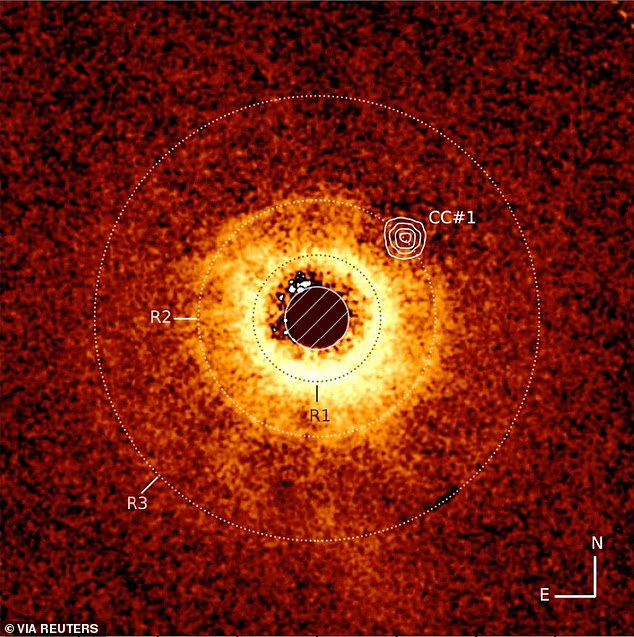
The James Webb Space Telescope (JWST) has captured its first direct images of a never-before-seen exoplanet (pictured)
The James Webb Space Telescope (JWST) has stunned astronomers yet again — this time by capturing the first direct image of a distant exoplanet roughly the size of Saturn.
The newly spotted world, dubbed TWA 7b, orbits a young red dwarf star about 111 light-years from Earth. Scientists estimate it has about the same mass as Saturn — or around 100 times more massive than Earth — making it the smallest exoplanet ever directly imaged. Previous direct observations have been limited to gas giants many times the size of Jupiter.
While JWST has discovered hundreds of exoplanets since its launch, these were all detected indirectly by observing their effects on their parent stars. This time, researchers managed to filter out the overwhelming starlight and isolate the faint infrared glow of TWA 7b.
“Detecting exoplanets is not easy in general — imaging them is even more challenging,” said lead researcher Dr Anne-Marie Lagrange, an astrophysicist at the Paris Observatory. “That’s why the lightest planets imaged before were massive giants, a few times Jupiter’s mass.”
This image combines ground-based data from the Very Large Telescope (VLT) and data from the JWST. The star has been hidden and marked with a white star symbol. The blue region shows the debris field spotted by the VLT and the orange circle is the exoplanet as seen by the JWST
Because exoplanets don’t produce much light themselves and appear close to their host stars, they’re typically obscured by the stars’ brilliance when viewed from Earth. Scientists usually find them using the transit method, measuring how much a star dims when a planet crosses in front of it.
However, two decades ago, Dr Lagrange and her team pioneered the use of a coronagraph — a device that blocks a star’s light — allowing them to see dusty rings of debris around distant stars for the first time. For TWA 7b, they applied that technique with JWST’s cutting-edge optics, choosing a young star with rings that could be seen from a “top-down” perspective, like a bird’s eye view of the planetary system.
TWA 7, just 6.4 million years old, is surrounded by three distinct debris rings — ideal for the coronagraph to peer through. After blocking the star’s light and removing residual glare through careful image processing, the researchers revealed a faint source of infrared radiation deep within one of the rings, about 50 times farther from its star than Earth is from the Sun.
Exoplanets (artist's impression) are normally very hard to spot since they are drowned out by the light from their star
The exoplanet sits inside a gap in one of the rings, hinting it is carving a path through the surrounding debris — a telltale sign of a young planet’s gravitational influence. Initial analysis suggests the world is cold and still forming, with an estimated temperature of around 47°C (120°F). Dr Lagrange believes it could also be surrounded by a Trojan Ring, a predicted but never-before-seen ring of dust orbiting with the planet.
“This is the first time an exoplanet comparable in size to planets in our own solar system has been directly observed,” Dr Lagrange said. “The ones we’ve seen before from Earth-based telescopes are all giants, many times Jupiter’s mass.” The discovery marks a leap forward for exoplanet science. With JWST’s unparalleled sensitivity, astronomers can now detect planets as small as a tenth of Jupiter’s mass — offering new clues about how planetary systems, including our own, form and evolve. But the dream of directly imaging Earth-like worlds in the habitable zone remains out of reach, at least for now. Dr Lagrange says that will require future telescopes like NASA’s proposed Habitable Worlds Observatory, which aims to study atmospheres for signs of life.
Peering into alien atmospheres
To understand what these faraway planets are made of, scientists rely on powerful telescopes like JWST and Hubble. Using a method called absorption spectroscopy, astronomers analyze starlight that passes through an exoplanet’s atmosphere. Each gas absorbs light at specific wavelengths, leaving behind dark lines — known as Fraunhofer lines — that act like fingerprints for molecules such as helium, sodium, or oxygen. By studying what’s missing in the light spectrum, scientists can decode an exoplanet’s chemical makeup. This analysis must be done in space; otherwise, Earth’s own atmosphere would distort the results. These techniques help researchers search for conditions that might support life — a quest that continues to drive astronomy’s most ambitious mission
Source: Daily Mail



