Written By |
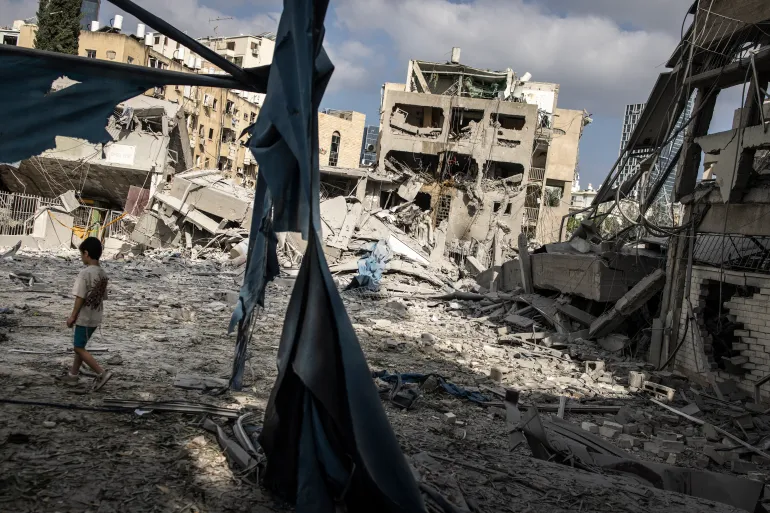
A young boy walks through the debris at the site of an Iranian missile strike in Bnei Brak, east of Tel Aviv, Israel on June 16, 2025
Agencies
Iran has launched a fresh wave of ballistic missile attacks targeting several cities in Israel, including Tel Aviv and Haifa, killing at least eight people and injuring dozens. The latest escalation follows renewed Israeli airstrikes on Tehran earlier in the day.
According to Iranian sources, the death toll from Israel’s recent attacks has risen to over 220, including 70 women and children. Among the dead are the intelligence chief of Iran’s Islamic Revolutionary Guard Corps (IRGC) and two other high-ranking generals.
Meanwhile, the UN nuclear watchdog chief Rafael Grossi has stated there is no visible damage at Iran’s Natanz or Fordow nuclear enrichment sites following the Israeli strikes.
Gaza Death Toll Continues to Mount
In Gaza, the ongoing Israeli offensive has killed at least 55,362 people and injured 128,741, according to the Gaza Health Ministry. These numbers come in the wake of the October 7, 2023 Hamas-led attacks on Israel, which left 1,139 people dead and over 200 taken captive.
A ‘New Middle East’ in the Making?
Former Israeli Justice Minister Yossi Beilin has suggested that Israel’s leadership understands it cannot destroy Iran’s nuclear program by force without the backing of the United States.
“At some point, we’ll have to acknowledge that we’ve delayed Iran’s nuclear ambitions, but haven’t eliminated them—unless the U.S. gets involved,” Beilin said.
He emphasized the need to think about "the day after" the war ends, stating that the Middle East is at a crossroads. “It’s a new situation. Arab and Muslim countries must now ask themselves: what’s next?” Beilin said, referencing the 1991 Madrid Peace Conference led by then-U.S. President George H.W. Bush as a milestone moment of regional cooperation.
Escalation Continues Amid Mounting Casualties
Hostilities between Israel and Iran showed no signs of easing on Monday, with both sides launching further attacks overnight and into the morning. The four-day conflict has now resulted in nearly 250 deaths.
Iran claims to have fired over 100 missiles in retaliation for Israeli strikes on its military and nuclear infrastructure. Since Friday, Israel's bombardments have killed at least 224 people in Iran, including top commanders and scientists. Israeli Army Radio reported that eight people were killed in the latest Iranian attack—five in central Israel and three in Haifa. Over 300 people have been wounded since Israel began its offensive.
A branch of the U.S. Embassy in Tel Aviv sustained minor damage, according to U.S. Ambassador Mike Huckabee.
Targeted Strikes and Vows of Retaliation
Israeli jets have targeted command centers in Tehran linked to the IRGC’s Quds Force, accusing them of orchestrating terrorist attacks using Iran’s regional proxies.
“In these command centers, Quds operatives planned attacks against Israel using Iranian proxies across the Middle East,” the Israeli military posted on X.
On Sunday, Iran reported that Israeli strikes hit oil refineries, population centers, and killed the IRGC’s intelligence chief.
Calls for Restraint Amid Rising Tensions
Global leaders have urged both countries to show restraint. The conflict erupted Friday when Israel struck Iran’s nuclear and missile facilities in a bid to disrupt Iran’s nuclear weapons program.
Iran responded with missile strikes, leading to an ongoing exchange of fire.
Former U.S. President Donald Trump said he hoped both sides would “make a deal,” but also noted they might have to “fight it out” first. Though distancing the U.S. from Israeli actions, Trump has warned that any attacks on American interests would trigger a full-scale U.S. military response.
Rhetoric Heats Up
Israeli Defense Minister Israel Katz warned that Tehran residents would “pay the price” for Iranian strikes that killed civilians.
“The boastful dictator from Tehran has become a cowardly murderer, targeting Israel’s civilians to deter us. But the people of Tehran will pay the price—soon,” Katz posted on Telegram.
In contrast, Iranian President Masoud Pezeshkian called for national unity.
“All internal differences must be set aside. We must stand united against this genocidal aggression,” he told Iran’s parliament.
Analysts Warn of Further Escalation
Military analyst Elijah Magnier told Al Jazeera that escalation is likely to continue.
“We are just in the early stages. Israeli officials have warned the public that this war will be long and costly.”
Alex Vatanka, a senior fellow at the Middle East Institute, said Iran may soon look for a way to end the conflict. “Iran is isolated. Unlike Israel, it lacks allies. Israel has the U.S., much of Europe, and other partners. That’s a big concern for Tehran.”



