Written By | Health News Agencies

FDA approves world-first "size-adjustable" valve that can be stretched with a balloon as kids get bigger — sparing heart patients from a lifetime of repeat open-chest surgeries
WASHINGTON, D.C.
For thousands of families, it is the cruellest arithmetic in children's medicine. A toddler born with a faulty heart gets a new valve. The child grows. The valve does not. And so, every few years, the surgeons must crack open the same small chest again to swap the old valve for a bigger one.
On Thursday, 1 October 2026, US regulators moved to rewrite that sum. The Food and Drug Administration approved the Autus Size-Adjustable Valve, made by Californian heart-device giant Edwards Lifesciences — the first heart valve ever designed to be made bigger after it has been sewn into a child's heart.
Instead of another open-heart operation, doctors can thread a thin tube called a catheter through a blood vessel, inflate a tiny balloon inside the valve, and stretch it to fit a growing body. The valve starts life at about 13 millimetres across — the right size for a toddler or preschooler — and can be widened all the way to 22 millimetres, roughly the size of an adult's.
"This valve is a game changer," said Dr Jennifer Romano, a children's heart surgeon at C.S. Mott Children's Hospital in Michigan who led one of the sites in the pivotal trial. "Typically, we give these children a temporary fix, knowing they will need more surgeries down the road. Now, we may be giving a child a valve that could potentially last them a lifetime."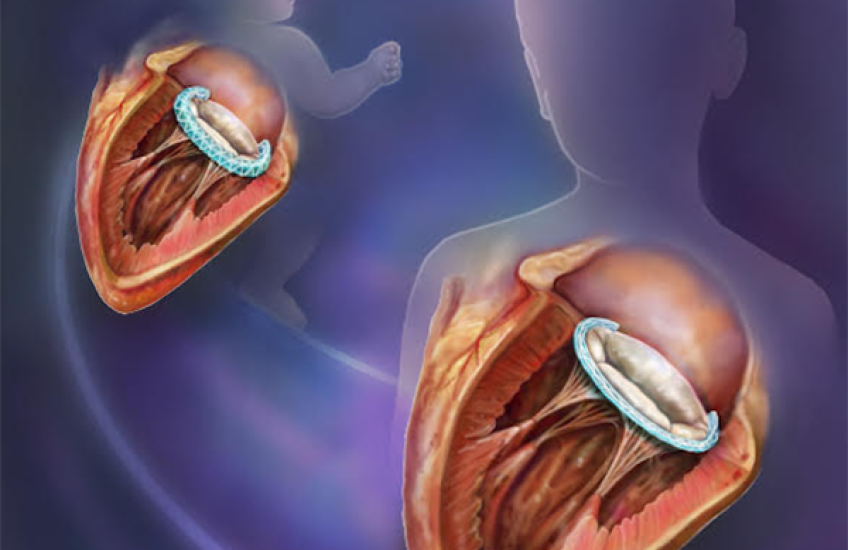
A FIRST — TWICE OVER
The approval is a double first. Not only is Autus the first valve built to "grow" with a patient, it is also the first artificial heart valve approved in the United States to use flaps made from a man-made polymer instead of animal tissue.
That matters more than it sounds. Most replacement valves used in children today have leaflets — the thin flaps that open and close with every heartbeat — made from cow or pig tissue. In young, fast-growing bodies those tissue flaps tend to stiffen and wear out quickly, the FDA said, often forcing doctors back into the operating theatre sooner than anyone would like.
The Autus leaflets are instead made from a thin, tough plastic called polytetrafluoroethylene — a close cousin of the material used in non-stick pans and in many vascular grafts. The FDA said one-year follow-up data suggest the polymer flaps "hold up well over time". This is the first time the agency has approved polymer leaflets for any heart valve at all.
"For children born with congenital heart disease, valve replacement timing has always been a difficult decision — wait too long and you risk harm to the child, but intervene too early and they may need multiple open-heart surgeries as they grow," said Dr Michelle Tarver, director of the FDA's Center for Devices and Radiological Health. "The Autus size-adjustable valve gives doctors the option of far fewer trips to the operating room, which may result in better quality of life for these children and their families."
THE PROBLEM IT SOLVES
The pulmonary valve sits between the heart's right-hand pumping chamber and the artery that carries blood to the lungs. In many children born with heart defects, that valve is missing, too narrow, or leaky. Surgeons often have to rebuild the area in infancy, and later replace the valve altogether.
For years, doctors have faced an impossible trade-off. Fit a new valve too early, and the child will quickly outgrow it, guaranteeing more surgery. Wait too long, and the leaking valve can force the right side of the heart to swell and weaken under the strain — damage that can haunt patients into adulthood.
"For some children with congenital heart disease, surgeons have historically had to choose between relieving an obstruction to blood flow from the heart and leaving the child with an incompetent pulmonary valve," Michigan Medicine explained when its surgeons began implanting the device earlier this year. Children can live with a leaky valve for years, but the extra volume of blood sloshing backwards can enlarge the right ventricle and store up problems for later life.
"With the Autus Valve, we can address the problem we need to fix without creating another problem," Dr Romano said. "We can give a child a competent valve now, protect the right ventricle and then expand that valve as the child grows."
WHAT THE TRIAL SHOWED
The FDA's decision rests on a study of 62 children treated at 12 hospitals across the United States. Every child had a successful implant.
According to the agency:
• Of the first 60 children to reach six months of follow-up, the valve was working acceptably — blood flowed through it within normal limits, with no more than mild leakage.
• There were no deaths, no strokes and no dangerous blood clots during the study.
• Three children had a small fracture in the valve's metal frame, and two had one flap that moved less freely than it should. None of these five problems caused symptoms.
• Two children had already started to outgrow their valves. Both had them successfully stretched with a balloon — no open surgery needed.
Edwards added that 100% of patients were free of device-related complications in the first 30 days, that no valve had to be redone in the first six months, and that all children who completed one year of follow-up still had less than moderate leakage and no repeat procedures.
"For decades, Edwards has worked to address the needs of structural heart patients with complex conditions," said Edwards chief executive Bernard Zovighian. "The Autus valve represents a meaningful advancement for children who have historically had limited treatment options."
THE SMALL PRINT
Before parents start ringing their cardiologists, there are important caveats — and the FDA itself has been careful to spell them out.
First, experience with actually stretching the valve is still limited. Only a handful of children in the trial have needed it so far, because most have not yet grown enough. The whole promise of Autus — fewer operations over a childhood — has not yet been proven over a childhood. That is why every patient will be followed for 10 years, to see whether repeated balloon expansions really can keep the valve working and keep children out of the operating theatre.
Second, the study had no comparison group. It shows the valve performed well, but it does not directly prove that children do better on Autus than on existing valves over the long run.
Third, the three frame fractures will be watched closely. They caused no harm in the trial, but doctors will want to know whether they become more common as the valves are stretched again and again.
And finally, the valve still has to go in through open-heart surgery the first time. Autus does not abolish the operating theatre — it aims to make the first trip the last big one, or close to it.
Edwards and the FDA have not said when the valve will be widely available, how much it will cost, or exactly which children will qualify. Michigan Medicine has described it as designed for children roughly 18 months to 16 years old.
FROM START-UP TO SHOWROOM
The valve was invented by a small company, Autus Valve Technologies, and later acquired by Edwards, one of the world's biggest makers of heart valves. It won the FDA's Breakthrough Device designation, which speeds up reviews for technologies that could offer major advances, and went through the agency's toughest approval route, known as premarket approval.
It is also the first children's device to come out of the FDA's Total Product Life Cycle Advisory Program, or TAP — a scheme that gives makers of promising devices earlier and more frequent advice from regulators.
While regulators were still reviewing the data, C.S. Mott Children's Hospital in Ann Arbor became the first US hospital to implant an Edwards-made Autus valve under a "continued access" study. In August, a six-year-old from Michigan became the first patient to receive one.
"Many of our patients need consideration for their entire lifetime," said Dr Gorav Ailawadi, chair of cardiac surgery at the University of Michigan. "We saw an opportunity for a novel, cutting-edge treatment with the potential to improve patients' long term outcomes."
EXPERT PERSPECTIVE
Children's heart surgeons have long described valve replacement in young children as a "temporary fix". Every reoperation means another round of anaesthesia, more scar tissue inside the chest, longer hospital stays and weeks off school — and each repeat surgery is technically harder than the last because of that scarring.
That is why specialists are excited. If the valve performs as hoped, a child who might otherwise face three or four open-heart operations before adulthood could instead need one operation plus a few catheter procedures — usually done through a small puncture in the groin, with a much quicker recovery.
But experts also stress that this is the beginning of the story, not the end. Polymer valves have been tried before in research and have struggled with durability and blood clots; the early Autus data are encouraging precisely because they have avoided those problems so far. The 10-year follow-up will be the real test.
Richard Ohye, co-director of the Congenital Heart Center at Mott, said bringing the device to patients during the trial "required extraordinary collaboration across our congenital heart center, from identifying the right patients to coordinating the procedures and supporting families".
WHAT THIS MEANS FOR YOU
Congenital heart disease is the most common type of birth defect, affecting roughly one in every 100 babies. Not all of them will need a pulmonary valve replacement — but for those who do, the Autus approval opens a new conversation.
If your child has a congenital heart condition and may need a new pulmonary valve:
• Ask your child's cardiologist whether a pulmonary valve replacement is likely, and when.
• Ask whether the Autus valve might be suitable, and whether your hospital offers it or plans to.
• Ask how the timing of surgery might change now that a growing valve exists — some families may be able to fix a leaking valve earlier than before.
• Ask what follow-up will look like, including how often scans will be needed and when a balloon expansion might be required.
• Do not cancel or delay any planned treatment without talking to your child's heart team first.
For adults who had heart surgery as children, this valve is not designed for you — but it is a sign of how quickly the field is moving.
THE BOTTOM LINE
For generations, a child's growth spurt has been something heart surgeons quietly dreaded, because every inch gained brought the next operation closer. The Autus valve does not make that problem vanish overnight, and its long-term record is still being written.
But for the first time, doctors have a valve that is built to keep up. In the words of Dr Romano, it "could be transformative" — and for the families who have sat in surgical waiting rooms again and again, that may be the most hopeful word of all.



