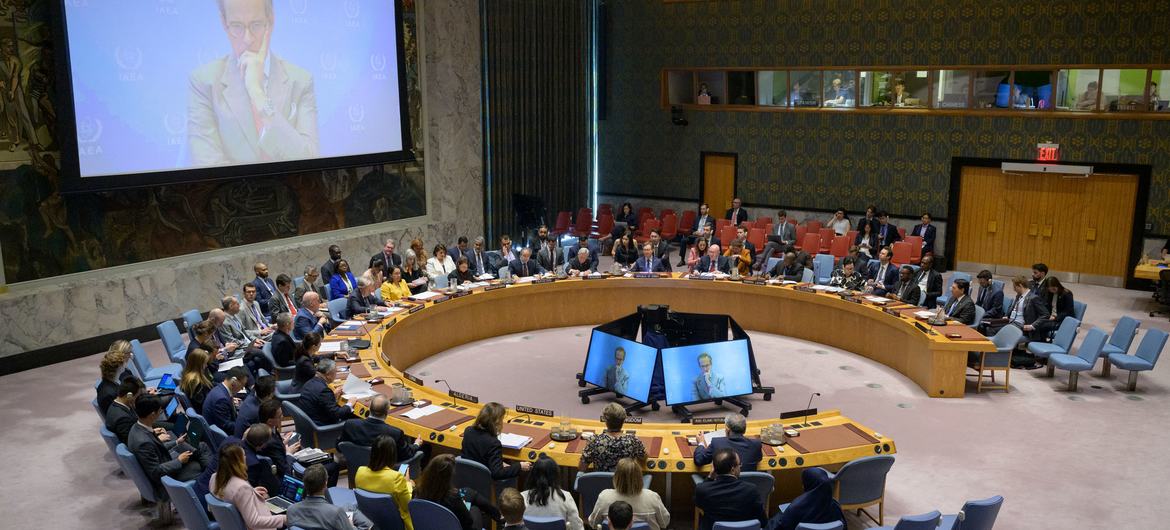
Nearly 130 leaders convene in New York as a seven-month war closes the Strait of Hormuz, the Secretary-General delivers his last annual address to a budget in retreat, and four of the world’s largest powers stay away.
World Politics
Background
The general debate of the eighty-first session of the United Nations General Assembly opened in New York on Tuesday, 22 September, the annual ritual in which all 193 member states are invited to take the podium and describe the world as they see it. It runs through Saturday 26 September and resumes on Monday 28 September, with a voluntary fifteen-minute limit on statements honoured more in the breach than the observance. Nearly 130 heads of state and government are expected to speak. The session itself began on 8 September, when Khalilur Rahman of Bangladesh took office as President of the General Assembly. The theme chosen for the year is “Restoring trust, managing transformation: a United Nations that delivers for all” — a formulation that reads, this September, less as an aspiration than as an admission.
The order of speakers is fixed by custom. Brazil always goes first, a habit begun in 1955 when no other delegation volunteered to open; the United States, as host country, traditionally follows. That convention put President Donald Trump at the podium on Tuesday morning, expected around 9:45am local time — the second speech of the week and, by some distance, the one the rest of the hall had come to hear.
He returns at the seven-month mark of a war against Iran that his administration launched and that has not produced the outcome it promised. A year ago he told the same chamber that American strikes had dealt a decisive blow to Iran’s nuclear programme. Since then the conflict has widened rather than closed: Tehran has restricted shipping through the Strait of Hormuz, the artery through which a large share of the world’s seaborne oil moves, and Brent crude has traded above $100. In the days before the summit, Yemen’s Houthis expanded their control along the Red Sea coast and took ground overlooking the Bab al-Mandeb Strait, the other chokepoint on the same route. The economic consequences have fallen hardest on states that had no part in the decision to go to war, and many of their representatives are in New York this week.

Key Developments
The session opened with Secretary-General António Guterres introducing his annual report — his final such address, since his second and last term ends on 31 December. The institutional backdrop he described is bleak. The UN80 initiative, the reform programme he has pressed since the organisation’s eightieth anniversary, has moved from what he calls diagnosis to design and now to implementation, which in practice has meant cuts. The 2026 regular budget fell from an original request of roughly $3.72 billion to somewhere between $3.24 billion and $3.45 billion depending on the accounting stage cited — sources differ — a drop of around 15 per cent against 2025. Roughly 2,900 Secretariat posts, close to a fifth of the workforce, have been abolished or relocated to lower-cost duty stations, alongside a 21 per cent cut to special political mission allocations. Guterres has warned for more than a year that the organisation faces a “race to bankruptcy” unless member states pay their assessed contributions in full and on time.
The largest single reason they have not is the United States, assessed at 22 per cent of the regular budget and 26.15 per cent of peacekeeping. Washington made no payment at all in 2025. In August the administration notified Congress of transfers of $725 million toward the regular budget and $125 million for peacekeeping in Haiti and the Democratic Republic of the Congo; a separate accounting records an $827 million payment of mandatory dues this month. Estimates of what remains outstanding range from about $4.2 billion to roughly $5 billion, the spread reflecting different cut-off dates and how peacekeeping arrears are counted. The United States has also withdrawn from or defunded more than thirty UN entities, including the World Health Organization. The institution being asked this week to manage two major wars, a global energy shock and the governance of artificial intelligence is doing so with a fifth fewer people than it had eighteen months ago.
The absences are their own commentary. President Xi Jinping of China, who last participated remotely in 2021, is not travelling to New York; he is expected instead to hold bilateral talks with Trump in Washington on Thursday. President Vladimir Putin, who has not attended in more than a decade, is sending Foreign Minister Sergey Lavrov. The leaders of India, Germany and South Africa are reportedly sending representatives rather than appearing themselves. Four of the five permanent members of the Security Council will thus be represented at the general debate by someone other than their head of state or government. Whatever else the week produces, it will not produce a photograph of the great powers in one room.
One absence is not voluntary. For the second consecutive year the United States has denied visas to Palestinian officials, and President Mahmoud Abbas will address the Assembly by pre-recorded video after member states voted last Thursday to permit it. The State Department justified the denial on the grounds of Palestinian efforts to “internationalise” the conflict, including cases brought before international tribunals. The United Nations says the decision violates the Headquarters Agreement, which obliges the host country to admit heads of state and government travelling for the organisation’s business. The precedent is not new: in 1988 the Assembly relocated to Geneva after Washington refused a visa to Yasser Arafat. This time it has adapted around the obstacle rather than moving.
The Week’s Diplomacy
Iranian President Masoud Pezeshkian addresses the Assembly on Wednesday, accompanied by Foreign Minister Abbas Araghchi, giving Tehran a platform to contest Washington’s account of the war before the same audience; there are no plans for Trump to meet the Iranian delegation, and the two capitals traded fresh threats in the days before the summit. Israeli Prime Minister Benjamin Netanyahu speaks on Thursday, notwithstanding the International Criminal Court arrest warrant against him and reports that sweeping American sanctions on the court are imminent. Sudan’s army chief, General Abdel Fattah al-Burhan, also speaks on Thursday, with a side meeting expected on a war that has displaced more than fourteen million people since April 2023.
Trump’s own diary is dense. He is expected to meet Japanese Prime Minister Sanae Takaichi, who will press Tokyo’s view of China ahead of the Washington summit later in the week, and British Prime Minister Andy Burnham for their first face-to-face encounter, with Ukraine, the Middle East and maritime security in the Strait of Hormuz on the agenda. A less formal “pull-aside” is planned with Venezuela’s acting president Delcy Rodríguez — their first meeting since the January raid that removed Nicolás Maduro and since last month’s agreement giving the United States a stake in Venezuelan oil. Iraqi Prime Minister Ali Faleh al-Zaidi is also expected, and Waltz has said Trump will meet Gulf leaders who have absorbed much of the war’s economic damage. On Ukraine there is a discrepancy worth flagging: President Volodymyr Zelensky said on Sunday that he and Trump had agreed to meet in New York on Tuesday for talks that “could change a lot,” while the Kyiv Post reported that the published White House schedule omits a Zelensky bilateral — both can be true if the meeting is handled informally.
Running underneath all of it is the contest to succeed Guterres. The Assembly formally appoints the Secretary-General, but the Security Council must recommend a candidate first and is still conducting straw polls; no decision is expected this week. Seven candidates remain — four women and three men — and several Council members have said openly that after nine male secretaries-general since 1945 it is time for a woman. Michelle Bachelet withdrew on Saturday after winning encouragement from only one of the fifteen members. The same poll put Costa Rica’s Rebeca Grynspan, head of UNCTAD, narrowly ahead (nine encourage, five discourage, one no-opinion), with Guyana’s Carolyn Rodrigues-Birkett second. Also in the field: Ivonne Baki and María Fernanda Espinosa of Ecuador, Rafael Grossi of Argentina, Macky Sall of Senegal and Olara Otunnu of Uganda. Any of the five permanent members can veto.
Reactions
American officials framed the week as a vindication. Ambassador Mike Waltz said on Friday that the president would “highlight how he has and his administration have confronted complex problems head-on around the world” and would “touch on the importance of ensuring that Iran never has a nuclear weapon.” The speech was expected to dwell on peace agreements, the twenty-point Gaza plan and efforts to widen the Abraham Accords. Waltz also said Trump “truly values hearing from” Gulf leaders and their concerns — an acknowledgement that the war’s costs are being paid partly by American partners.
European governments have pressed Washington to reverse the visa ban on the Palestinian delegation, without success, and UN spokespeople continue to describe the host-country obligation as binding. Qatar’s prime minister argued before the summit that Gulf states need “good relations” with Iran as part of any new regional security framework — a position that sits awkwardly with the American approach and shows how far the Gulf’s calculation has drifted from Washington’s over seven months of war. Diplomats expect a sideline meeting intended to advance a two-state solution, while conceding that significant progress is unlikely.
The mood in the building is captured less by any statement than by the rest of the week’s schedule: high-level meetings on climate action and on the Declaration on the Right to Development (23 September), sea level rise (24 September), pandemic preparedness (25 September), the Durban Declaration against racism (28 September) and the elimination of nuclear weapons (29 September). It is an agenda designed for an organisation with capacity. It is being taken up by one that has just cut a fifth of its staff.
What’s Next
The immediate questions are narrow and answerable. Does Pezeshkian’s speech on Wednesday leave an opening for negotiation or harden Tehran’s position? Does the Trump–Zelensky meeting happen, and in what form? Does the Xi–Trump summit in Washington on Thursday produce anything on artificial intelligence transparency, which officials on both sides have signalled as a topic? And does the Security Council converge on a Secretary-General, or does the race run into the autumn with Guterres’s term expiring on 31 December?
The larger question is the one the theme was written to avoid asking directly. An institution created to prevent wars is convening while two are being fought by its own permanent members or their close allies, with its budget cut, its largest contributor several billion dollars in arrears, four of the five veto powers represented below head-of-state level, and one invited leader barred from the country that hosts it. The general debate will produce a week of speeches. Whether it produces anything the speeches are about is the test that the phrase “restoring trust” was chosen to name.
Published By | News Editor