ACCRA / MILAN
In many African cultures, the courtyard occupies a space that Western architecture rarely designates so clearly: neither fully private nor fully public, it's the place where families eat together, where elders pass down knowledge to children, where neighbors gather to talk through the events of the day. It's an architectural idea as much as a physical one — and it's precisely that idea designer Terry Aidoo set out to translate into furniture with his new Kabila Collection, which this month won Product Designer of the Year in the People-Centric Design category at the inaugural Africa International Design Awards.
What the Collection Actually Is
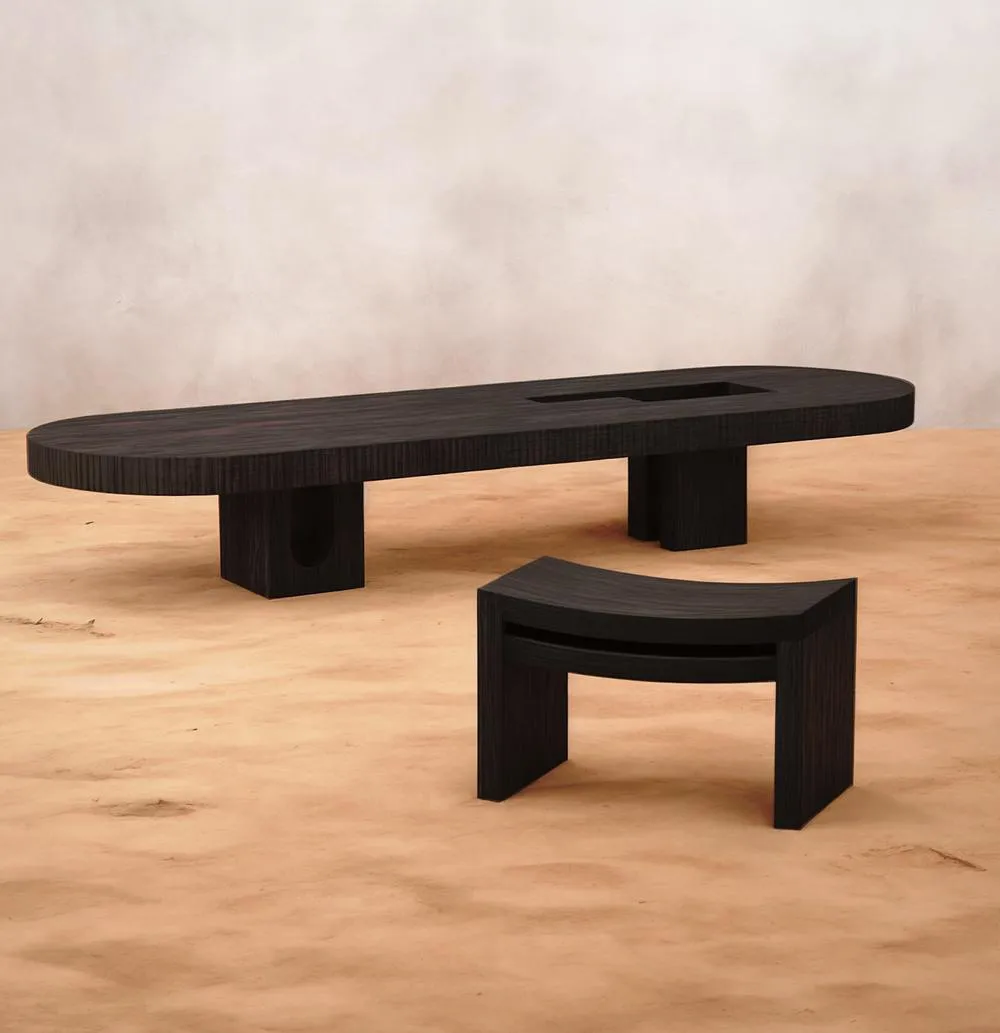
Stripped to its essentials, the Kabila Collection consists of two pieces: a sculptural coffee table and a single symbolic stool. Both are handcrafted from sapele wood — a durable, richly grained timber responsibly sourced from Nigeria — and produced using a combination of traditional woodworking techniques and contemporary fabrication processes in Italy, a pairing that bridges craft traditions across two continents in the object's very production history.
The collection takes its name from "Kabila," a word meaning clan or tribe in both Swahili and Arabic — a deliberate choice meant to evoke forms of identity built through family, tradition, and shared experience rather than through individual ownership, which is itself a quiet rebuke to how much of contemporary furniture design centers the solitary user.
The Symbolism Carved Into the Wood
What separates Kabila from a merely handsome coffee table is the density of cultural reference built into its details. A carved motif on the tabletop references Oware, the traditional West African board game played across generations as both entertainment and a tool for teaching strategy and social interaction — the kind of game passed from grandparent to grandchild in exactly the courtyard setting the collection is named for.
Elsewhere on the table, a recessed circular detail draws directly from the Eritrean coffee ceremony, a ritual built entirely around hospitality, unhurried conversation, and togetherness — a fitting reference point for a coffee table, made literal rather than incidental. The accompanying stool, meanwhile, borrows its form from traditional seating of the Benin Kingdom in present-day Nigeria, where Edo stools historically carried real symbolic weight, often signaling the status and identity of whoever sat on them.
Taken together, the two pieces don't just gesture vaguely at "African-inspired" design, a label that has too often been applied loosely and reductively in Western design markets. Instead, Aidoo has built a piece-by-piece index of specific cultural practices — a board game, a coffee ritual, a seat of status — each drawn from a different region of the continent and rendered legible to anyone willing to look closely at the carving.
The Designer's Perspective
Aidoo has described the recognition from AIDA's jury as especially meaningful precisely because the award specifically honors people-centric design — work judged not on novelty or spectacle but on how genuinely it serves human connection. In discussing the win, Aidoo framed his practice within a larger movement: he believes African product and furniture design is playing an increasingly significant role in shaping global design conversations, with designers across the continent bringing forward perspectives, histories, and cultural narratives that have historically been underrepresented in major design institutions and publications.
Platforms like AIDA, in his view, exist to create space for exactly those stories — to ensure they are seen, understood, and celebrated on the same global stage as design movements that have dominated the conversation for decades. That AIDA's very first edition chose to elevate a project built entirely around African cultural specificity, rather than a more generically "international" style, suggests the jury shared that same conviction.
A New Award, a New Stage
The Africa International Design Awards, which held its inaugural ceremony this year, was conceived explicitly as a global stage for design talent from Africa and the diaspora — a category of design that has long lacked a flagship award of its own scale, despite decades of influential work across architecture, product, and furniture design originating on the continent. Aidoo's win, alongside the collection's other recognitions this year, positions Kabila as something of a flagship project for the award's opening chapter: proof of concept for what the ceremony's organizers hope becomes an annual fixture on design's global calendar.
What This Means for Design Lovers
For anyone who follows contemporary furniture design, Kabila is worth watching not just as a beautiful object but as a signal of where the field's most interesting cultural storytelling is currently happening. As Western design markets increasingly search for authenticity beyond minimalist Scandinavian or industrial aesthetics that have dominated the last two decades, collections like Aidoo's — rooted in specific, well-researched cultural practice rather than generalized "ethnic" motifs — represent the more thoughtful end of that shift. If you're furnishing a space and looking for a piece with genuine narrative depth behind it, designers working in this vein, sourced through galleries and design fairs increasingly paying attention to African design talent, are worth seeking out.
Conclusion
A coffee table is, in most furniture catalogs, an afterthought — a flat surface for coasters and remote controls. Terry Aidoo's Kabila Collection insists otherwise, treating the object as a vessel for an entire social architecture: games passed between generations, coffee ceremonies built on hospitality, seats that once signified who you were in your community. In turning a courtyard into a coffee table, Aidoo hasn't just won an award — he's made a case for what furniture design can carry, if a designer is willing to look at it that closely.
Published By | Features Editor