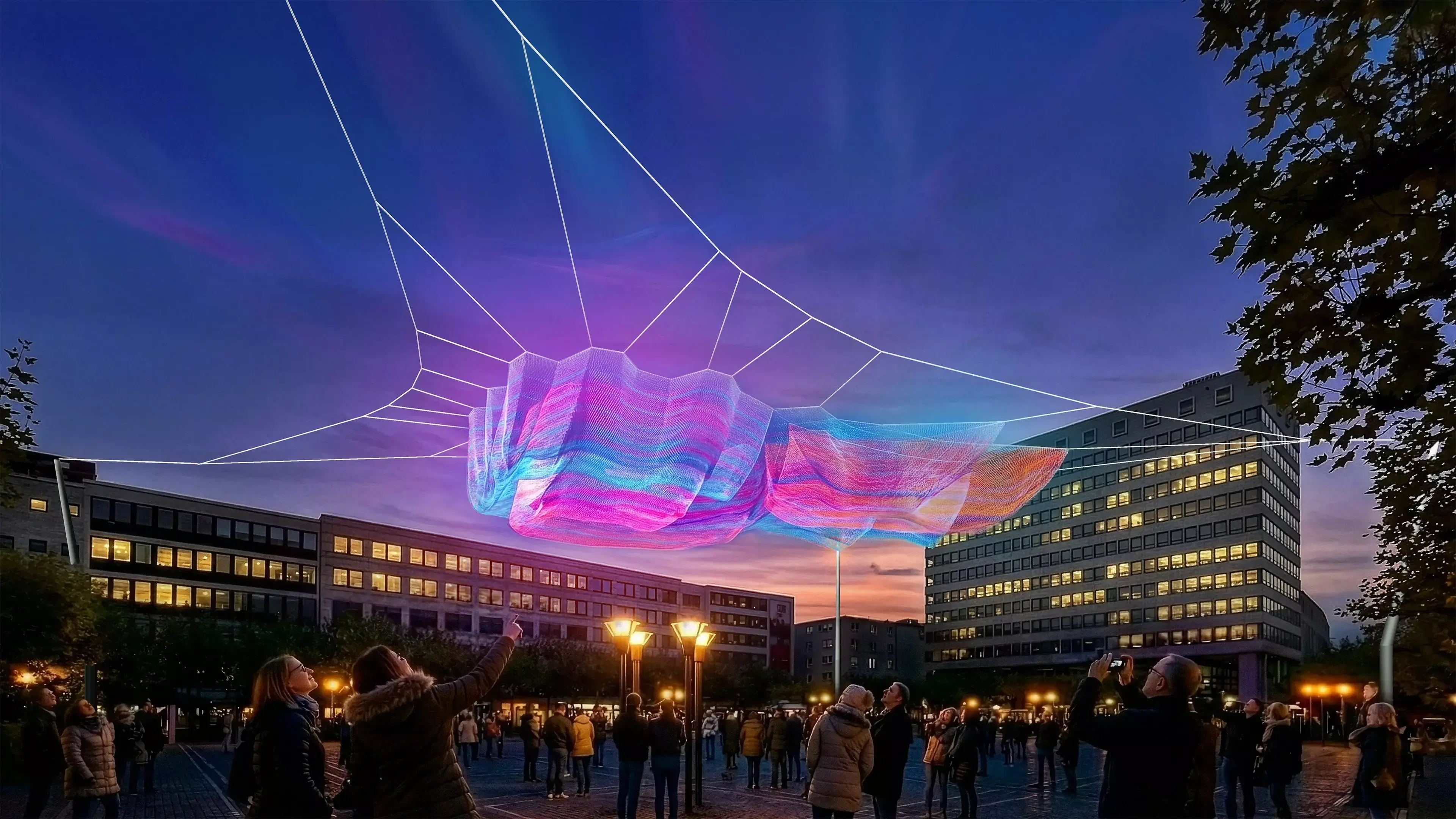
Frankfurt, Germany
Above Frankfurt's Konstablerwache square, a public plaza more accustomed to market stalls and commuter traffic than monumental art, a woven textile sculpture now hovers twelve metres in the air, catching wind and light in equal measure. Titled "A Sky Full of Hope," the piece by internationally acclaimed artist Janet Echelman unveiled on August 11 and has quickly become the visual centerpiece of Frankfurt RheinMain's turn as World Design Capital 2026 — the first time a German region has held the title.
The sculpture's arrival kicked off what organizers are calling the region's "Month of Design," a concentrated stretch of exhibitions, public installations and interactive experiences meant to make the yearlong World Design Capital program tangible to residents and visitors alike, rather than confined to conference halls and trade fairs.
Design for Democracy
The full World Design Capital 2026 program runs under the guiding theme "Design for Democracy. Atmospheres for a Better Life," an ambitious framing that positions everyday design decisions — how a public square feels, how a transit stop functions, how a neighborhood invites or discourages gathering — as inseparable from the health of civic and democratic life. Organizers have structured the year around five thematic priorities, each assigned to a cluster of months: "Shaping living spaces together" earlier in the year, "Rethinking learning" in spring, "Cycles of the future" around craftsmanship and industry in early summer, and now, for August and September, a theme organizers describe simply as "With all the senses."
That sensory framing is deliberate. Echelman's floating sculpture, illuminated at night and shifting shape with the wind, was chosen specifically to give residents an immersive, physical experience of design rather than an object to observe from a distance — an approach organizers hope will carry through the rest of the sensory-themed programming into September.

Music, Design and Social Issues Collide
The sculpture unveiling was followed within days by the Module Festival, which ran August 13 through 16 at the Kulturcampus Frankfurt, pairing workshops and talks on design and democracy with DJ sets and audiovisual performances. The pairing of policy-adjacent discussion with nightlife programming reflects a broader strategy behind Frankfurt's World Design Capital bid: rather than positioning design as an academic or industry-only conversation, organizers have repeatedly tried to fold it into formats — festivals, public art, food, music — that draw crowds who would never attend a traditional design symposium.
That strategy extends to the region's approach to public space more broadly. Frankfurt RheinMain's original bid for the World Design Capital title emphasized using design as a tool for urban renewal across a region grappling with the same pressures facing many mid-sized European metro areas: aging infrastructure, housing pressure, and questions about how public space should function as cities adapt to climate change.
"Design for Democracy. Atmospheres for a Better Life." — Official theme, World Design Capital Frankfurt RheinMain 2026
Why This Title Matters
The World Design Capital designation, awarded by the World Design Organization, rotates among cities and regions roughly every two years and has previously gone to places including Helsinki, Cape Town, Mexico City and Valencia. Winning it typically triggers a wave of civic investment, tourism attention and cultural programming that outlasts the calendar year itself — host regions frequently point to permanent public art, redesigned public spaces and new design institutions as the lasting return on what is, in the short term, an expensive prestige project.
For Frankfurt RheinMain, being the first German recipient of the title carries particular weight. The region is best known internationally as a financial and logistics hub — home to the European Central Bank and one of Europe's busiest airports — rather than as a design destination in the mold of Milan or Copenhagen. Organizers have been explicit that one goal of the year is repositioning that international perception, using high-visibility public commissions like Echelman's sculpture to signal that the region can compete culturally, not just economically.

What It Means for Visitors and the Design World
For travelers, the Month of Design offers a rare concentrated window to see a major European region using its full civic apparatus — museums, public squares, transit hubs, festivals — as a single, coordinated design showcase, rather than piecing together a handful of gallery visits. Echelman's sculpture is expected to remain installed at Konstablerwache for the duration of the sensory-themed programming through September, giving visitors through the early autumn a chance to see it.
For the broader design and architecture industry, Frankfurt's approach is being watched as a test case for whether "design for democracy" as a curatorial theme can produce work with genuine civic impact, rather than serving as an abstract framing device for what is, functionally, a very large public art and tourism program. Early reception to the Echelman commission — widely shared on social media and credited with driving unusually heavy foot traffic to a square not typically considered a destination — suggests the strategy is, at minimum, succeeding at getting people to look up.
The Bottom Line
A floating textile sculpture won't singlehandedly fix the pressures facing a mid-sized European region, and organizers aren't claiming it will. But as an opening statement for a year built around the idea that good design can make public life feel more generous, Frankfurt's Month of Design has done exactly what it set out to do: turned a commuter square into a place worth stopping for.
Published By | Features Editor