Written By | Business Experts
Egypt's economy grew 5.2 percent in the first nine months of fiscal year 2025/26 (July 2025 through March 2026), a pace well ahead of the government's own projections
Egypt entered the second half of 2026 in a position it has not occupied in years: growing faster than expected, borrowing costs falling, and its currency reserves at record highs, all while the International Monetary Fund keeps releasing fresh tranches of a program that has now stretched across four years. Yet beneath the improving headline numbers sits a population that has spent that same period absorbing repeated subsidy cuts, a floated currency, and inflation that has refused to fully retreat. Egypt's story in 2026 is less a turnaround than a test of how long macroeconomic stabilization can proceed without a matching improvement in ordinary living standards.
A Faster-Than-Expected Recovery
Egypt's economy grew 5.2 percent in the first nine months of fiscal year 2025/26 (July 2025 through March 2026), a pace well ahead of the government's own projections. The IMF now expects real GDP to expand by roughly 5.0 percent for the full 2025/26 fiscal year and 4.9 percent in 2026/27, an upgrade from earlier, more cautious forecasts of around 4.4-4.6 percent growth. The acceleration follows a sharp deceleration in 2023 and early 2024, when a foreign-currency shortage, a widening parallel exchange-rate market, and the Gaza war's disruption of Red Sea shipping and tourism hammered the economy simultaneously.
The rebound has been powered by three forces converging at once: a stabilizing currency after the March 2024 devaluation and float, a surge of investment tied to the $35 billion Ras El-Hekma coastal development deal with the UAE's ADQ sovereign fund, and a recovery in the two sectors most exposed to regional instability — tourism and Suez Canal transit. Non-tax revenue linked to the Ras El-Hekma project has been a major driver of the government's improved fiscal position over the past two years, giving Cairo breathing room even as debt-servicing costs remain the single largest line item in the budget.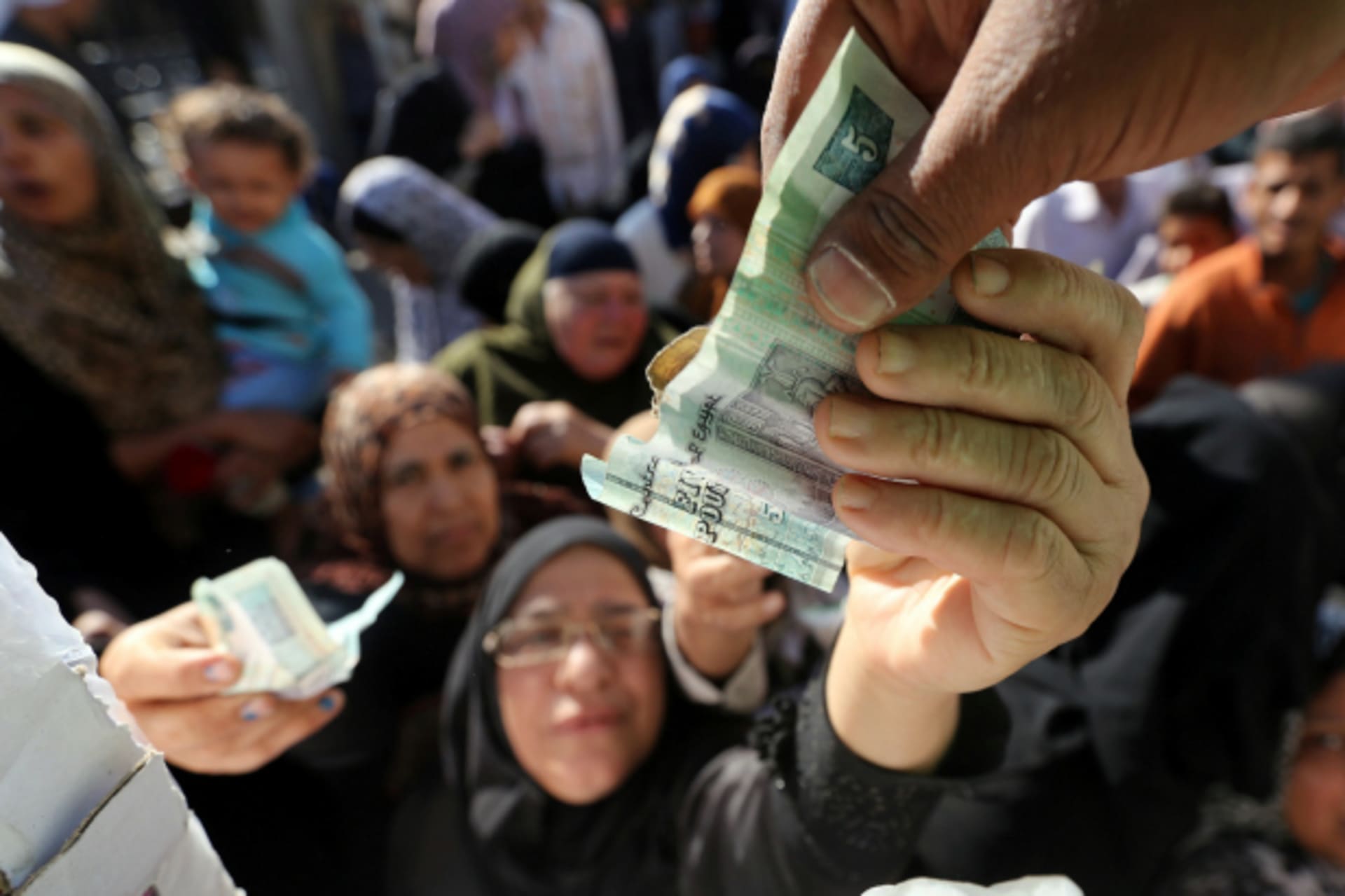
The IMF Program: Extended, Reviewed, and Still Unfinished
Egypt's $8 billion Extended Fund Facility, approved in December 2022 and later augmented, has become one of the IMF's longest-running active arrangements in Africa. In February 2026 the IMF's Executive Board completed the combined fifth and sixth reviews of the EFF alongside the first review of a parallel Resilience and Sustainability Facility arrangement, releasing roughly $1.5 billion under the EFF and about $272 million under the RSF. By late July 2026, the Fund had completed a seventh review, unlocking further disbursements and extending the overall arrangement's timeline through December 15, 2026.
Inflation has cooperated with the program's aims to a degree: headline CPI fell to 11.9 percent in January 2026 from levels above 30 percent at the peak of the 2023-24 crisis, aided by tight monetary policy from the Central Bank of Egypt and a more stable pound. But the disinflation has not been linear. By July 2026, annual inflation had climbed back to 14.9 percent from 14.3 percent the prior month, driven in large part by housing and utility costs, which were running at 40.4 percent year-on-year as electricity subsidies continued to be unwound. The IMF's own staff reports have flagged persistent gaps between headline progress and structural follow-through, warning specifically that the continued dominance of state- and military-linked enterprises in sectors from cement to poultry remains the principal obstacle to a durable, private-sector-led, job-rich expansion. Divestment from state assets — a core EFF commitment — has moved more slowly than the program originally envisaged.
Debt Trajectory Improves, But Financing Needs Stay High
Egypt's public debt-to-GDP ratio, which the IMF estimated near 90.9 percent at its recent peak, is now on a clearly downward path. The government's updated debt strategy targets a reduction to around 77 percent of GDP by the end of fiscal year 2026/27, with the IMF projecting the ratio could fall to roughly 79 percent by 2026 under the current trajectory. That improvement reflects both faster nominal GDP growth and a primary fiscal surplus, but Egypt's gross financing needs remain among the highest of any IMF program country, meaning the government must continue rolling over large volumes of short-term debt even as the ratio itself declines. Foreign reserves have strengthened considerably, reaching $67.5 billion by the end of February 2026, up from $59.7 billion a year earlier — a buffer that gives the central bank more room to manage currency volatility than it had during the 2022-23 crisis.
Subsidy Reform Meets the Cost of Living
The core tension in Egypt's program is between fiscal consolidation and household purchasing power. The government's original plan called for lifting most remaining subsidies on electricity and petroleum products — with exceptions carved out for diesel and household cooking gas — starting in fiscal year 2026/27, a step expected to feature in the draft budget presented to parliament. In practice, the timeline has already slipped: officials froze fuel prices through the end of the 2026 fiscal year and held household electricity tariffs steady into mid-2026, opting for a more gradual approach after earlier rounds of subsidy withdrawal triggered sharp, back-to-back price shocks. Business electricity tariffs, less politically sensitive, were still raised by roughly 20 percent in April 2026 as part of the phased removal.
The social cost of this multi-year adjustment is visible in the poverty data. The World Bank's most recent household survey put Egypt's national poverty rate at 33.5 percent in 2021/22, and the Bank has since estimated that poverty rose by roughly five additional percentage points between 2022 and 2024 as inflation eroded real incomes faster than wages or transfers could adjust. Poverty measured against the region's lower-middle-income line is expected to remain essentially stagnant through 2026, meaning the growth recovery now underway has yet to meaningfully reverse the ground lost during the currency crisis. Egypt's unemployment rate, by contrast, has held at historically low levels, dropping to 6.2 percent in the fourth quarter of 2025 from 6.4 percent the previous quarter — a reminder that job availability and household living standards are not moving in lockstep in the current recovery.
Suez Canal and Tourism: The External Engines Restart
Few of Egypt's revenue streams were hit harder by regional instability than the Suez Canal. Houthi attacks on shipping in the Red Sea beginning in late 2023 pushed many major carriers to reroute around the Cape of Good Hope, and Suez Canal Authority revenue collapsed to roughly $4.2 billion in fiscal year 2024/25 from a record near $10 billion two years earlier. A Gaza ceasefire and improving regional security have since restored some of that traffic: canal revenue reached $449 million in the opening weeks of 2026 alone, and the Authority's fiscal-year 2025/26 revenue rebounded to about $4.67 billion, a 23 percent year-on-year increase, with oil-tanker transits up 22.3 percent. Officials now project revenue could approach $8 billion for the current fiscal year and climb toward $10 billion by 2027/28 if the recovery in shipping-line confidence continues through the back half of 2026.
Tourism has staged a comparable rebound. Revenues climbed 17.3 percent in the first half of fiscal year 2025/26 to about $10.2 billion, up from roughly $8.7 billion in the same period a year earlier, while full calendar-year 2025 tourism revenue rose to $16.7 billion from $14.4 billion in 2024. Alongside this, remittances from Egyptians working abroad — historically one of the country's largest sources of hard currency — totaled $22 billion over the same six-month window, underscoring how central the diaspora economy remains to Egypt's external balance even as domestic reforms proceed.
What to Watch Through the Rest of 2026
Egypt's near-term trajectory now hinges on three variables converging at once: whether the IMF's eighth review proceeds on schedule and keeps disbursements flowing, whether the government follows through on delayed subsidy removals without reigniting the inflation spikes of 2023-24, and whether the state's promised divestment from military- and state-linked enterprises finally accelerates enough to open space for private investment. The external engines — Suez Canal transit, tourism, and remittances — are recovering largely independent of Cairo's own policy choices, tied instead to regional security conditions that remain fragile. Egypt's growth numbers for 2026 are genuinely improved from the depths of the 2022-24 crisis; whether that improvement reaches households still absorbing the cumulative weight of currency devaluation and subsidy withdrawal is the harder, still-open question.



