Written By |
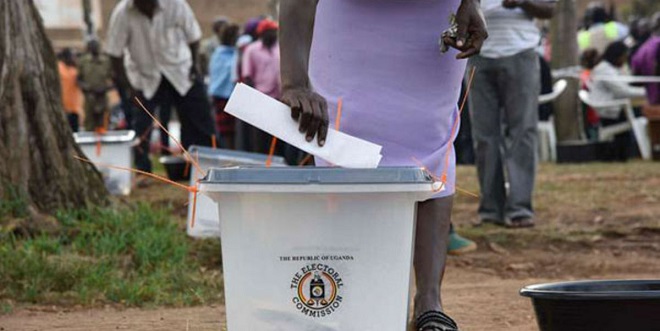
Byabakama, yesterday announced that the electoral body will create new polling stations across the country
As the road to 2026 starts to bend, the chairperson of the Electoral Commission (EC), Simon Byabakama, yesterday announced that the electoral body will create new polling stations across the country.
Byabakama explained that this move will ease the voting process in light of the expected increase in the number of voters from 18 million during the 2021 general polls to over 22 million.
"If you look at the trend since we started having elections in 1996, the voter population continues to grow," he told journalists during a media interaction at Royal Suites Hotel in Bugolobi, Kampala. A preliminary census report indicated that nearly half of the 45.9 million Ugandans will be eligible to vote in 2026.
"By the time we come to 2026, some of these will have turned 18 years, necessitating the EC to create more polling stations," Byabakama said.
Number of Polling Stations
Although Byabakama did not provide exact figures, a simple calculation by EC officials indicates that an additional 5,000 polling stations will be created to cater to the 4.7 million people who will turn 18 years ahead of the 2026 polls.
According to EC guidelines on general elections, a polling station should ideally not exceed 900 voters in rural areas and 1,000 in urban areas.
In the last election, there were 34,684 polling stations and 18.1 million voters. This means there could be close to 40,000 polling stations by the time the country gets into the 2026 elections.
According to Peter Walubiri, a member of the Uganda People’s Congress (UPC) breakaway faction, the creation of new polling stations is a good move under ideal circumstances because it will enable more Ugandans to vote.
"Ordinarily, there would be no big issue because access to polling stations impacts how easily people can vote and exercise their rights. But we are dealing with a situation where the commission is not independent," he said.
"So the creation of the polling stations will be marred by trickery and controversy. It could also be used to disenfranchise some voters. They can create a new polling station and, without giving notice, transfer you to one of the new distant stations. They can also use it to create ghost stations," he added.
Walubiri alleged that in 2001, the random creation of new polling stations was abused.
"When I was a campaign agent of Winnie Byanyima, former Mbarara Municipality MP, we found that they had created a polling station in a eucalyptus forest in Mbarara in 2001. So, I can’t put it beyond them to create fictitious polling stations in the name of ensuring the population gets a place to vote," he said.
However, Waiswa Mufumbiro, the deputy spokesperson for the National Unity Party (NUP), and Dr. Swaibu Nsereko, the spokesperson for JEEMA, called for stakeholder engagement before the new polling stations are created.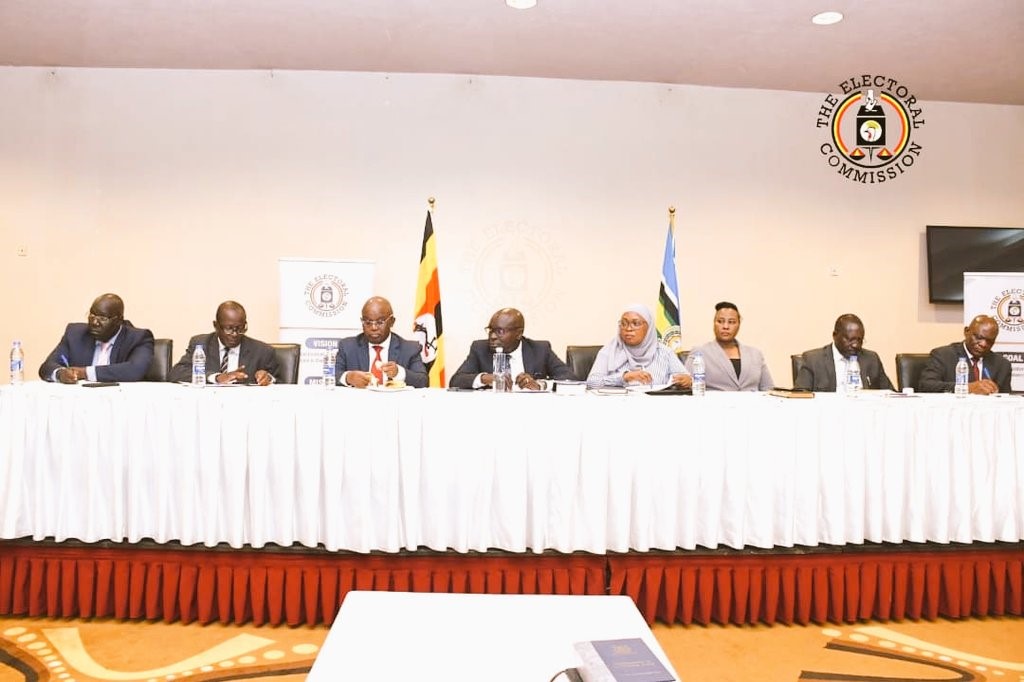
The Chairperson of the Electoral Commission Justice Byabakama Mugenyi Simon together with the entire Commission members interacting with the media
Stakeholder Engagement
According to Nsereko, this will help make necessary adjustments.
"Taking into consideration the demographics that have changed since the last electoral exercise, we welcome stakeholder engagement. However, it should not be about that alone but also include electoral reforms," he said.
"We should not limit ourselves only to demographics, but also push for other interventions that help smooth the electoral processes in the country," he added.
Mufumbiro said they would welcome the creation of new polling stations as long as they are not ghost creations.
Revised Election Roadmap
At the event, Byabakama also announced that the EC will unveil a revised electoral roadmap in the next few months to enable the country to hold what he described as “free and fair elections in a tranquil environment.” The EC chief also warned Ugandans against violence. "When violence is perpetrated, or the threat of it escalates, it causes fear in the hearts and minds of some people, which may result in some voters staying away from the polls," he said. "We need to refrain from all acts of violence, whether physical or verbal. We need to build a culture of respect for the rule of law and follow guidelines issued by the Electoral Commission," he added. On the commercialization of politics, Byabakama called for the enactment of laws and regulations to control how much each political party and individual can spend during campaigns to level the playing field for all contenders.
According to the roadmap released last year, the general update of voters’ registers in each parish is expected to run from January 3 to 24, 2025, while the nomination of candidates at both national and local government levels is scheduled from July 14 to December 12, 2025. The nomination of presidential candidates is fixed for October 2-3, 2025. According to the same roadmap, the polling day for presidential, parliamentary, and local government councils is fixed for January 12 and February 12, 2026. Additionally, the deadline for the resignation of public servants intending to contest is June 13 to August 3, 2025.
New Political Parties
On the registration of new political parties, Byabakama said seven political parties have applied to be registered.
These include the National Economic and Redemption Party (NERP), the National Foundation Party (NFP), National Revival Coalition (NRC), National Agrarian Party (NAP), People Power Front (PPF), Shine Uganda (SU), and Uganda Prosperity Party (UPP).
In one of his letters to these new parties, the secretary of the Electoral Commission, Jacques Leonard Mulekwah, said on March 28 that returning officers and regional election officers should permit promoters of these parties to collect signatures as they embark on the registration journey.
Torch Media Africa



