Written By | Health News Agencies
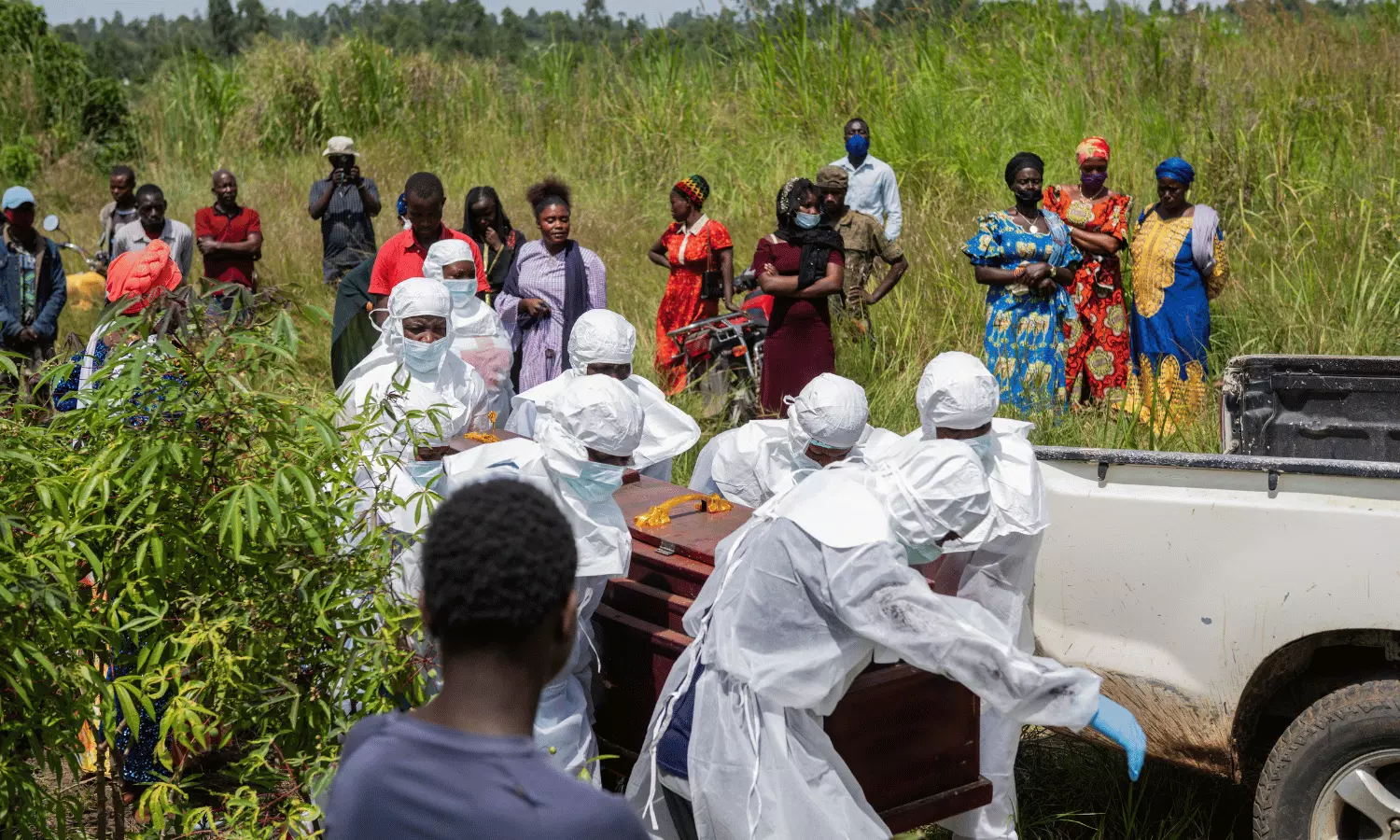
More than 1,600 people are now dead in a Central African epidemic that has spread faster than any Ebola outbreak ever recorded — and the world has barely noticed.
BENI, Democratic Republic of Congo
In the dense, conflict-scarred hills of eastern Congo's Ituri province, a virus with almost no name recognition and no approved vaccine has done something no strain of Ebola has ever managed before: it has outrun every containment effort thrown at it. As of this week, the Democratic Republic of Congo's Ministry of Health has confirmed 3,442 cases and 1,521 deaths — a staggering 50 percent jump in fatalities in just the past seven days alone. Aid workers on the ground say the true toll is almost certainly higher, buried in villages the response teams still haven't reached, and hospital wards that are recording deaths faster than they can be logged into the national system.
The Fastest-Spreading Outbreak Ever Recorded
When the outbreak was first confirmed on May 15, 2026, it looked like a containable flare-up — a handful of cases in a remote corner of Ituri province, the kind of localized event that has struck the region before and been stamped out within months. Eleven weeks later, it has become the third-largest Ebola outbreak since the virus was first identified in 1976, trailing only the catastrophic 2014-2016 West African epidemic and the 2018-2020 outbreak that struck this same corner of Congo. What sets this one apart isn't its eventual size — it's the speed. The World Health Organization declared it a Public Health Emergency of International Concern on May 16, just one day after confirmation, one of the fastest such declarations in the agency's history for an Ebola event.
By July 9, Africa CDC was already warning of the "fastest-growing Ebola outbreak ever" as the death toll crossed 600. Three weeks later, on July 30, Congolese officials announced the toll had passed 1,500. The trajectory has stunned even veteran outbreak responders who cut their teeth on the brutal 2018-2020 epidemic in the same region, which took nearly two years to reach a similar death count. This time, the virus got there in under three months.
A Rare and Ruthless Strain
Part of what makes this outbreak so frightening is the specific culprit behind it: the Bundibugyo ebolavirus, the rarest of the four species known to sicken humans. Unlike the more familiar Zaire strain — the target of the two FDA-approved Ebola vaccines, Ervebo and the Zabdeno/Mvabea two-dose regimen — Bundibugyo has no licensed vaccine and no approved treatment anywhere in the world. That means the tools that helped bring earlier outbreaks under control, including the ring-vaccination strategy credited with helping end the 2018-2020 Congo epidemic, simply aren't available this time around.
Four candidate vaccines targeting the Bundibugyo strain — from the nonprofit IAVI, from Moderna, from Oxford University's ChAdOx1 platform, and from a University of Cambridge-linked program — are in various stages of development, but none are far enough along for emergency deployment. That has left health officials fighting one of the deadliest viruses on the planet with the same rudimentary tools doctors had in the 1970s: contact tracing, isolation, and supportive care. There is no antiviral silver bullet waiting in the wings this time.
Why Contact Tracing Is Losing The Race
The World Health Organization says containing an Ebola outbreak requires tracing 90 to 95 percent of an infected person's known contacts, so that anyone who was exposed can be monitored and isolated before they infect someone else. In eastern Congo, responders are currently reaching just 78.3 percent of contacts — a gap that, with a virus this contagious, translates directly into new, invisible chains of transmission the response teams don't even know exist yet.
Africa CDC has pointed to a familiar and painful list of obstacles: armed conflict that renders large swaths of Ituri province physically inaccessible to health teams, deep community mistrust built up over years of instability and misinformation campaigns, and a healthcare system stretched far past its breaking point. Nearly 90 percent of confirmed cases remain concentrated in Ituri province, but the virus has now been confirmed across 48 separate health zones spanning five provinces — a geographic spread that makes coordinated containment exponentially harder. Cases also appeared in neighboring Uganda, where 20 people were infected and two died, before the country was formally declared Ebola-free again in mid-June.
A Region That Has Buried Too Many Already
This is not eastern Congo's first brush with catastrophe. The same general region endured the 2018-2020 Ebola epidemic, which killed roughly 2,300 people over nearly two years and was, until now, considered the deadliest sustained outbreak the area had ever survived. That epidemic played out against a backdrop of armed conflict and community distrust eerily similar to what responders are contending with today — health workers were attacked, treatment centers were burned, and rumors that Ebola was a fabrication invented by outsiders spread almost as fast as the virus itself.
Those same fault lines have reopened this time, only faster. Decades of instability in Ituri and neighboring provinces have left large stretches of territory controlled by armed militias, some of which actively block humanitarian access. Aid convoys have been rerouted, delayed, or turned back entirely, and several health zones remain effectively unreachable by road. Responders who lived through the 2018-2020 epidemic say the on-the-ground obstacles feel almost identical — except this time, the virus is moving roughly twice as fast.
The Global Ripple Effect
For the first time in years, this Ebola outbreak has crossed continents. A U.S. citizen infected in the outbreak zone was medically evacuated to Germany for treatment earlier this summer, and on June 24 France's Ministry of Health confirmed a second imported case, also linked to travel from the affected region. Neither incident triggered local transmission outside Africa, but both were enough to prompt the U.S. government to keep in place a travel restriction — first issued in the spring and repeatedly renewed, most recently on July 13 — suspending entry for foreign nationals who have recently traveled through the outbreak zone.
The CDC has activated its Emergency Operations Center and issued a Health Alert Network advisory instructing American clinicians to consider Ebola in any patient presenting with fever and a relevant travel history, however statistically unlikely that scenario might be for an emergency room in Ohio or Texas. Airports and border crossings across the region have also stepped up symptom screening for travelers heading toward or away from the affected provinces, and several international airlines have adjusted routing and layover policies for flights connecting through Central African hubs.
The European Centre for Disease Prevention and Control has likewise been tracking the outbreak closely, publishing regular risk assessments for EU member states even as it maintains that the likelihood of sustained transmission within Europe remains low so long as imported cases continue to be identified and isolated quickly, as they have been so far in both Germany and France.
Expert Perspective
Public health leaders have been unusually blunt about how badly this outbreak is going. Africa CDC's leadership has publicly acknowledged that the outbreak "continues to outpace the response," a rare admission from an agency built to project confidence during health emergencies. WHO officials in Geneva have echoed the alarm, noting that international funding pledges have not kept pace with need even after Africa CDC secured a $319 million emergency response budget earlier this year.
Doctors Without Borders, which has deployed treatment units across Ituri province, describes teams working in extraordinarily difficult conditions: makeshift isolation wards in areas without reliable electricity or clean water, staff facing threats and intimidation from armed groups, and community health workers going door to door in villages where some residents still don't believe Ebola is real. Field coordinators with the organization have said plainly that every week the response fails to get ahead of transmission, more people who didn't have to die will die — a sentiment echoed in nearly every situation report issued since the outbreak was declared in May.
What This Means For You
For most people outside Central Africa, the personal risk from this outbreak remains extremely low. Ebola requires close contact with the bodily fluids of a symptomatic or deceased person — it does not spread through the air the way viruses like COVID-19 or influenza do. There is no evidence of sustained transmission anywhere outside DRC and Uganda, and both imported cases, in Germany and France, were contained without any further spread to close contacts or healthcare workers.
That said, health officials are urging heightened awareness for anyone with travel plans to the region, and the CDC advisory to U.S. clinicians reflects standard, sensible precaution rather than a signal of imminent domestic risk. If you or someone you know has recently traveled to eastern DRC or the affected areas of Uganda and develops a fever, the guidance is unambiguous: seek medical attention immediately and disclose the travel history before being examined, so health workers can take appropriate protective precautions from the very first point of contact.
Conclusion
Eleven weeks in, this outbreak has already claimed more lives than most Ebola epidemics manage across their entire lifespan, and there is no clear end in sight. The absence of an approved vaccine for the Bundibugyo strain has turned what should be a containable regional crisis into a grim numbers game, one where progress is measured in how many more health zones can be reached before the virus gets there first. Vaccine developers are racing to advance their candidates through emergency pathways, and international funding is finally beginning to scale up to match the emergency designation WHO issued back in May.
But for the families in Ituri province burying loved ones this week, that help is arriving in a place still very much on fire. Until a vaccine reaches the field or contact tracing finally catches up with transmission, the grim arithmetic of this outbreak — a 50 percent jump in deaths in a single week — is likely to keep climbing before it slows down.



