Tbilisi, Georgia
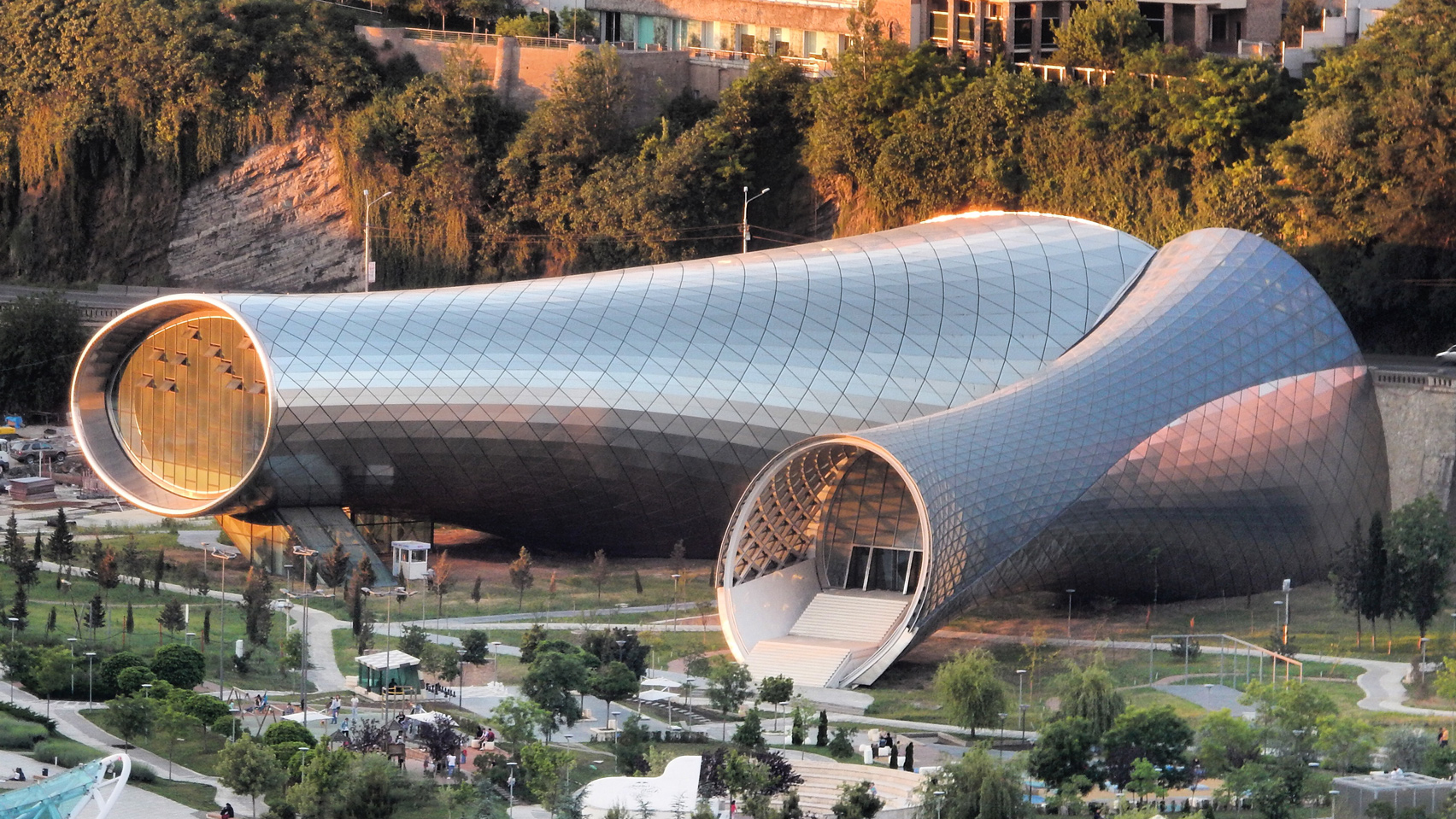
Some buildings fail after opening night. The Rike Concert Hall in Tbilisi never got one. Completed in 2012 at a cost of roughly 40 million euros, the Italian firm Studio Fuksas's soaring twin-tube concert hall and exhibition complex has sat empty on the banks of the Kura River for nearly a decade and a half — a finished, functioning, never-used building, and now, as of early August, an active demolition site. It is one of architecture's stranger and sadder stories: a structure built to open a country up to the world, quietly erased before most people ever got to see inside it.
On July 13, Tbilisi's city architecture department granted formal permission for the demolition of the Rike Park Music Theatre & Exhibition Hall complex, giving the property owner until December 25 to fully remove it. Work began in early August, and by the time this piece publishes, machinery has already started tearing into a building whose sinuous steel-and-glass form once symbolized something much bigger than a concert venue: an entire country's bid to reinvent its image on the world stage.
A Building Born From Politics — and Buried By Them
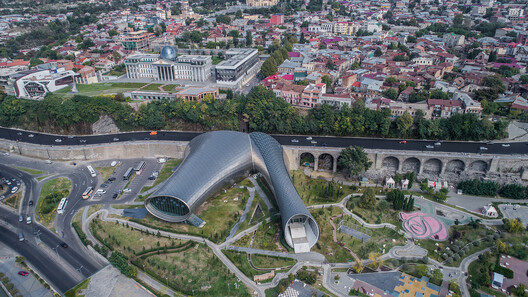
To understand why a 10,000-square-metre concert hall never opened, you have to understand the politics that built it. The Rike complex was commissioned under President Mikheil Saakashvili's government, part of a wave of ambitious, internationally designed public architecture meant to signal Georgia's pivot toward the West after the 2008 war with Russia — glassy, futuristic buildings scattered across Tbilisi as physical proof of a modernizing, outward-looking nation. Studio Fuksas's design, two soft, tubular structures wrapped in steel and glass rising above Rike Park, was arguably the most visually ambitious of that era's projects: an unmistakable, almost biomorphic silhouette meant to read as a symbol of the new Georgia from across the river.
Then the government changed. Saakashvili's party lost power in 2012, the same year the building was completed, and the incoming administration had little interest in finishing or funding a project so closely associated with its political predecessor. The concert hall sat structurally complete but functionally abandoned — no interior fit-out, no operating budget, no path to opening — for the next fourteen years, an increasingly awkward landmark that neither side of Georgia's political divide seemed to want to claim, repair, or formally kill off. Until now.
Critics of the current demolition decision have pointed to the timing and framing of the move: Georgia's government in 2026 has been widely described in international press coverage as pro-Russian in its orientation, a marked reversal from the pro-Western posture that originally commissioned the building. Tearing down one of the clearest physical symbols of the earlier era's Western alignment, several commentators have noted, carries a political charge that goes well beyond a routine real-estate decision about an underused building.
The Architects Fight Back
Studio Fuksas has not gone quietly. In a statement issued to the design press, the firm said it had spent the past year trying repeatedly to reach Tbilisi officials and the building's owners to discuss alternatives to demolition, without success. "Over the past months, the studio repeatedly offered to work with the Georgian authorities to explore alternative solutions that could preserve and repurpose this iconic building, avoiding what we believe would be a premature and irreversible demolition," the firm said.
The architects' core argument is a familiar one in preservation fights, but with an unusually strong financial logic behind it: the building was constructed with public money, and demolishing it will require spending more public money, rather than investing that money in adapting a structure that already exists. "Tbilisi still has the opportunity to transform an unfinished project into a symbol of regeneration, innovation, and international openness," the firm urged. "Let this opportunity not be wasted."
That argument has found some sympathy among architecture critics and Italian cultural voices, who have described the demolition as a "significant cultural setback" — not just for Tbilisi, but for the broader idea that ambitious, publicly funded architecture can survive a change in political weather. Losing the Rike Concert Hall means losing a rare large-scale, publicly accessible venue for classical music and contemporary art in a city that doesn't have many equivalents, regardless of who originally commissioned it or why.

A Familiar Story With a Twist
Never-opened buildings and abandoned "ghost" architecture are not new territory for design writers — most cities have at least one high-ambition project that stalled out before completion. What makes Rike unusual is that the building was actually finished. This isn't a half-built skeleton or a foundation slab left to weeds; it's a complete, weatherproofed, structurally sound piece of architecture that simply never crossed the final threshold into use, undone entirely by the accident of who happened to be in power when the ribbon-cutting was supposed to happen.
That distinction is part of why the story has resonated so strongly in architecture circles this summer. A half-finished building can be written off as a failed plan. A finished one being torn down unused reads instead as a decision — a choice about what a city wants to remember and what it would rather bulldoze, quite literally, out of view.
What This Means for You
You don't need to care about Georgian politics to find something worth thinking about here. The Rike Concert Hall is a stark case study in a question that comes up again and again in cities everywhere, including your own: what happens to expensive, ambitious public buildings when the people who championed them lose power, and who gets to decide whether an unused structure is a waste worth cutting loose or an asset worth fighting to save? It's a question with real relevance well beyond Tbilisi, as cities worldwide sit on aging civic architecture nobody has quite decided what to do with.
Conclusion
Barring a last-minute reversal, the Rike Concert Hall will be gone by Christmas, its steel tubes and glass skin reduced to rubble on a riverbank where, for fourteen years, it stood as proof that a building doesn't need to open its doors to say something about the country that built it. Whether that final statement is one of resilience or of erasure now depends entirely on what — if anything — Tbilisi decides to build in its place.
Published By | Features Editor