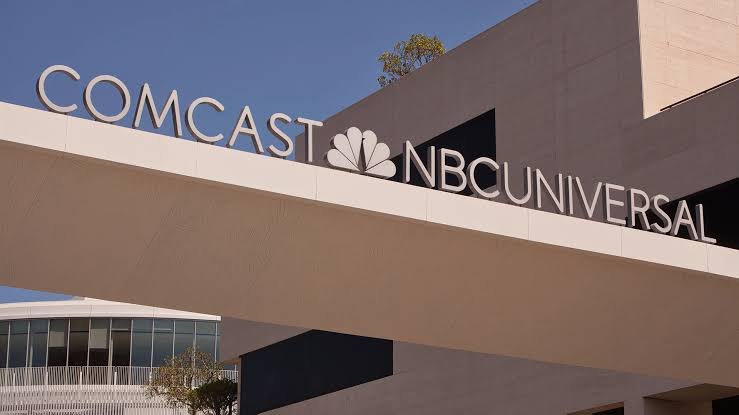
Shares jumped nearly 23% as chairman Brian Roberts unveiled plans to separate a century-old cable empire from Peacock, Universal Studios, Telemundo and the theme parks — a move reshaping the future of American entertainment.
PHILADELPHIA
The End of an Era
For more than four decades, Comcast built itself into one of the most powerful companies in American media by acquiring, bundling, and holding on. This week, it announced it's doing the opposite. Comcast confirmed plans to split into two separately traded public companies, spinning off NBCUniversal — along with British broadcaster Sky — from its core broadband, wireless, and cable business.
The announcement landed like a thunderclap across the entertainment industry. Comcast shares jumped 22.8% in pre-market trading the moment the news broke, one of the sharpest single-day reactions the stock has seen in years — a sign that investors had been waiting a long time for exactly this kind of move.
What's Splitting From What
The new, spun-off NBCUniversal entity will house the company's entire entertainment portfolio: the NBC broadcast network, Spanish-language giant Telemundo, the Peacock streaming service, Universal's film and television studios, Sky, and the Universal theme parks division. Left behind in the original Comcast company will be the business most people actually pay a monthly bill to: cable, broadband, wireless, and business services.
It's a clean split along an obvious fault line that's existed inside Comcast for years — a slow-growing but cash-rich legacy pipe business on one side, and a glitzier, more volatile content and streaming business on the other. Wall Street analysts have argued for years that keeping the two bundled together was suppressing the stock's value, since investors interested in cable infrastructure and investors interested in Hollywood studios tend to be very different people with very different expectations.
Roberts Makes His Case
Comcast chairman and co-CEO Brian Roberts, whose family has controlled the company for decades, framed the split as an evolution rather than a retreat. "This is a very exciting day for our company," Roberts said. "The transaction we are announcing will unlock a more entrepreneurial management approach and open up a multitude of new opportunities for each business."
On an investor call, Roberts went further, explaining the strategic logic: "As we look ahead, it has become clear that our technology and media businesses each have compelling opportunities in front of them that are distinct in nature and best pursued with dedicated focus, strategic flexibility, and tailored investment priorities. That is why today we announced an important next step in Comcast's evolution — our plan to create two separate companies, Comcast and NBCUniversal."
He was careful to push back on the idea that this is really about softening NBCUniversal up for a sale. "This is not about separating what we've built together," Roberts said. "It's about positioning two exceptional businesses to move forward with greater focus, agility and the ability to fully capitalize on the opportunities ahead enabled by the strength of our balance sheet and cash flows." Comcast has said it will retain a stake of up to 19.9% in the new NBCUniversal for as long as a year after the spinoff completes, and Roberts himself plans to stay "actively involved in the leadership" of both companies, working alongside each one's CEO.

Not M&A Prep — Or Is It?
Comcast has publicly and repeatedly denied that the split is a prelude to a sale or merger, insisting shareholders should "absolutely not" read it that way. But industry watchers aren't entirely convinced. The move echoes Warner Bros. Discovery's own high-profile split earlier this decade, which separated its cable networks from its streaming and studio business — a maneuver that many now view, in hindsight, as a precursor to deal-making. Analysts covering the space have noted that a leaner, standalone NBCUniversal — freed from Comcast's cable baggage — becomes a considerably more digestible acquisition target or merger partner for a rival media company down the line, even if that's not the framing Comcast wants attached to this announcement.
More details on execution, timing, and leadership structure are expected when Comcast reports second-quarter earnings on the morning of July 23 — a date now circled by media reporters and Wall Street analysts alike.
What This Means for Viewers
For the average Peacock subscriber or NBC viewer, very little changes on the surface right away — the shows, the streaming app, and the cable bundle will keep functioning as they do today. But the ownership change matters over the medium term. A standalone NBCUniversal, no longer subsidized or weighed down by a slower-growing cable parent, may move faster and more aggressively on streaming pricing, content investment, and potential partnerships — for better or worse, depending on whether you're rooting for lower prices or better shows.
It's also a signal flare for the rest of the industry. If Comcast's stock pop is any indication, investors want media companies to stop being everything at once. Expect other conglomerates juggling legacy infrastructure and streaming ambitions to face fresh pressure to consider similar breakups.
A Bigger Story Than One Earnings Call
Comcast's split isn't just a corporate finance footnote — it's a marker of how thoroughly streaming has restructured the entertainment business over the last decade. The old logic of bundling cable pipes with cable content made sense when both grew together. That logic has been breaking down for years, and this week, one of the industry's largest players finally acted on it.
Whatever Comcast and NBCUniversal look like as separate companies a year from now, July 2, 2026 will likely be remembered as the day the entertainment industry's biggest hybrid conglomerate admitted the hybrid model had run its course.
Published By | Features Editor