HEALTH
A Virus Walks Into an Oncology Ward
It sounds like the setup to a horror movie: doctors deliberately injecting a strain of herpes virus into a patient's tumor. But for a growing number of advanced melanoma patients who have run out of options, that injection just became their best shot at survival.
On August 6, 2026, the U.S. Food and Drug Administration granted accelerated approval to Tudriqev — known by its clinical name vusolimogene oderparepvec-wtpg, and to the scientists who spent a decade building it, simply as RP1. Made by Massachusetts biotech Replimune Group, the drug is a genetically modified version of herpes simplex virus type 1, the same family of virus responsible for cold sores. Stripped of the genes that let it cause disease and rewired to hunt cancer cells instead, it is now approved in combination with the blockbuster immunotherapy nivolumab (sold as Opdivo) for adults with unresectable advanced cutaneous melanoma whose cancer kept growing even after standard PD-1 immunotherapy failed them.
For a disease that kills roughly 8,000 Americans a year and where treatment options shrink fast once frontline immunotherapy stops working, the approval landed like a lifeline. It also capped one of the most dramatic comeback stories in recent FDA history — a drug that regulators rejected not once, but twice, before finally waving it through.
Third Time's the Charm: Inside the Rejection Saga
Replimune's road to approval was anything but smooth. The company first sought clearance for RP1 in mid-2025, only to be hit with a Complete Response Letter — FDA-speak for rejection — in which agency reviewers wrote bluntly that they "would not recommend" approval based on the single-arm trial data the company had submitted. Their core objection: without a comparator arm, there was no clean way to prove how much of the drug's effect came from RP1 itself versus nivolumab, which was already an approved cancer therapy on its own. Regulators also raised a more unusual concern given the drug's mechanism — because RP1 is injected directly into a visible tumor, could it really be trusted to work throughout the whole body, including on cancer that had spread to organs the needle never touched?
A second rejection followed. For a smaller biotech with a single lead product, two strikes from the FDA is often a company-ending event. Replimune's stock cratered, and industry watchers openly speculated whether RP1 was dead. Instead, the company went back to its data, refined its argument, and filed a third resubmission. The FDA accepted it, setting a new target decision date of August 2, 2026.
The turning point came at a public FDA advisory committee meeting, where outside experts reviewed the same data that had twice failed to convince agency staff. Despite reviewers again flagging concerns about the single-arm design, the committee voted 10 to 3 in favor of the drug's benefit-risk profile — a rare rebuke of the FDA's own internal skepticism, and a signal of how much unmet need there is among patients whose melanoma has stopped responding to everything else. Four days later, the accelerated approval came through, granted alongside the agency's Breakthrough Therapy and Priority Review designations that had been attached to the drug for years.
How a Cold-Sore Virus Learns to Hunt Cancer
The science behind Tudriqev reads like something out of a biohacking thriller, but it's grounded in more than a decade of oncolytic virus research. Scientists started with a proprietary strain of herpes simplex virus type 1 (HSV-1) — the virus responsible for the vast majority of oral cold sores in the general population — and deleted two of its genes, known as ICP34.5 and ICP47.
Removing ICP34.5 cripples the virus's ability to replicate in healthy cells while leaving its ability to multiply inside cancer cells largely intact, because tumor cells have quirks in their internal machinery that the crippled virus can still exploit. Removing ICP47 knocks out a viral trick that normally helps herpes hide from the immune system, which — inside a tumor — becomes a feature rather than a bug: it allows infected cancer cells to display more of their internal proteins on their surface, essentially raising a flag that tells nearby immune cells where to attack.
Engineers then added two more components to the stripped-down virus. The first is a fusogenic protein borrowed from a different virus that helps infected tumor cells fuse together and die more efficiently. The second is a gene for human GM-CSF, an immune-signaling protein that recruits and activates dendritic cells — the immune system's foot soldiers responsible for teaching T-cells what to attack.
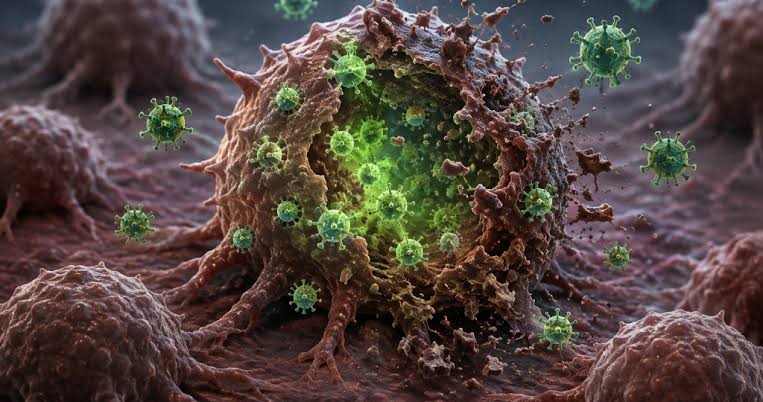
Injected straight into an accessible tumor, the modified virus replicates almost exclusively inside cancer cells, causing them to rupture in a process called lysis. That rupture spills tumor antigens, viral particles, and inflammatory signals into the surrounding tissue, waking up the immune system not just at the injection site but, in a meaningful subset of patients, at tumor sites the needle never reached — a phenomenon researchers call the abscopal effect. Paired with nivolumab, which releases the brakes the immune system normally puts on itself, the combination is designed to turn a single injected tumor into a training ground for a body-wide immune attack.

The Numbers Behind the Approval
The approval rests on data from the IGNYTE trial, an open-label, single-arm study that enrolled 140 adults with Stage IIIB, IIIC, or IV unresectable melanoma who had already progressed after at least eight consecutive weeks on a PD-1-blocking drug. Of those, 91 patients who had at least one tumor that wasn't directly injected were used to measure whether the treatment's effects extended beyond the needle.
In that efficacy-evaluable group, 24.2% of patients saw their cancer measurably shrink — a response rate that might sound modest next to headline cancer-drug numbers, but that clinicians stress needs to be read in context: these were patients who had already failed the best available immunotherapy and had few remaining options. More striking to many oncologists was the durability: the median duration of response was 14.1 months, with the upper bound of that estimate not yet reached at the time of the FDA filing, meaning a meaningful share of responders were still benefiting from the drug well over a year later.
The Price Tag Problem
Access is where the celebration gets complicated. Replimune has set the list price of Tudriqev at $450,000 for a full course of treatment, before any rebates or insurance negotiations — and that figure can climb depending on how many injection cycles a patient's tumor burden requires. For a country already wrestling with cancer-drug affordability, a single-therapy price tag north of a family home's median value is likely to reignite familiar fights over insurance coverage, prior authorization delays, and out-of-pocket exposure for patients who often have precious little time to spare.
Replimune executives have pointed to the drug's Breakthrough Therapy and accelerated approval status as evidence regulators recognize an urgent, underserved need — an argument that tends to carry more weight with prescribers than with the insurers who ultimately decide what patients can actually access.
The Fine Print: An Approval With Homework Attached
Because Tudriqev was cleared through the FDA's accelerated approval pathway — reserved for serious conditions where a drug shows promising early results before its full clinical benefit is confirmed — its continued availability isn't guaranteed. Replimune is required to complete a confirmatory Phase 3 trial called IGNYTE-3, which is randomizing roughly 400 patients to either RP1 plus nivolumab or a physician's choice of alternative therapy, a design specifically built to answer the comparator-arm question that sank the drug's first two submissions.
That trial's data isn't expected until 2030, meaning Tudriqev will spend the next several years on the market on a kind of probation: available to patients now, but with its long-term future contingent on results that are still years away. If the confirmatory trial disappoints, accelerated approvals can be — and occasionally have been — withdrawn.
What Doctors Are Saying
Oncologists who treat advanced melanoma have largely welcomed the approval, framing it less as a miracle cure than as a genuinely new tool in a treatment landscape that had gone stagnant for patients who fail PD-1 therapy. Unlike most systemic cancer drugs, RP1's local-injection mechanism gives physicians a way to directly target and shrink accessible tumors — often useful for painful or disfiguring skin and lymph node lesions — while hoping for a broader immune spillover effect elsewhere in the body.
That dual promise is also why the FDA's advisory committee ultimately sided with patients over its own reviewers' statistical caution: for a population with few remaining options and a fast-moving disease, a 24% response rate with over a year of durability in many responders was judged meaningful enough to make available now rather than wait years for a comparator trial to read out.
What This Means for You
If you or someone you love is living with advanced melanoma that has stopped responding to PD-1 immunotherapy such as pembrolizumab or nivolumab alone, Tudriqev in combination with nivolumab is now a legitimate option worth raising with your oncologist — particularly if you have tumors that are accessible for direct injection, such as skin, soft tissue, or superficial lymph node lesions.
Because it is newly approved and carries an eye-watering list price, patients should expect insurance friction: prior authorization requirements, possible step-therapy demands, and a real conversation with your care team's financial counselors about manufacturer assistance programs before treatment begins. It's also worth asking your doctor directly about the accelerated approval status and what it means — this is a drug available today on genuinely promising but not yet fully confirmed evidence, and understanding that distinction matters when weighing it against other options like clinical trial enrollment.
For the broader public, the approval is also a reminder of how far cancer immunotherapy has traveled from the crude chemotherapy era. Deliberately infecting a tumor with an engineered virus to provoke the body's own immune system into fighting cancer would have sounded like science fiction twenty years ago. Tudriqev is only the second oncolytic virus therapy ever approved for cancer in the United States, following talimogene laherparepvec (Imlygic) in 2015 — meaning an entire new drug class is only now beginning to mature.
The Bottom Line
Tudriqev's approval is a genuine milestone: a twice-rejected drug that clawed its way back through better data packaging and vocal expert backing, built on a wild bit of biology that turns a cold sore virus into a cancer-hunting weapon. But it arrives with real caveats — a response rate still under 25%, a six-figure price tag, and a confirmatory trial that won't finish until the next decade.
For melanoma patients out of other options, that combination of promise and uncertainty may be an easy trade to make. For the health system paying the bill, the real test of whether this virus earns a permanent place in oncology is still years away.
Published By | Features Editor