NAIROBI
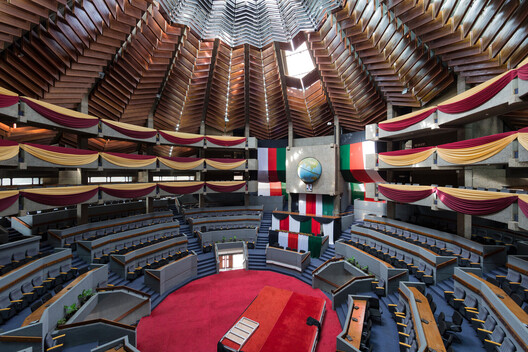
Four days from now, the Kenyatta International Convention Centre — Nairobi's 1970s modernist landmark, the one on the back of the thousand-shilling note — will open its doors to something the architecture world has never had: a biennale of African spatial practice, curated from within Africa, staged in an African city, answering to nobody in Venice.
The inaugural Pan-African Biennale runs September 7 to 11. It has been three years in the making, it was announced to a certain amount of scepticism, and it is now, by any measure, happening.
Its founder and artistic director, the Somali-Italian architect Omar Degan, has been unusually direct about what it is for. "The Pan-African Biennale does not seek to correct exclusion from within existing frameworks," he said in announcing the official selection. "It establishes a new one, one in which Africa is the author of its own spatial knowledge, its own architectural discourse, its own futures." And then the line that has been quoted everywhere since: "The center has always been here."
The rule that changes everything
The structural decision that distinguishes this biennale from every other is deceptively small. Every pavilion gets equal space, regardless of the size or wealth of the country it represents. Nigeria — 230 million people, the continent's largest economy — will occupy exactly the same footprint as Botswana. Or the Seychelles. Or São Tomé and Príncipe.
Anyone who has walked the Giardini in Venice understands why this is radical. There, national pavilion size is a fossil record of early twentieth-century geopolitics: the countries that were powerful in 1907 have the grand permanent buildings, and everyone else is distributed through the Arsenale and the city according to what they can afford. Prestige is architecture, literally.
Nairobi has thrown that out. The effect on the floorplan is that a two-person studio from Lesotho is given the same platform as an established Nigerian practice — and the visitor, walking through, receives no cue about which country's economy is larger. It is a curatorial argument disguised as a floor plan.
Three strands, fifty-four nations
The inaugural edition carries the theme "Shifting the Center: From Fragility to Resilience," and it is organised through three thematic strands: Land Under Pressure, which addresses climate change; Inherited Knowledge, which addresses vernacular intelligence; and Worlds to Come, which addresses African futures.
The framing is pointed. African cities are routinely described in global development literature as fragile — a word that carries a whole worldview inside it. The biennale's proposition is that those same cities are sites of knowledge production on precisely the questions the rest of the world is now scrambling to answer: how to build in extreme heat, how to house displaced populations, how to construct without cheap carbon, how to urbanise at speed without collapse.
The confirmed selection spans architects, studios, research collectives and material practitioners from across the continent, with contributions from more than thirty countries already named and further participants, keynote speakers and contributors still being announced. Among them: Djamel Klouche of Algeria; Banga Coletivo of Angola; the Benin-based team of Larry Tchogninou, Olufemi Hinson Yovo and Armel Sagbohan; Cape Verde's Ramos Castellano Arquitectos; Ghana's Hive Earth, known for rammed-earth construction; Association La Voûte Nubienne, which has spent decades reviving vaulted earthen roofing across the Sahel; Egypt's Megawra–BEC; Raas Architects; MASS Design Group; Design Without Borders; and practitioners including Aboubakar Fofana, Nu Goteh, Daar Studio and Lemon Pebble.
Contributors have been confirmed from Comoros, Djibouti, Equatorial Guinea, Eritrea, Eswatini, Gabon, Gambia, Guinea, Guinea-Bissau, Ivory Coast, Lesotho, Libya, Madagascar, Malawi, Mauritania, Mauritius, Morocco, Namibia, Nigeria, Senegal, Seychelles, South Sudan, Sudan, São Tomé and Príncipe, Togo, Tunisia, Zambia and Zimbabwe — a roster that reaches deliberately into countries that have never had an architectural platform of this visibility.
Built to last longer than one week
The most consequential detail is the least glamorous. The Pan-African Biennale is registered in Kigali and operates as an independent institution, not as an event. It is designed to rotate between African cities every two years, and its remit combines exhibitions with publications, public programming and archival production.
That archival ambition is the real bet. African architecture's persistent structural problem has never been a shortage of good buildings; it has been a shortage of documentation, publication and canon-formation controlled from the continent. Projects get built, photographed once, and then exist mainly in the archives of European journals or not at all. An institution that publishes and archives continuously, rather than one that mounts a show and disperses, is aimed squarely at that gap.
Nairobi is the first edition of what is intended to become a recurring continental fixture. Where it goes in 2028 has not been announced.
Why this should matter to you
If you are not an architect, the temptation is to file this under professional news. That would be a mistake, for a straightforward reason: the problems this biennale is organised around are arriving everywhere.
Passive cooling in buildings designed before air conditioning. Load-bearing earth construction with a fraction of concrete's carbon cost. Housing typologies that absorb rapid population growth without producing slums. Water capture at the scale of a building rather than a city. These are not regional curiosities; they are the exact techniques European and North American practices are now trying to retrofit into their own work as energy costs rise and building codes tighten. The difference is that on this continent they are not experiments. They are in use.
Whether Nairobi becomes the venue where that knowledge finally gets published on its own terms is the thing worth watching next week — and it will not be decided by the opening ceremony. It will be decided by whether anyone is still publishing in 2030.
Degan's own framing suggests he knows it. "This is not just about architecture," he has said of the project. "It is about who gets to define the future."
Published By | Features Editor