NEW YORK
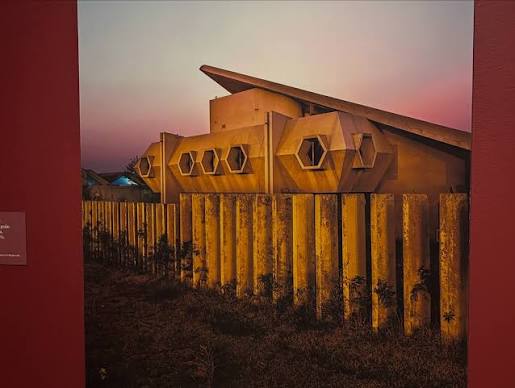
Walk through the Museum of Modern Art's Architecture and Design galleries this summer and you'll encounter a version of the twentieth century that most design history has quietly skipped over: soaring concrete parliament buildings in Accra, university campuses in Lagos, cultural centers in Dakar — structures that weren't imitating European modernism so much as reprogramming it entirely, in service of nations that had just fought their way to self-rule.
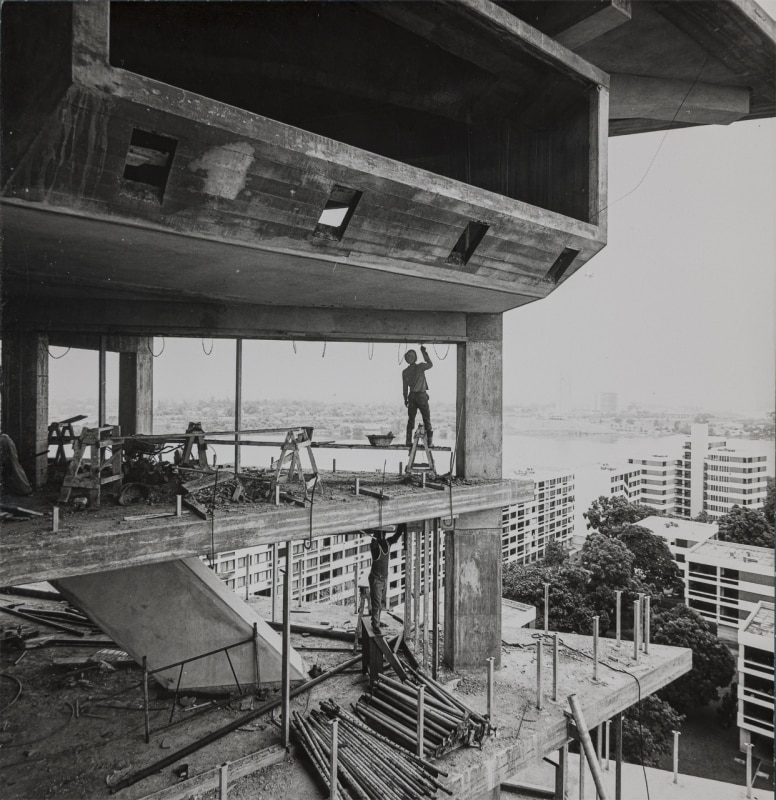
"Architects of Liberation: Modernism in Western Africa," which opened at MoMA on July 5 and runs through January 2, 2027, is the museum's most ambitious attempt yet to correct that gap. Drawing on four years of on-the-ground research across seven countries — Benin, Cameroon, Côte d'Ivoire, Ghana, Nigeria, Senegal, and Togo — the exhibition assembles roughly 450 drawings, models, photographs, and archival objects to make a single, forceful argument: that modern architecture in West Africa's independence era wasn't an import to be politely absorbed, but a language its architects fundamentally rebuilt for their own political and climatic conditions.
A story architectural history left out
The exhibition covers the period from the late 1950s through the early 1980s, precisely the window in which one West African nation after another threw off colonial rule and had to answer an unglamorous but existential question: what does a newly sovereign country's government building, university, or national bank actually look like? For the architects working across the region during those decades — some trained locally, others returning from study abroad, still others arriving from Europe and elsewhere to work alongside newly empowered local governments — the answer became an architecture engaged directly with the political ideas of Pan-Africanism and "Africanization," a deliberate, visible break from colonial-era design.
Martino Stierli, MoMA's Philip Johnson Chief Curator of Architecture and Design and one of the show's organizers, has framed the exhibition as surfacing an under-examined chapter of African history at exactly the scale it deserves — not a regional footnote to global modernism, but a parallel architectural movement with its own internal logic and ambition. The show is co-organized by Ikem Stanley Okoye, guest curator and associate professor at the University of Delaware, whose scholarship on West African art and architecture — and its entangled connections to other regions shaped by colonialism — anchors the exhibition's central premise.
Notably, "Architects of Liberation" isn't a standalone project. It's the closing chapter of a triptych MoMA has been building for years, following "The Project of Independence: Architectures of Decolonization in South Asia, 1947–1985" in 2022 and "Toward a Concrete Utopia: Architecture in Yugoslavia, 1948–1980" in 2018. Taken together, the three shows represent one of the most sustained institutional efforts by a major Western museum to reframe modernism as a genuinely global, politically charged movement rather than a story that radiates outward from Europe and North America alone.
Why "self-determination" is the operative word
What separates this exhibition from a conventional survey of postcolonial architecture is its insistence that the buildings on display were themselves acts of political speech. A national assembly building wasn't simply a place to legislate — it was a visible, permanent statement to citizens and the watching world that a nation had arrived, was modern, and answered to no one but itself. University campuses, cultural centers, and civic monuments across the seven countries covered by the show were commissioned with that dual audience explicitly in mind: inward-facing symbols of new national identity, and outward-facing signals of cosmopolitan legitimacy on the international stage.
That dual purpose produced a strikingly varied architectural vocabulary rather than a single "West African modernist style." Climate-responsive design — deep overhangs, brise-soleil screening, cross-ventilation strategies suited to tropical heat — sits alongside monumental concrete forms borrowed and reworked from international modernism, alongside detailing and ornamentation drawn from regional building traditions that predate colonial contact entirely. The exhibition's curatorial team spent years in the field precisely to document work that, in many cases, exists in incomplete or scattered archives, at real risk of being lost to time, demolition, or simple institutional neglect.
A curatorial rescue mission as much as an exhibition
That preservation angle gives the show an urgency beyond typical museum programming. Much of the material on view — original drawings, models, and photographs pulled from personal and institutional archives across West Africa — has never before been exhibited outside the region, and in some cases had never been properly catalogued at all. The four-year research process functioned as much as archival rescue work as curatorial preparation, a reminder that architectural history from the Global South has often been undocumented not because it lacked significance, but because the infrastructure to preserve and study it was itself a casualty of the same colonial and postcolonial disruptions the buildings were responding to.
What this means for design-conscious readers
For anyone whose mental map of "great twentieth-century architecture" runs through Le Corbusier, Mies van der Rohe, and a handful of familiar American and European names, "Architects of Liberation" is a genuinely corrective experience. It doesn't ask visitors to add a regional footnote to an existing canon — it asks them to recognize an entirely parallel movement, developed under its own political pressures, answering its own design questions, and arguably as formally inventive as anything being built in Europe during the same decades.
The show also lands at a moment when major institutions are under increasing pressure to diversify not just whose work they exhibit, but whose historical narratives they treat as central rather than supplementary. MoMA closing out its decolonization-architecture triptych with West Africa specifically — after South Asia and Yugoslavia — suggests a deliberate, long-term institutional commitment rather than a one-off programming choice timed to a cultural moment.
The bottom line
"Architects of Liberation: Modernism in Western Africa" runs at MoMA through January 2, 2027, giving visitors nearly six months to encounter a version of architectural modernism that rewrites the assumption that the style's most ambitious ideas all originated in the West. For the seven nations whose independence-era buildings anchor the show, these structures were never just shelter — they were the built proof of sovereignty, and MoMA's exhibition finally gives them the scale of attention that proof deserves.
Sources: ArchDaily, MoMA.org, Architectural Record, e-flux, MoMA Magazine, Architect Magazine
Published By | Features Editor