George Lucas's museum opens to the public in Los Angeles on Tuesday. The building is the most divisive piece of architecture in the city — and the argument about it is only half about the architecture.
LOS ANGELES
Two nights ago, Oprah Winfrey, Spike Lee, Leonardo DiCaprio, Christopher Nolan, Robert De Niro and Kim Kardashian walked into a building that looks like a cloud deciding whether to land. On Tuesday, everyone else gets a turn.
The Lucas Museum of Narrative Art opens to the public on September 22 after more than a decade of site fights, redesigns and delays across three cities. It is a $1 billion, 11-acre campus in Exposition Park, and it is the most conspicuous new cultural building in Los Angeles since the Broad — a comparison that will come up repeatedly, and not always kindly.
The building
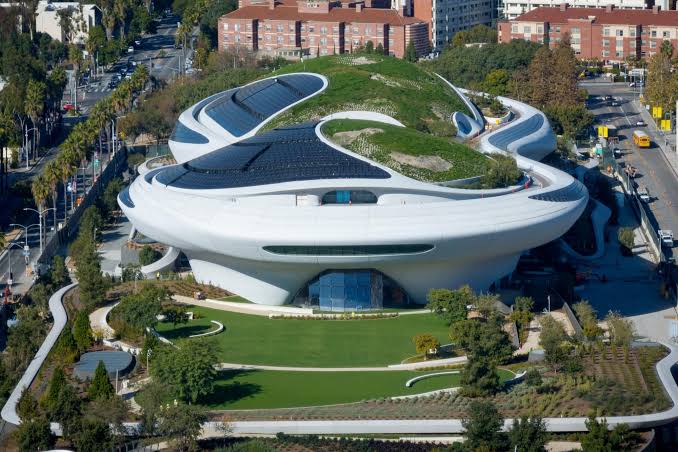
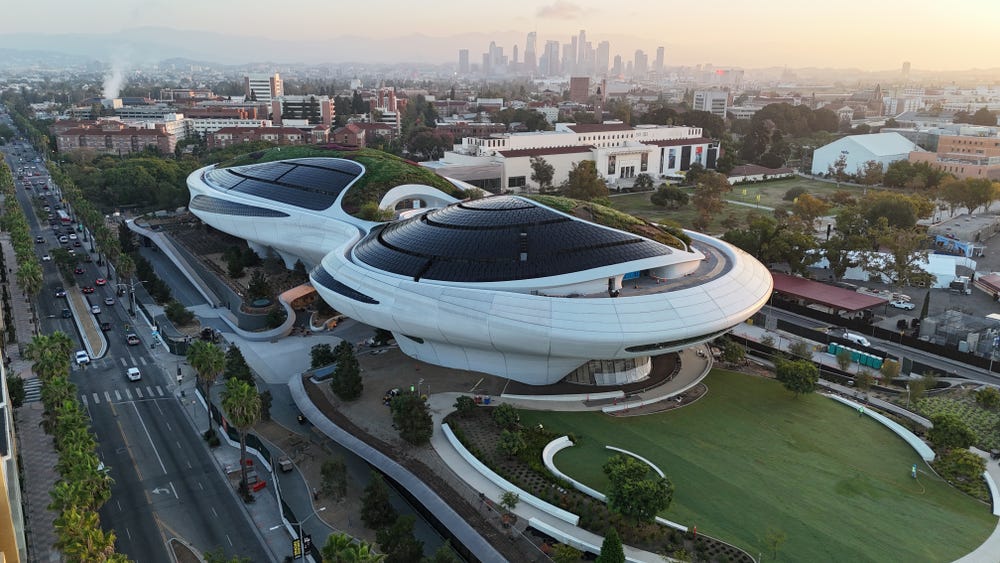
The architect is Ma Yansong of MAD Architects, working with Stantec, and the defining fact of the 300,000-square-foot structure is a negative one: it contains not a single straight line.
That is not a flourish. The curved envelope is the entire organising logic. The building lifts off the ground on a curving underbelly, so that the landscape appears to run beneath it rather than stop at a façade, and the transition between outdoors and indoors becomes gradual instead of transactional. Inside, more than 100,000 square feet of gallery space is distributed across thirty-plus galleries, alongside two theatres, a library, a restaurant, a café, retail and event spaces.
The site itself is the quiet argument in the museum's favour. The 11 acres were previously surface parking — asphalt, in a park, in a city that has very little public green space per resident. The project replaces it with new public landscape, most of which requires no ticket.
Ma has spent the run-up defending the design against a familiar charge: that an organic, swooping, unmistakably twenty-first-century silhouette dropped into a park full of Beaux-Arts and mid-century institutions is an act of ego rather than urbanism. His answer, consistently, has been that a museum devoted to narrative should not look like a vault.
What is actually inside
The collection is where the institution makes its real wager. More than 40,000 works, assembled over decades by George Lucas and his wife, the businesswoman Mellody Hobson, span illustration, painting, muralism, comic art, children's book imagery, science-fiction illustration and photography — alongside cinematic artifacts, including the Star Wars archives.
Put plainly: this is a museum that treats a Norman Rockwell, a comic panel, a picture-book spread and a production model from a 1977 film as belonging to the same conversation. That premise is the source of the second argument surrounding the opening, and it is older than the building.
Hobson has not been defensive about it. Answering critics who suggest that narrative art is insufficiently serious, she offered the line that has followed the museum through its preview coverage: if a museum of narrative art is too much like a popcorn movie and not enough like an art film, "well, we like popcorn movies in our family."
It is a good line, and it is also a real position. The hierarchy that separates illustration from fine art was constructed relatively recently and largely on the basis of where the work was published. A museum built to ignore that hierarchy is doing something intellectually defensible, whatever one thinks of the collection's individual holdings.
The price of the ticket
The sharpest criticism aimed at the opening is not about the curves or the comics. It is about $25.
That is the adult admission price. Visitors seventeen and under enter free. The number has drawn pointed comparison to Los Angeles's free institutions — the Getty Center and the Broad — and to Crystal Bridges in Arkansas, the other museum founded by an enormous private fortune with an explicitly populist collecting mission, which does not charge for its permanent collection either.
The comparison stings because of the framing the museum has chosen for itself. An institution premised on the idea that popular art deserves the same walls as canonical art invites the obvious follow-up question about whether popular audiences can get through the door. Free entry for minors is a substantive answer for families and not much of one for anyone else.
The defence is that the campus is not the galleries: the landscaped grounds, replacing a parking lot, are open to the public at no cost, and in a park-poor city that is worth something real. Whether it is worth enough will be settled by who shows up on a Tuesday in February, not by who showed up to the gala.

What it means for the city
Exposition Park has been slowly assembling itself into a genuine cultural district for years, and the Lucas Museum is the piece that makes the claim stick. For Angelenos, the practical effect is a new anchor in a part of the city that has been underserved by major institutions relative to the Westside, reachable by rail, wrapped in green space that did not exist before.
For the broader museum world, the opening is a test of a model rather than a building. Privately founded, single-vision institutions — the Broad, Crystal Bridges, and now this — are increasingly where ambitious new museum architecture happens, because public funding for it largely no longer exists. That produces spectacular buildings and concentrates enormous curatorial authority in very few hands.
The Lucas Museum is the largest and most expensive example yet, and it has chosen the most populist possible subject matter with the least populist possible price. Holding both of those things at once is the institution's central problem, and it is not one the architecture can solve.
Still, on Tuesday, a parking lot becomes a park, and a billion dollars of curved concrete opens its doors to anyone willing to pay for a ticket or walk the grounds for nothing.
For a city that has spent a century telling stories and comparatively little time exhibiting them, that is a reasonable place to start the argument.
Published By | Features Editor