The state opens its case
For twenty-one months, the prosecution of Uganda's most durable opposition figure had been a story about procedure — about which court could hear it, which lawyers could appear, and whether the accused was well enough to sit in the dock. In the last fortnight, that changed. The treason trial of Dr Kizza Besigye has moved into its evidentiary phase, and the state has begun laying out, in open court, the substance of what it says was a plot to overthrow the Government of Uganda by force of arms.
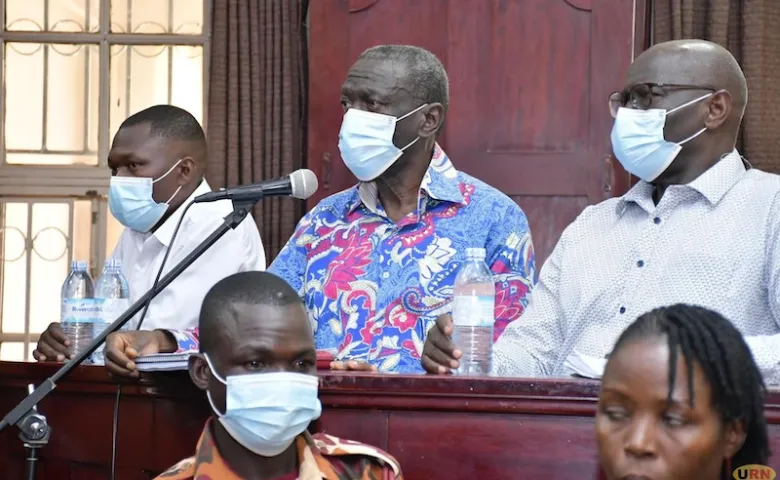
On Tuesday 1 September, the High Court's Criminal Division in Kampala reconvened before Justice Emmanuel Baguma to hear audio recordings that the prosecution says capture Dr Besigye and an American national, Andrew Wilson, discussing plans to remove the government. It was the latest sitting in a run of hearings that began in mid-August and has produced the most detailed public account yet of the allegations the state intends to prove.
Dr Besigye, a four-time presidential candidate and the man who has stood against President Yoweri Museveni more often than anyone else, is jointly charged with treason and misprision of treason alongside his long-time aide, Hajji Obeid Lutale, and Captain Denish Oyaa Oola of the Uganda People's Defence Forces, an officer attached to the Armoured Brigade. The charges carry a maximum penalty of death on conviction.
What the witness told the court
The prosecution's first witness has dominated the proceedings. Andrew Wilson, an American private security contractor who told the court he acted as an undercover informant for Ugandan security agencies, began testifying on 19 August after the court ruled that the trial could proceed in Dr Besigye's absence.
Wilson's account centres on a meeting he says took place in Geneva, Switzerland, on 28 January 2024. He told Justice Baguma that he raised the possibility that anyone serious about overthrowing the government would need to consider assassinating President Museveni, and alleged that Dr Besigye and an associate, Joel Wakayima, agreed with the suggestion.
In testimony on 27 August, Wilson went further. He said he was expected to send two men to Entebbe to monitor State House, observe the President's movements and assess the level of his security, after which they would evaluate a plan allegedly supplied by Dr Besigye — including identifying the most suitable time and location for an assassination attempt. He told the court the group was networking and preparing for an insurrection in 2025, that Kisumu in western Kenya had been identified as a training location for men who would later enter Uganda, and that the group discussed moving drones to Kisumu for training before bringing them into Uganda to launch attacks.
On 24 August, prosecutors tendered a set of videos and audio recordings from meetings held outside Uganda. Reporting from the courtroom described some of the material as indistinct, and the recordings played on 1 September were the continuation of that exercise. Separate sittings have heard Wilson's claims about proposed use of poison and explosives, and an allegation that Dr Besigye planned to circulate counterfeit currency to destabilise the economy. Under cross-examination, the court has also heard the witness concede that evidence gathered in Nairobi was lost.
None of these allegations has been tested to conclusion. Dr Besigye denies the treason charge, and his defence has not yet opened its case.

How the case got here
The prosecution's origins lie outside Uganda's borders. On 16 November 2024, Dr Besigye and Lutale travelled to Nairobi for the launch of a book by the former Kenyan justice minister Martha Karua. Armed men seized the two at a private meeting in the Kenyan capital. Dr Besigye next surfaced in Ugandan military custody, was arraigned before the General Court Martial, and was remanded to Luzira maximum security prison in Kampala. The cross-border seizure drew condemnation from human rights organisations and strained relations between Kampala and Nairobi.
The military charges — which included treachery and unlawful possession of firearms — alleged that between February 2023 and November 2024 the accused held meetings in Geneva, Athens, Nairobi and Uganda to compromise the country's security.
That prosecution collapsed as a matter of jurisdiction on 31 January 2025, when Uganda's Supreme Court, led by Chief Justice Alfonse Owiny-Dollo, declared the trial of civilians in military courts unconstitutional and ordered all such cases transferred to the ordinary courts. Dr Besigye nonetheless remained in Luzira. In February 2025 he was hospitalised after a hunger strike protesting his continued detention despite the ruling. He was subsequently charged with treason in the civilian High Court, where the case now sits.
The path to trial has been contested at every turn. The High Court dismissed a defence application to halt the proceedings and set them down for 13 July 2026. On 29 July, Dr Besigye collapsed in the dock after protesting for close to half an hour against starting the trial without his preferred counsel; he was taken to Mulago National Referral Hospital. The court had earlier assigned state lawyers to him over the defence's objection. When proceedings resumed in August, a prison official told the court he had declined to attend even virtually — an account disputed by Lutale, who said Dr Besigye had been hospitalised rather than refusing to appear.
Why it matters
The trial is unfolding against a political backdrop that gives it unusual weight. President Museveni was returned to office in January 2026 with 71.65 per cent of the vote, extending a presidency that began in 1986. The post-election period was violent: at least seven people were killed in clashes between police and opposition supporters in Butambala District, the government banned live broadcasting of riots, the Uganda Communications Commission suspended mobile internet services, and the opposition MP Muwanga Kivumbi was arrested over the Butambala unrest.
Since then the 12th Parliament has passed the Protection of Sovereignty Bill, 2026, which Human Rights Watch, ARTICLE 19 and Ugandan civil society groups say will curtail freedom of expression, association and civic participation, and which the Leader of the Opposition, Joel Ssenyonyi, has called duplicative and economically damaging. Parliament also saw a change of Speaker in May, when Anita Among lost the backing of Gen. Muhoozi Kainerugaba's Patriotic League of Uganda amid an Inspectorate of Government inquiry into her wealth, and Jacob Oboth-Oboth took the chair. Read together, these events describe a political system in which the space for organised opposition is narrowing at the same moment its most senior veteran stands trial for a capital offence.
There is also a straightforward institutional question. The Supreme Court's January 2025 ruling was one of the most consequential judgments in recent Ugandan constitutional history, and its practical meaning is being worked out in this courtroom. Dr Besigye won that ruling and remained in prison for more than four hundred days afterwards. How the High Court handles the trial — the treatment of the accused's health, the adequacy of his representation, the weight given to contested audio and the credibility of a paid informant — will shape how far the judgment is understood to have changed anything.
What to watch next
Three things will determine the trial's direction over the coming weeks. The first is cross-examination. Wilson is the state's central witness, and his testimony carries the case; the admission that Nairobi evidence was lost, and the reported poor quality of some recordings, give the defence material to work with. Whether Dr Besigye's chosen lawyers rather than court-assigned counsel conduct that cross-examination remains unsettled.
The second is the defendant's presence and health. A capital trial proceeding in the absence of the accused is legally fraught and politically combustible. Each adjournment on health grounds has slowed the case and sharpened the argument, made by his supporters and by international rights groups, that his detention is itself the point.
The third is the reaction beyond the courtroom. Dr Besigye's Nairobi seizure has already been a diplomatic irritant with Kenya, and a conviction carrying a possible death sentence would place the case squarely before Uganda's international partners at a moment when the Protection of Sovereignty Bill has already drawn scrutiny of the country's civic space.
The court is expected to continue hearing the state's evidence in the coming sittings. On the record so far, the prosecution has offered a narrative — Geneva, Kisumu, drones, surveillance of State House — but not yet a verdict on whether that narrative holds.
Published By | News Editor