Written By | Fashion and Design Desk
Cooper Hewitt's new permanent collection installation skips the timeline entirely
NEW YORK
Most museum surveys tell a story chronologically: ancient first, modern last, a tidy march through centuries. Cooper Hewitt, Smithsonian Design Museum, opened a new permanent collection installation today that deliberately throws that structure out. "Design Across Time: Exploring the Smithsonian's Design Collection," opening Friday inside the Carnegie Mansion, organizes more than 125 works not by date but by what designers were actually doing when they made them—repeating a pattern, transforming scrap into something useful, showing off technical mastery, simplifying a complex idea down to its essence.
The installation runs for an unusually long stretch—a full two years, with rotating objects throughout—and arrives as part of the Smithsonian's "Our Shared Future: 250" initiative, a system-wide push tied to the nation's upcoming 250th anniversary.
What's Actually on the Walls
The exhibition is built around six thematic clusters: Repeat, Transform, Show Off, Simplify, Tweak, and Play. Each is illustrated with objects chosen specifically because they demonstrate that creative action rather than because they fit a particular century or region.
A second-floor digital feature rounds out the installation: Alexandra Daisy Ginsberg's "The Substitute," an immersive video installation that uses AI to digitally resurrect the extinct male northern white rhino.
Why the Museum Is Doing This Now
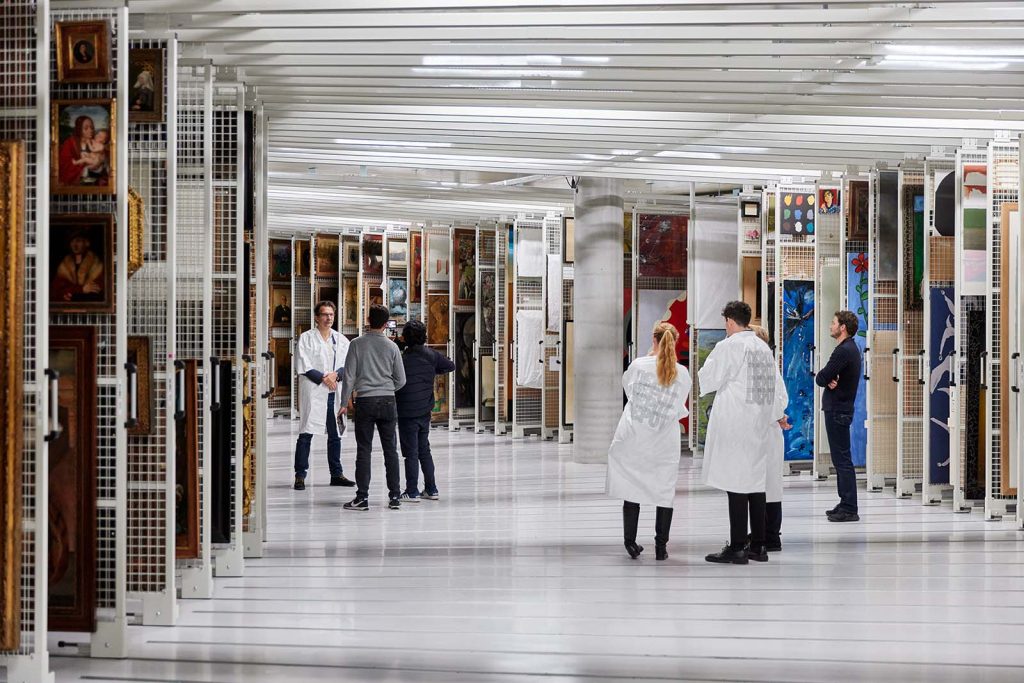
"Cooper Hewitt holds the nation's design collection, a public resource that belongs to all and that, as is common across museums worldwide, is largely kept in storage," said director Maria Nicanor. "Expanding access for all to this rich repository of ideas—at a time when creativity and design can help us navigate uncertainty and complexity—is urgent."
That framing—design as a tool for navigating uncertainty, not just a category of beautiful objects—runs through the entire installation. The show was organized by Matilda McQuaid, Susan Brown, Emily Orr, and Julie Pastor, with exhibition design by JA Projects (Jayden Ali) and graphic identity by Pacific.
The layout resists a single linear walking path, reinforcing the thematic rather than chronological premise.
The Bigger Picture for Cooper Hewitt
The reinstallation isn't an isolated gesture. Cooper Hewitt has also announced plans for a redesigned online collections platform, described as among the first public-facing AI-integrated experiences within the Smithsonian system, allowing visitors to explore the museum's full collection of more than 215,000 objects beyond what fits in the Carnegie Mansion's galleries. That platform, designed by Champions Design with development by Schema Design, is expected to roll out in the coming months.
The museum has also lined up an extended public program around the exhibition's two-year run, including talks, panels, and workshops with designers and cultural leaders.
What This Means for Visitors
For the casual museum-goer, "Design Across Time" offers something rare: the chance to see an ancient Egyptian lotus-shaped cup, a 19th-century royal jewel cabinet, and a 2023 glass vessel by Toots Zynsky treated as part of the same conversation rather than separated by centuries. For design students and professionals, the thematic structure offers a usable framework—repeat, transform, show off, simplify, tweak, play—for thinking about creative process that extends well beyond any single object.
And for a Smithsonian system investing heavily in 250th-anniversary programming, Cooper Hewitt's bet is that the most compelling way to mark a quarter-millennium of American history isn't a chronological greatest-hits reel, but an argument that design has always been less about when something was made and more about what its maker was trying to do. "Design Across Time" is on view now through 2028.



