Written By | Health News Agencies
On Thursday, after four decades of nothing, the FDA approved the first treatment in history. One infusion
HEALTH
THE DISEASE THAT RUNS THE FILM BACKWARDS
Most diseases take something away. Sanfilippo syndrome type A takes everything away, in the order the child learned it.
A toddler with the condition usually looks well for the first year or two. Then development slows, and stops, and reverses. The words go first — a child who was speaking in sentences goes quiet. Then the walking. Then the swallowing. Somewhere in the middle come the seizures, the sleeplessness, the behavioural storms, the recurrent infections. Median life expectancy is around 15 years.
The cause is a single missing enzyme. A fault in a gene called SGSH means the body cannot make sulfamidase, one of four enzymes needed to break down a long sugar molecule called heparan sulfate. Without it, heparan sulfate piles up inside cells. The cells worst affected are in the brain.
Both parents have to be carriers. Neither has any symptoms. Sanfilippo syndrome overall affects roughly one in 70,000 births, and type A is the most common and the most severe form. Ultragenyx estimates 3,000 to 5,000 patients in what it calls "commercially accessible geographies" — which is another way of saying this is one of the smallest markets in medicine.
Until Thursday afternoon, there was nothing to offer those families except symptom management. Sleep drugs. Anti-seizure drugs. Feeding tubes. Hospice.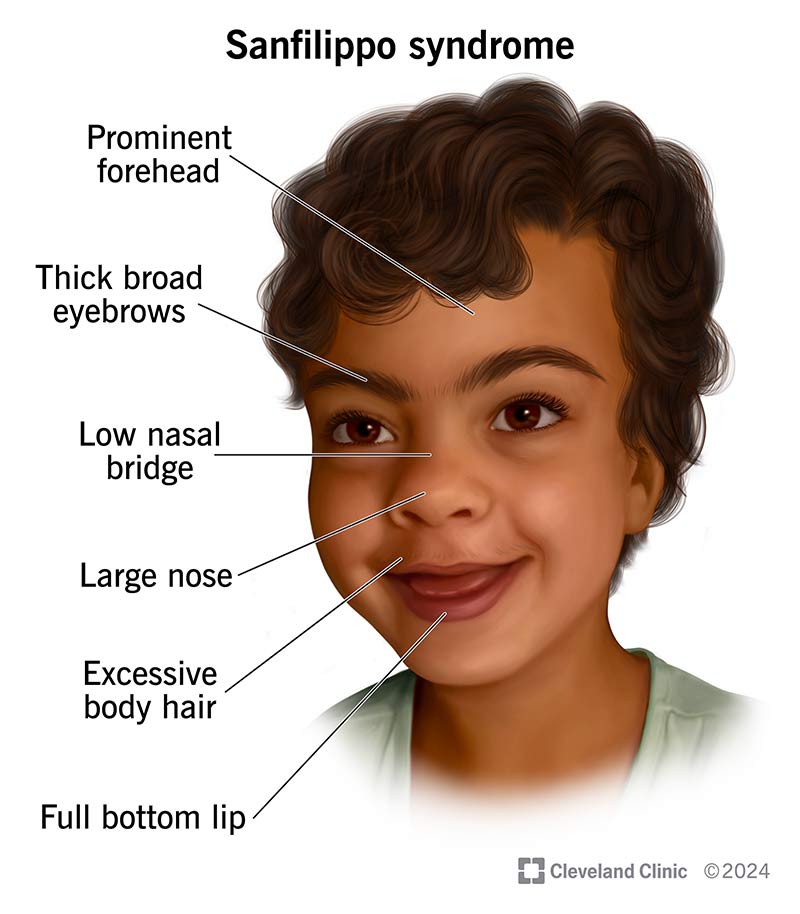
ONE INFUSION, ONE GENE
On 17 September the US Food and Drug Administration granted standard full approval to FAYUVI (rebisufligene etisparvovec-hopf), known throughout its long development as UX111, for the neurologic manifestations of mucopolysaccharidosis type IIIA — Sanfilippo syndrome type A — in paediatric patients with preserved neurodevelopmental function.
It is the first FDA-approved treatment for the disease in history.
The mechanism is conceptually simple and technically brutal. FAYUVI is a single-dose intravenous gene therapy built on an adeno-associated virus type 9 shell — AAV9, chosen because it is one of the few viral vectors that reliably crosses from the bloodstream into the central nervous system. Inside the shell is a working copy of the SGSH gene. Delivered once, into a vein, the therapy is designed to get that gene into brain cells so the body can start manufacturing the enzyme it was born unable to make.
There is no second dose. There is no adjusting the dial later. You get one shot at it, and the clock on the disease does not stop while you decide.
THE NUMBER THAT WON THE APPROVAL
The approval rests on the pivotal Transpher A trial and its long-term follow-up, with clinical data now stretching to nearly eight years.
The biochemistry came first and came clearly: treated children showed reduced levels of accumulated heparan sulfate in their cerebrospinal fluid throughout the study, across every age group. The enzyme was being made. The sugar was being cleared.
The harder question was whether that translated into a child who could still think. To answer it, investigators measured the mean change in Bayley-III cognitive raw score between the ages of 24 and 60 months in 17 treated patients — the modified intention-to-treat population — and compared them against 27 untreated children with the same disease drawn from an external natural history cohort.
The treated children scored 23.5 points higher than the untreated comparison over the study period, with a p value below 0.0001.
Two things need saying honestly about that figure. The first is that it is large. A 23.5-point separation on a cognitive raw score in a disease that reliably destroys cognition is not a marginal signal. The second is that the comparison group was external, not randomised — there was no placebo arm of children with a fatal neurodegenerative disease left untreated on purpose. That is an ethically defensible design and a scientifically weaker one, and the FDA accepted it. Regulators granted standard full approval rather than accelerated approval, which means the agency considered the evidence of clinical benefit established, not merely probable.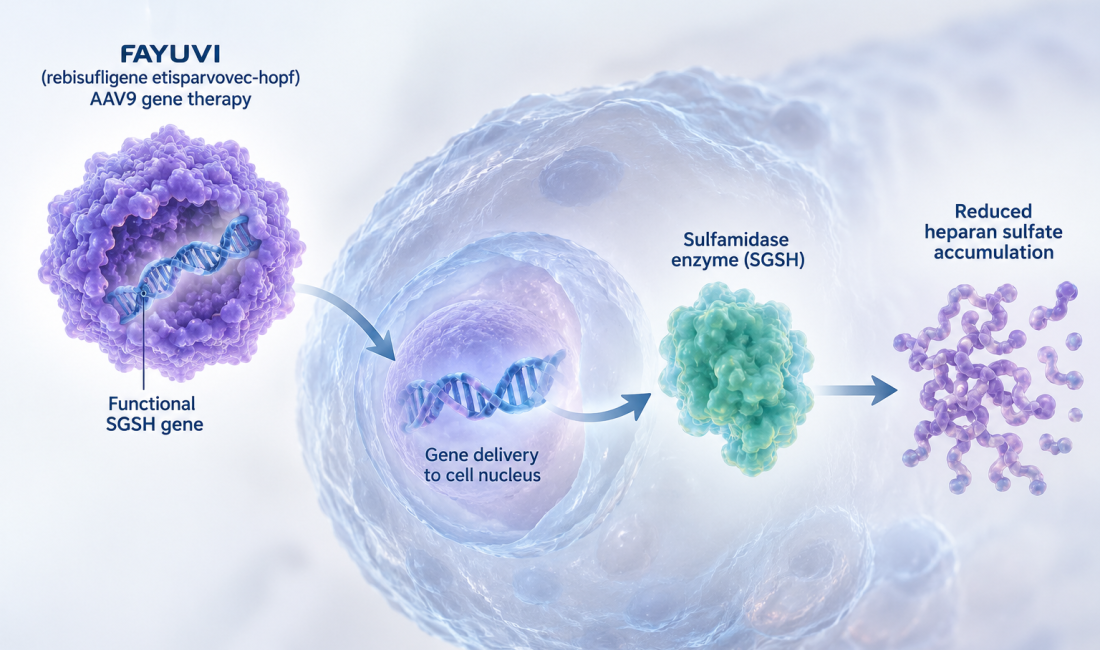
THE DRUG THAT NEARLY DIED THREE TIMES
The most remarkable thing about FAYUVI is not the science. It is that it exists at all.
The therapy was invented more than a decade ago by Haiyan Fu and Doug McCarty during their tenures at Ohio State University and Nationwide Children's Hospital in Columbus, Ohio. It was licensed to Abeona Therapeutics, where it was known as ABO-102. Then Abeona ran into funding constraints — despite having positive clinical data in hand — and made the decision that saved the programme: rather than let the asset sit, it out-licensed it. In 2022 Ultragenyx picked up exclusive rights, with Abeona in line for up to $30 million in commercial milestones plus tiered royalties.
That was near-death number one. Number two came on 11 July 2025, when the FDA issued a Complete Response Letter — a rejection. Crucially, the rejection had nothing to do with whether the drug worked. The agency's clinical reviewers acknowledged that the clinical data were robust and the biomarker data supportive, and raised no issues with the clinical package or clinical inspections. What the FDA wanted was more information on chemistry, manufacturing and controls, and fixes for observations from recently completed manufacturing facility inspections.
In other words: a therapy that had been shown to protect the minds of children with a fatal brain disease was delayed for fourteen months over paperwork and plumbing. Ultragenyx resubmitted, the FDA accepted the resubmission with a target action date of 19 September 2026, and the approval landed two days early.
Near-death number three was corporate and almost comically recent. On 2 September, just fifteen days before the Sanfilippo approval, Ultragenyx reported that its Phase 3 Aspire trial of apazunersen in Angelman syndrome had missed its primary endpoint. The stock crashed more than 43 per cent, and the company announced it would "assess its planned operations" and begin "significant expense reductions." A fortnight later the same company had the first-ever approved treatment for Sanfilippo type A, and its shares closed Thursday up 13 per cent at $14.50.
Ultragenyx made a point of naming the people who kept the programme alive. "The approval of FAYUVI reflects years of research from scientists and developers, as well as unwavering support from so many families and patient organizations in the face of a devastating, universally fatal disease with no treatment options," said Emil D. Kakkis, the company's chief executive and president. "This is a historic milestone for a community that has waited far too long, but has never given up hope."
THE PRICE
FAYUVI carries a wholesale acquisition cost of $3.95 million.
That makes it one of the most expensive medicines ever sold anywhere, second only to Orchard Therapeutics' Lenmeldy for paediatric metachromatic leukodystrophy at $4.25 million. It is also considerably more than Ultragenyx's other newly approved gene therapy, Genglycos for glycogen storage disease type Ia, which is expected to cost $2.7 million.
The company's justification is the arithmetic of the alternative: the lifetime cost of caring for a child with Sanfilippo syndrome type A can exceed $8 million. On that reading, a single $3.95 million infusion is not an extravagance but a discount — assuming, of course, that it works well enough and long enough to replace the care it is being priced against.
The economics underneath are worth understanding, because they explain why a drug for 3,000 children costs what a house costs many times over. Ultragenyx argues its existing manufacturing infrastructure can push production costs down to "biologics-like levels." Jefferies analysts project peak sales of around $250 million. And the approval handed Ultragenyx something almost as valuable as the drug: a Priority Review Voucher, its second this year. Vouchers can be sold to other drugmakers, and William Blair analysts noted the market rate is roughly $200 million — money that "will significantly bolster the company's balance sheet." As of 30 June the company held $436 million in cash and marketable securities.
Two vouchers, then, are worth more than a year and a half of projected FAYUVI sales. That is the rare-disease business model in one line, and it is the reason this drug survived at all.
THE FINE PRINT NOBODY PUTS IN THE PRESS RELEASE
FAYUVI is not a cure and it is not gentle. The approved indication is narrow in a way that matters enormously to families: it covers paediatric patients with preserved neurodevelopmental function. The therapy is designed to stop or slow the loss of abilities. It is not designed to give back abilities already gone. In a disease that begins destroying a brain in toddlerhood, that makes early diagnosis the whole game — and Sanfilippo is routinely misdiagnosed for years as autism, ADHD or simple developmental delay.
The safety profile is real. Elevated liver enzymes were seen in 85 per cent of patients, which is why every child receives corticosteroids before and after infusion, with liver function monitored until two weeks after the steroid taper finishes. Vomiting occurred in 67 per cent, abnormal behaviour in 56 per cent, diarrhoea in 48 per cent, fever in 41 per cent. Platelet counts fell in 19 per cent and must be checked weekly for four weeks then monthly for six months. Seizures were recorded in 11 per cent, adrenal insufficiency in 7 per cent.
The label also carries warnings for thrombotic microangiopathy — not seen with FAYUVI in trials but reported with AAV gene therapies as a class — for infusion reactions including anaphylaxis, and for malignancy, because AAV vector DNA can integrate into the genome. Live vaccines must be avoided for 30 days before treatment and throughout steroid therapy. And for three months after infusion, families are advised on handling bodily fluids and waste, because the vector is temporarily shed.
None of that will deter a parent watching their child forget words. All of it is why the therapy will only be given at designated Qualified Treatment Centers, US hospitals specifically trained to administer gene therapy.
EXPERT PERSPECTIVE
Kevin M. Flanigan, director of the Center for Gene Therapy at Nationwide Children's Hospital and principal investigator on the trial that led to approval, framed it as a homecoming as much as a milestone. "This gene therapy addresses a pressing unmet clinical need and offers families a promising therapeutic option," he said. "It is additionally gratifying in that this vector was first developed at Nationwide Children's more than a decade ago, and its approval highlights our commitment to developing therapies that meaningfully impact children's health."
The patient organisations that funded, lobbied and waited put it less clinically. Glenn O'Neill, president and co-founder of the Cure Sanfilippo Foundation, and Terri Klein, president and chief executive of the National MPS Society, issued a joint statement calling the approval "a milestone that the Sanfilippo syndrome Type A community spent decades fighting to achieve: the first-ever treatment for a disease that relentlessly steals a child's abilities, independence, and future."
Then they said the thing that gets lost in approval-day coverage. "We celebrate by honoring every family who contributed and remembering the children we lost while waiting for this day."
WHAT THIS MEANS FOR YOU
If Sanfilippo syndrome is not in your family, the practical takeaway is about the cluster of symptoms that precedes diagnosis. Developmental regression — a child losing skills they previously had, particularly speech — is not a normal variation and is not something to watch for six months. Combined with coarsening facial features, an unusually large head, chronic diarrhoea, recurrent ear and sinus infections, severe sleep disturbance and behaviour that escalates rather than settles, it warrants asking a paediatrician directly about metabolic and genetic testing. Urine testing for glycosaminoglycans and enzyme assays are straightforward; the diagnosis is confirmed genetically.
That advice has teeth today in a way it did not on Wednesday. For the first time, an early diagnosis in Sanfilippo type A changes what can be done, not just what can be predicted. A child diagnosed with preserved neurodevelopmental function is now potentially treatable. A child diagnosed after the regression has taken hold is not covered by the approved indication.
If Sanfilippo is in your family, the immediate practicalities are these. Ultragenyx expects commercial product to ship to Qualified Treatment Centers within 30 to 60 days. The company's UltraCare programme now includes dedicated Gene Therapy Guides to help with insurance coverage and the treatment process, reachable Monday to Friday from 9am to 8pm Eastern on 888-756-8657, with details at ultracaresupport.com and a product site at fayuvi.com expected shortly. Manufacturing is entirely US-based, at Ultragenyx's Bedford, Massachusetts facility and Andelyn Biosciences in Columbus. The company says it is already receiving requests, including from outside the United States, where the therapy is not yet approved.
Insurance is the open question. A $3.95 million one-time payment does not fit any standard benefit design, and no payer has yet said publicly how it will handle it.
THE BOTTOM LINE
A therapy invented in an Ohio children's hospital lab, orphaned by a biotech that ran out of money, rescued by a licensing deal, rejected by the FDA over factory paperwork, and delivered by a company that had just watched a different drug fail and started cutting costs — is now the first and only approved treatment for a disease that has killed every child it has ever touched.
It costs $3.95 million. It does not restore what is already lost. It has a long list of side effects and a genuine, if small, cancer warning. And for the parents of a two-year-old who has just been diagnosed and can still say their own name, it is the only thing in the world that matters.



