DHAKA, BANGLADESH
The number came out on a Wednesday afternoon, delivered in the flat, careful language that health ministries use when they are about to say something unbearable. One thousand and two. That is how many children have now died of measles in Bangladesh since the outbreak began in March, according to the country's Directorate General of Health Services (DGHS). Alongside it came a second figure: 187,484 infections.
Measles. Not a novel virus. Not some exotic pathogen dragged out of a rainforest. Measles - a disease that has had a safe, cheap, wildly effective vaccine since the 1960s, a disease that most parents in wealthy countries have never seen and cannot picture, a disease that the world once seriously discussed eliminating altogether.
The United States Centers for Disease Control and Prevention says the South Asian nation of 178 million people is currently experiencing the largest measles outbreak in the world. And the most devastating detail is not the size of the number. It is that essentially every one of those 1,002 deaths was preventable by two doses of a vaccine that costs a matter of cents.
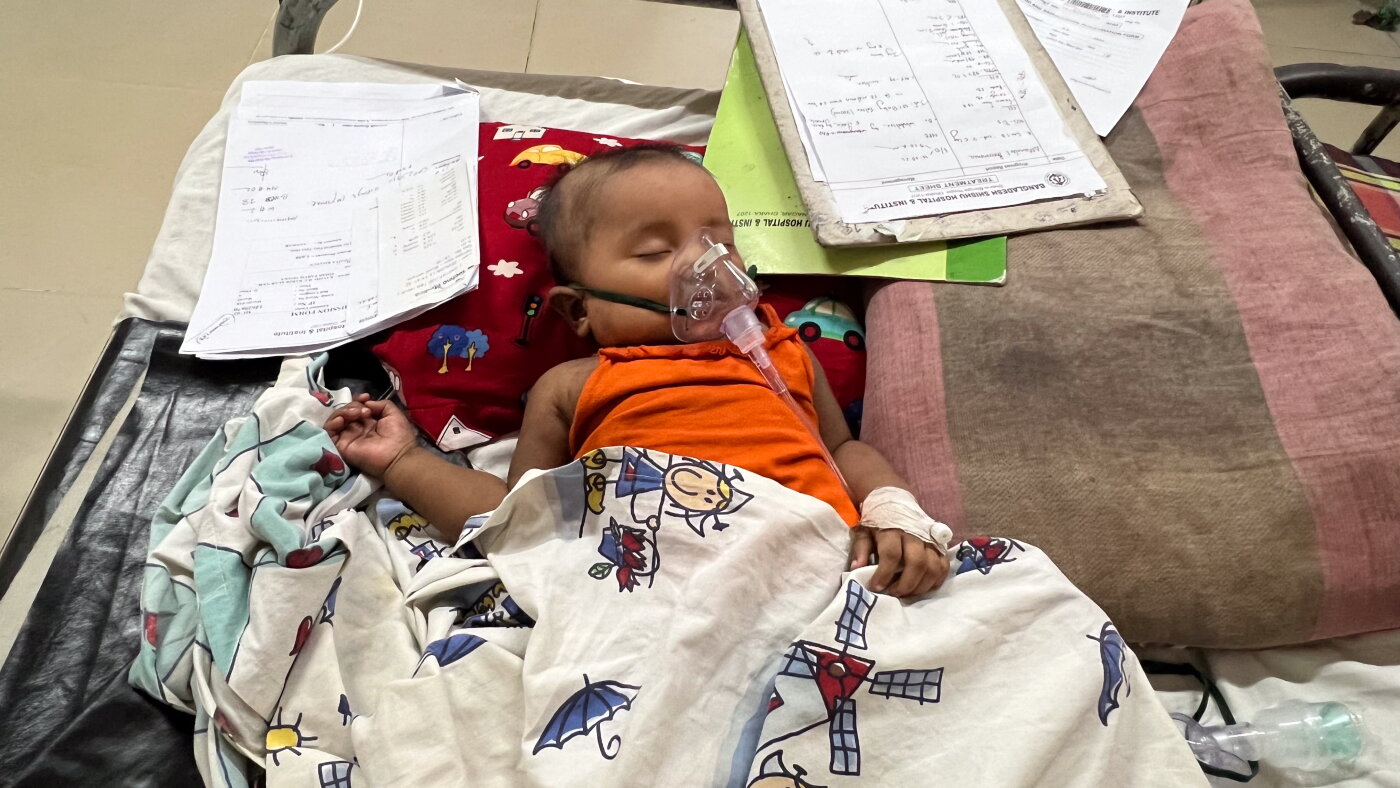
'A truly terrible situation'
Professor Mahmudur Rahman, the former director of Bangladesh's Institute of Epidemiology, Disease Control and Research in Dhaka, has spent a career watching outbreaks come and go in this country. He told the Reuters news agency that he has never seen anything remotely like this.
"To my knowledge, Bangladesh has never witnessed so many children dying from measles," he said. "Nor have we ever seen such a high number of patients in a single year. This is a truly terrible situation, and the saddest part is that the victims are children."
The victims are, overwhelmingly, very small children. In the early phase of the outbreak, more than 80 per cent of cases were in children under the age of five. Babies too young to receive their first dose are hit hardest of all - they have no protection of their own, and they depend entirely on everyone around them being immune. In an outbreak this large, that protection has collapsed.
At the Infectious Diseases Hospital in Dhaka this week, a Reuters photographer captured a 22-year-old mother named Mariam holding her nine-month-old son Nayem, who is being treated for measles. He is one of the lucky ones - he has a bed, and he has a hospital.
Sixty beds, and children on the floor
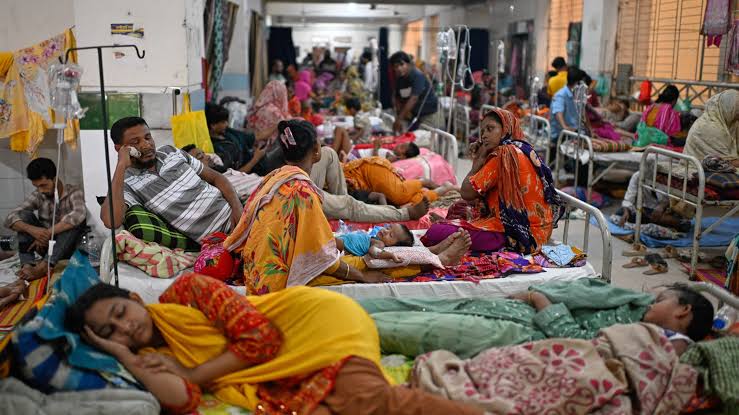
Many do not. Dr Nanda Dulal Saha, acting director of the state-run Shaheed Suhrawardy Medical College Hospital in Dhaka, described a facility being physically overwhelmed. The hospital has 60 beds allocated to measles patients. Far more children than that keep arriving, and many are being treated lying on the floor.
The shortages go beyond beds. Saha reported a shortage of paediatric saline - the basic rehydration fluid that is one of the few things clinicians can actually give a child with measles, because there is no specific antiviral treatment for the disease. When a child with measles is dying, it is usually dehydration, pneumonia or brain swelling that kills them, and saline is frontline supportive care. Running out of it is the kind of failure that turns a survivable case into a fatal one.
This is what a health system looks like when it is asked to absorb a preventable epidemic. Not dramatic collapse - just beds that run out, fluids that run out, staff who do not sleep, and a rising column of numbers.

How a country lost its shield
Bangladesh was, until recently, something of an immunisation success story. Its Expanded Programme on Immunisation was one of the more admired in South Asia. So how did the country end up hosting the world's worst measles outbreak?
The World Health Organization and UNICEF have both pointed to the same fault line: gaps that opened up in the national immunisation programme during 2024 and 2025, in the political turmoil that followed the ousting of then-Prime Minister Sheikh Hasina. When a government is fighting for its survival, the machinery of routine childhood vaccination - the cold chain, the outreach workers, the district registers, the procurement contracts - is not usually anyone's top priority. But that machinery does not tolerate neglect.
On Monday, Bangladeshi Health Minister Sardar Husain told parliament something remarkably candid: changes to procurement policy during that period created a vaccine shortage. In other words, the doses were not there when the children were.
Epidemiologists have a term for what happens next. Measles is one of the most contagious diseases known to medicine - a single infected person can transmit it to a dozen or more susceptible people. To stop it circulating, a population needs roughly 95 per cent coverage with two doses. Anything less and the virus does not disappear; it waits. Each year of imperfect coverage adds another cohort of unprotected children to the pile. Public health workers call this a susceptibility pocket, and it behaves exactly like dry brush in a fire season.
Independent situational analyses of the outbreak have found that around 72 per cent of cases were in children who had received no measles vaccine at all - the so-called zero-dose children - and another 16 per cent in children who were only partially vaccinated. Nearly nine in ten of the children falling ill had been failed by the immunisation system before the outbreak ever started.
Eighteen million reached. Four million missed.
When the deaths began mounting in April, Bangladesh did what public health doctrine says to do: it launched a nationwide emergency vaccination campaign, backed by UNICEF, the WHO and the vaccine alliance Gavi, with an initial push targeting more than 1.2 million children aged six months to five years across 30 upazilas in 18 high-risk districts, before expanding.
By any ordinary measure the campaign was enormous. Eighteen million children were vaccinated.
And it was not enough. Official figures show roughly four million children were never reached at all.
"We couldn't achieve herd immunity," DGHS spokesman Zahid Raihan told the AFP news agency this week, adding that teams were still out searching for the children who had been missed. "Measles cannot be eradicated and the aim was to reduce casualties. We will keep vaccinating our children."
That admission - we couldn't achieve herd immunity - is the whole tragedy compressed into five words. A four-million-child gap in a country where the virus is already circulating freely is not a rounding error. It is a reservoir. It is why the death toll kept climbing through the summer and crossed a thousand in September rather than levelling off in June.
Reaching those last children is the hardest, least glamorous work in public health. They are in dense urban slums where families move every few months and no register can keep up. They are in remote char islands and hill districts. They are in displaced and marginalised communities that have learned not to expect much from official visitors. Vaccination coverage in Bangladesh has, unusually, been worse in urban settings than rural ones - a signal that the missing children are concentrated exactly where crowding makes transmission fastest.
What measles actually does
Because measles has been rare in rich countries for a generation, most people picture it as a childhood rash - an inconvenience, a week off school. That picture is dangerously wrong.
Measles begins as a high fever, cough, runny nose and inflamed eyes, followed a few days later by the characteristic blotchy rash spreading from the face downwards. There is no specific treatment once a child catches it. In severe cases the virus causes pneumonia and encephalitis - swelling of the brain - which can kill or leave permanent disability, deafness or blindness.
There is also a longer shadow. Measles infection wipes out part of the immune system's memory of pathogens it had previously learned to fight, a phenomenon researchers call immune amnesia. A child who survives measles can be left more vulnerable to other infections for years afterwards. In a country where malnutrition and vitamin A deficiency are common in poorer districts, that combination is lethal - and it means the true death toll of an outbreak this size extends beyond the 1,002 already counted.
And at the same time: dengue
As if one epidemic were not enough, Bangladesh's hospitals are simultaneously absorbing a severe dengue season. More than 45,000 people have been admitted for dengue this year. On Tuesday the country recorded its worst dengue day of 2026 on both measures at once: 1,571 admissions and nine deaths.
Two outbreaks competing for the same beds, the same nurses, the same fluids, the same ambulances. This is the compounding effect that public health officials dread and that rarely makes international headlines - not one crisis, but two crises sharing a single overstretched system, each making the other deadlier.
Expert perspective: a warning light for everyone else
It would be comfortable to file this away as a Bangladesh problem. It is not.
Global measles vaccination coverage has still not recovered from the disruption of the pandemic years. Worldwide coverage with the first measles dose has been stuck at around 84 per cent, with second-dose coverage at roughly 77 per cent - both far below the 95 per cent two-dose threshold needed to interrupt transmission. The WHO and CDC have estimated on the order of 95,000 measles deaths globally in 2024, the overwhelming majority in children under five.
The Measles and Rubella Partnership and UN agencies have repeatedly warned that dozens of countries have experienced large or disruptive measles outbreaks in a single 12-month window, and that outbreaks are now occurring in every region of the world. More than half of all zero-dose children live in fragile, conflict-affected or vulnerable settings - places where, exactly as in Bangladesh, political instability can knock out an immunisation programme faster than anyone can rebuild it.
The pattern is consistent enough to be predictive. Coverage slips for a couple of years. Nothing appears to happen. Susceptible children accumulate quietly. Then the virus arrives, and a country discovers all at once how many of its children it forgot to protect.
What this means for you
If you are reading this far from Dhaka, there are still three concrete things to take from it.
First: check your own children's records. Two doses of the measles vaccine - given as MMR or MR depending on the country - are what confer near-complete protection. One dose leaves a meaningful gap. If a dose was skipped or delayed during the pandemic years, that is fixable in a single appointment, and catch-up vaccination is standard practice at any age.
Second: if you are travelling to a country with an active outbreak, check your own status as well as your children's. Adults born after routine vaccination began but who received only one dose are not as protected as they assume, and measles is the classic imported infection - one traveller can seed a cluster in an under-vaccinated community back home.
Third: understand what herd immunity is actually for. High vaccination coverage is not primarily about protecting the vaccinated individual. It is about protecting the people who cannot be vaccinated - the newborns too young for a first dose, children on chemotherapy, people with immune conditions. When coverage falls, those are the people who pay, and they are the people filling the wards in Dhaka right now.
None of this is a lecture aimed at Bangladeshi parents, who by every available account have been queuing for vaccines that were not always there to give. The failure in Bangladesh was a supply and systems failure at the top, not a refusal at the bottom. But the arithmetic of measles does not care why coverage fell. It only cares that it did.
The bottom line
One thousand and two children. Since March. In a single country. From a disease that a two-dose vaccine prevents with about 97 per cent effectiveness.
Bangladeshi health workers are still out looking for the four million children the emergency campaign never reached, and they will keep going - Zahid Raihan's promise that "we will keep vaccinating our children" is not a slogan but a description of what the next months of this outbreak will actually consist of. Whether the toll stops in the low thousands or climbs considerably higher depends almost entirely on how fast those children are found.
The rest of the world gets to watch this one from a distance. It should not get too comfortable. Every percentage point of measles coverage that a country lets slip is a promissory note, and Bangladesh is currently discovering what it looks like when the note comes due.
Published By | Features Editor




