Uganda Tourism
The road south from Kampala unspools through banana groves and trading-center bustle, past Lukaya's roadside honey stalls and the rolling hills of Masaka, before the land suddenly opens. Acacia trees flatten into a horizon of gold grass, and somewhere close to the tarmac a zebra lifts its striped head to watch the traffic pass. This is the gateway to Lake Mburo National Park, and for a park so often overshadowed by Uganda's marquee gorilla forests and Nile-fed savannahs, that first glimpse of wild zebra grazing within sight of the highway is a fitting introduction: understated, unexpected, and entirely its own.
At just 370 square kilometers, Lake Mburo is the smallest of Uganda's savannah national parks, and the closest to Kampala — a drive of roughly three and a half hours that has made it the country's default weekend safari and the first stop for travelers easing into the rhythms of an East African road trip. But smallness here is deceptive. Within its compact borders sits a mosaic of five lakes, papyrus wetlands, rocky outcrops and dense acacy-thicket woodland that supports a density and variety of wildlife well out of proportion to its size.
A Park Born of Cattle Country
Lake Mburo's story begins not with conservationists but with hunters. The area was first gazetted as a controlled hunting zone in 1933, a designation that regulated rather than prohibited the taking of game. Three decades later, in the early 1960s, it was upgraded to a game reserve, and by the 1980s it had been elevated again to full national park status — though not without friction. The park sits within Ankole cattle-keeping country, and the tension between pastoralist land use and wildlife protection has shaped its management history more than in almost any other Ugandan reserve. Community conservation programs now work to balance grazing corridors and livestock coexistence with the park's ecological mandate, a model increasingly held up as an example of how conservation and rural livelihoods can be reconciled rather than pitted against each other.
Zebra Country
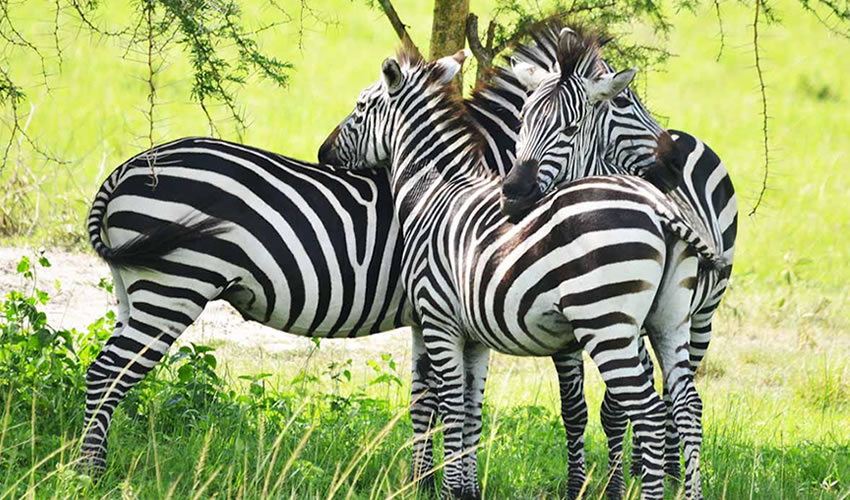
What makes Lake Mburo genuinely distinctive is its wildlife roster. This is one of only two places in Uganda — alongside remote Kidepo Valley in the far northeast — where Burchell's zebra can be seen, their crisp black-and-white stripes a startling sight against the gold savannah. The park also holds Uganda's only significant population of impala, the slender, russet-coated antelope whose name, fittingly, gave Kampala its own. Eland, Uganda's largest antelope, browse the acacia scrub alongside topi, bushbuck, common duiker, reedbuck and defassa waterbuck, while over seventy mammal species in total move through the park's woodlands and grassland.
Predators are present but famously discreet: leopard and spotted hyena patrol the thickets, more often heard than seen, which has allowed Lake Mburo to build a different kind of reputation — as one of the few parks in Uganda, and indeed East Africa, where visitors can safely explore on foot and on horseback rather than being confined to a vehicle. Guided walking safaris weave between grazing zebra and skittish impala with a ranger's rifle as the only concession to caution, while horseback safaris — a rarity in African wildlife tourism — let visitors approach herds at a pace and angle no jeep can match.
Birdwatchers, meanwhile, regard Mburo as one of the finest small-park circuits on the continent. More than 315 species have been recorded within its boundaries, from the flamboyant Ross's turaco to the plates of black-and-white kingfishers, malachite kingfishers, and the localized red-faced barbet, along with African finfoot on the shier fringes of the papyrus. Birders chasing Uganda's famous shoebill stork elsewhere in the country often build in a Mburo detour purely for the sheer density of species in the swamp-edge habitat around the lake.
Life on the Water
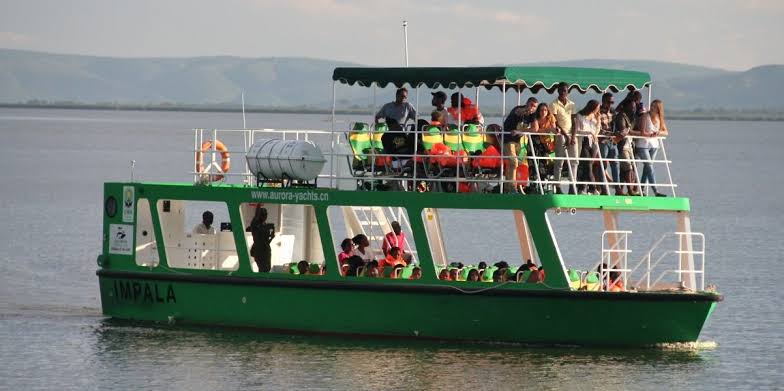
The park takes its name from its centerpiece lake, one of five within its boundaries and by far the largest, and the two-hour boat safari across its calm waters is, for most visitors, the signature Mburo experience. Flat-bottomed boats nose along reed-lined shores where pods of hippo surface and submerge in unhurried rotation, and where sunbathing Nile crocodiles — some enormous — barely stir as the engine passes. Fish eagles perch in dead trees along the shoreline, African darters dry outstretched wings on half-sunk branches, and, with luck, a shy sitatunga antelope can be spotted picking through the swamp margins, a species so elusive that a Mburo sighting is something safari veterans still talk about.
Planning the Visit
Lake Mburo rewards visitors year-round, but the dry seasons — June through September and December through February — offer the clearest game viewing, as animals concentrate around the remaining water sources and dirt tracks stay firm underfoot. The rainy stretches, March to May and October to November, transform the park into a deeper green and are prized by birders, though some interior roads can turn to mud. Entry fees for 2026 stand at USD 40 per day for foreign non-residents, USD 30 for foreign residents, and UGX 20,000 for East African citizens, with children under fifteen exempt; a single payment covers a full 24 hours from the time of entry. Accommodation ranges from mid-range lodges overlooking the lake to tented camps and a handful of budget bandas just outside the gates, and most visitors combine Mburo with a wider western circuit — it lies directly on the route toward Bwindi, Queen Elizabeth, and the crater lakes of Fort Portal, making it as much a convenient first or last night on safari as a destination in its own right.
This Week in Ugandan Tourism
Uganda's tourism sector has moved through a busy stretch of policy and conservation news in recent months. On July 1, 2026, the Uganda Wildlife Authority's new gorilla trekking permit prices took effect: USD 800 for foreign non-residents and USD 700 for foreign residents, alongside an increase in the gorilla habituation permit from USD 1,500 to USD 1,800 for non-residents — with a low-season discount of USD 600 still available in April, May and November for travelers able to shift their dates.
That price change followed two other UWA policy shifts earlier in the year. Since March 1, 2026, the authority has suspended its seven-day permit reservation window, meaning gorilla permits must now be paid for in full at the time of booking rather than held provisionally — a move tour operators say has tightened planning timelines for last-minute travelers. Then, in an April 14 letter to tourism and conservation stakeholders, UWA's executive director announced the authority would stop issuing extra gorilla permits beyond the standard daily allocation to individuals and licensed operators, a step framed as protecting habituated gorilla families from excess pressure during peak booking periods.
On the conservation front, the biggest story of the year so far has been the return of rhinos to Kidepo Valley National Park after more than four decades of local extinction. The reintroduction, launched March 17, 2026, began with the translocation of two Southern White Rhinos from Ziwa Rhino Sanctuary, with plans to relocate a total of eight animals in this first phase — a milestone conservationists have called one of the most significant wildlife comebacks in the country's recent history.
On the accommodation front, Asilia Africa is preparing to open Erebero Hills Lodge in early 2026, a new property set on 45 acres of reforested land at the northern edge of Bwindi Impenetrable Forest, built explicitly around community reforestation and conservation financing alongside guest access to the park's mountain gorilla population. And on the marketing stage, Destination Uganda picked up the “Best in Show — Africa” honor at the 2026 Travel & Adventure Show in New York this year, a recognition the Uganda Tourism Board has pointed to as evidence of the country's rising profile among North American travelers weighing East African safari options.
Taken together, the week's headlines sketch a sector in transition: pricier and more tightly managed gorilla tourism at the marquee end, paired with genuine conservation wins and a steady drip of new lodge investment further down the safari circuit — including, this week, a fresh spotlight on the zebra-striped plains of Lake Mburo.
Published By | Features Editor




