Written By |

A morning in Bwindi Impenetrable National Park, the forest that shelters almost half the mountain gorillas left on earth
The mist does not lift in Bwindi so much as it decides, slowly, to move somewhere else. At six in the morning in Buhoma the ridges are stacked one behind the other like sheets of grey paper, and the sound that carries up from the valley is not birdsong but water — a hundred small streams working their way down through the ferns. Then the light finds the canopy, and the forest turns an improbable green, and a ranger in a UWA beret says the sentence every visitor has flown across the world to hear: "We have located them. They are feeding, about an hour up."
What follows is not a game drive. There is no vehicle, no road, and for long stretches no path. Guides cut through the undergrowth with machetes while porters — most of them from the villages that ring the park — take your daypack and, when the slope turns to mud, your hand. And then the cutting stops. Somebody signals you to be quiet. Six metres away, a silverback the size of a filing cabinet is stripping a stem of wild celery with the unhurried competence of a man reading the newspaper. He looks at you once. He decides you are not interesting. That, more than anything else in Ugandan tourism, is the moment people carry home.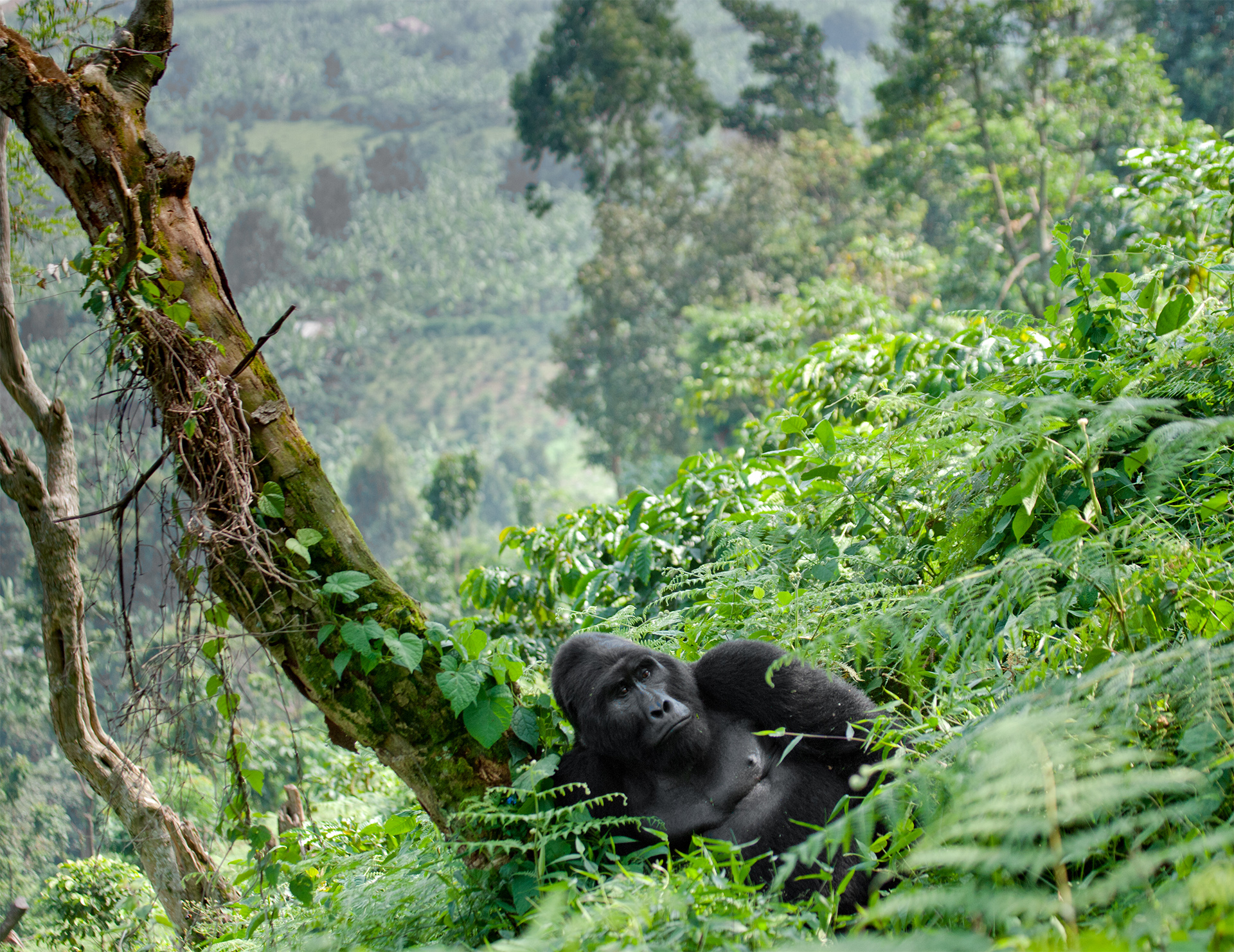
A forest older than the ice ages
Bwindi Impenetrable National Park covers roughly 331 square kilometres of montane and lowland rainforest along the Democratic Republic of Congo border, draped over the steep Kigezi highlands between about 1,160 and 2,600 metres above sea level. It was gazetted as a forest reserve in 1932, upgraded to national park status in 1991, and inscribed on the UNESCO World Heritage List in 1994. Its scientific value rests on an accident of geology: while much of tropical Africa dried out during the Pleistocene glaciations, Bwindi stayed wet. It is one of the very few African forests where lowland and montane vegetation meet without a break, and it has been accumulating species for an estimated 25,000 years.
The numbers bear that out. More than 200 tree species grow here, ten of them found nowhere else, alongside some 104 species of fern — the richest such assemblage in East Africa. Bwindi is the continent's most important forest for montane butterflies, with 202 recorded species, roughly 84 per cent of Uganda's total. Birders come for a different list: around 350 species, including 23 of the 24 Albertine Rift endemics, among them the African green broadbill, Grauer's swamp warbler and the almost mythical Shelley's crimsonwing. Chimpanzees, L'Hoest's monkeys, forest elephants and duikers all move through the same undergrowth, largely unseen.
But Bwindi's fame rests on one animal. The global mountain gorilla population has climbed past 1,000 individuals, up from fewer than 700 a decade ago — the only great ape whose numbers are rising rather than falling. Somewhere around 459 of them live in Bwindi, close to half the world total, in groups that have been patiently habituated over years so that visitors can spend one strictly rationed hour in their company. The trekking is spread across four sectors: Buhoma in the north, the most accessible and the original base; Ruhija, higher and cooler, quietly regarded as the best birding ground in the park; and Rushaga and Nkuringo in the south, where the hills are steepest and the gorilla families most numerous.
Practical matters
A gorilla permit for 2026 costs USD 800 for foreign non-residents, USD 700 for foreign residents, USD 500 for other African nationals and UGX 300,000 for East African citizens. It buys one hour with a habituated family and waives the park entrance fee on the day of the trek; on non-trekking days that entrance fee is USD 40 per twenty-four hours. In the green-season months of April, May and November the Uganda Wildlife Authority discounts the foreign non-resident permit to USD 600 — the single best value in East African wildlife tourism, provided you are willing to be rained on. The four-hour Gorilla Habituation Experience, available only in the Rushaga sector, currently costs USD 1,500, though that rises to USD 1,800 from 1 January 2027.
Book early and expect no mercy: permits for the peak windows of June to September and December to February routinely sell out six months or more ahead, and UWA has removed the old seven-day courtesy reservation, so a permit is now only yours once payment clears. Guided forest walks in Ruhija cost USD 30 for foreign non-residents on top of entrance, and the Batwa Cultural Experience — a two-hour walk led by guides from the forest's original inhabitants, covering hunting technique, gathering and herbal medicine — runs about USD 80 per person, falling to USD 60 for groups of five or more.
Getting there remains the honest part of the equation. Bwindi lies roughly 520 kilometres from Kampala, an eight to nine hour drive that is scenic for the first six hours and character-building for the last two. Scheduled and charter flights shorten it considerably: Kihihi and Kayonza airstrips serve Buhoma and Ruhija, while Kisoro airstrip is the gateway to Rushaga and Nkuringo. The dry seasons of June to September and December to February give the firmest trails and the clearest views; the wet months bring lower prices, thicker vegetation and a genuine chance of a four-hour slog through mud. Whatever the month, pack gaiters, gardening gloves and a waterproof shell, and hire a porter — it costs a few dollars, it eases the climb, and it puts money directly into the households that live alongside the gorillas.
That last point is not sentiment. Bwindi is the clearest demonstration anywhere in Africa that a forest can pay for its own protection: revenue sharing, porter fees, community lodges and craft cooperatives have turned a park that villagers once experienced purely as a loss of land into the most reliable employer in Kanungu and Kisoro. The gorillas are increasing because that arithmetic, finally, works.
This Week in Ugandan Tourism
Three days of free national park entry, 25–27 September. The Ministry of Tourism has confirmed open days at Uganda Wildlife Authority parks for both Ugandan and foreign visitors, announced by State Minister for Tourism Susan Nsambu Nakawuki during a tour of Murchison Falls National Park and Ajai Wildlife Reserve. Gorilla and chimpanzee permits are not included in the waiver.
Habituation permit rises to USD 1,800 on 1 January 2027. Part of the revised UWA tariff structure announced on 26 February 2026 under Executive Director Dr James Musinguzi, which also formalised the USD 600 low-season gorilla permit for April, May and November and scrapped the seven-day reservation window in favour of instant payment.
Erebero Hills opens near Bwindi. Asilia's eight-suite lodge, which began welcoming guests in August 2026, adds a high-end, wellness-focused option on the montane forest edge — a signal that Bwindi's bed stock is moving upmarket rather than simply expanding.
Uganda Airlines confirms two new regional routes. The Entebbe–Accra service starts 27 October 2026 with four weekly flights, and a daily Entebbe–Kigali rotation begins 18 November 2026. Separately, Air Serv has launched scheduled Entebbe–Arua flights, cutting the journey to the West Nile to about one hour twenty minutes. In August, airline executives also presented a broader fleet and network expansion plan reaching into Asia, Europe and the Middle East.
Kampala's hospitality capacity steps up. President Yoweri Museveni formally opened the dual-branded Kampala Marriott Hotel and Marriott Executive Apartments in Nsambya on 27 August 2026, strengthening the city's hand in the conference and incentive-travel market that increasingly feeds safari itineraries. Earlier in the year, Uganda Tourism Board joined the World Travel & Tourism Council as a Destination Partner and took "Best in Show – Africa" at the New York Travel & Adventure Show.



