Written By |

At Sipi Falls, three waterfalls, a volcano and the world’s most quietly famous Arabica share the same cliff — and this month, the country’s tourism spotlight finally swings east
KAPCHORWA, EASTERN UGANDA
The sound arrives before the sight. You climb out of Mbale on a road that keeps bending upward through banana shade and maize, and somewhere past the last trading centre the air turns cold and green and begins to hum. Then the escarpment opens, the Karamoja plains fall away behind you in a haze the colour of weak tea, and a ribbon of white drops ninety-five metres off the shoulder of an extinct volcano into a bowl of ferns. That is the main fall at Sipi. There are two more above it, and a coffee farm on nearly every terrace between.
For a country whose tourism brochures are dominated by mountain gorillas and Nile-side game drives, Sipi Falls has always been the outlier — no permit, no entrance gate, no herd of safari vehicles. It is a place you walk into. And in September 2026, with the national World Tourism Day celebrations heading to Mbale and the Elgon region deliberately placed at the centre of the country’s domestic tourism push, the outlier is about to have its moment.
Three falls, one cliff
Sipi Falls is not one waterfall but a staircase of three, strung along the Sipi River as it leaves Mount Elgon National Park and spills over the western escarpment in Kapchorwa District, roughly 277 kilometres north-east of Kampala. The lowest and most photographed is the main fall, a clean ninety-five-metre plunge into a mossy amphitheatre you can walk behind on a wet ledge. Above it sit Ngasire, at about eighty-five metres, and Simba, at seventy-four — shorter, broader, less crowded, and in the view of most guides here, the better swim.
The name is older than the tourism. The river and the falls take their name from the “sep”, a plant that grows thick along the banks and is used locally as a remedy for measles and influenza. Two peoples share the slopes: the Bagisu, whose land runs down toward Mbale, and the Sabiny of Kapchorwa and Kween, higher and colder on the shoulder of the mountain. Both grow coffee. Neither, historically, has grown rich from the tourists who come to look at their water.
That is changing, slowly, through a community-fee model that is unusual in Uganda. There is no national park entry charge at Sipi — the falls sit just outside the boundary of Mount Elgon National Park — and instead visitors pay a community fee of around USD 15 (roughly UGX 35,000 for East Africans) for the full three-falls hike, guide included, with the money routed back through village associations. A walking stick comes free. A guide is not strictly compulsory but is strongly advised: the trail is a loop of steep, root-laced footpaths, farm tracks and a few genuinely exposed rock steps, and in the rains it becomes a mudslide with opinions.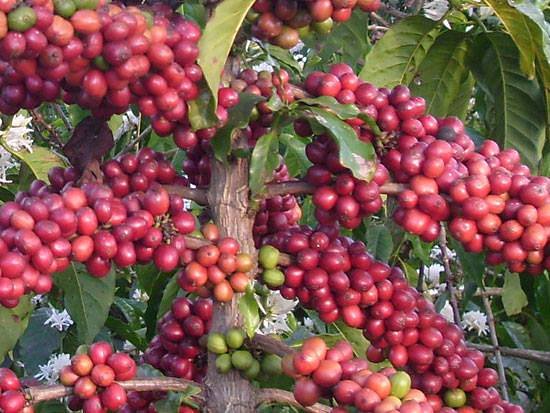
The bean that grows on a volcano
Ask anyone in Kapchorwa what Sipi is famous for and you will get the answer twice: the water, and the coffee. Bugisu Arabica — grown only in the narrow altitude band between roughly 1,400 and 1,900 metres on Elgon’s volcanic soils — is Uganda’s most celebrated speciality crop, and the farms that produce it begin literally at the edge of the waterfall trail.
The coffee tour has become the most reliably excellent half-day in eastern Uganda. It is not a plantation showpiece. A farmer walks you through the whole arc — picking red cherries, pulping them by hand-crank, drying them on raised beds, pounding, winnowing in a flat basket with a practised flick, then roasting over an open fire in a clay pan until the room fills with smoke and something close to caramel. You grind it with a mortar. You drink it sitting on a bench looking at a volcano. Most visitors leave with a kilo in a paper bag and a slightly altered view of what they have been buying at home.
For the adrenaline-inclined, the other signature activity is abseiling the hundred-metre face beside the main fall — about ninety minutes on the rope, priced near USD 50 for non-residents and around UGX 130,000–150,000 for East African and foreign residents. Beyond that there is caving, rock climbing, community cycling on the ridge roads, and, for those with several days and stronger legs, the trailheads for Mount Elgon itself, whose Wagagai summit stands at 4,321 metres and is one of the few high African peaks you can climb without technical gear or a queue.
Getting there, and when to go
Sipi sits about an hour beyond Mbale by road, most of it tarmac and the last stretch a climbing murram switchback. From Kampala, allow six to seven hours by private vehicle, or take a bus to Mbale and a shared taxi up to Kapchorwa. The village of Sipi is small enough to walk end to end in fifteen minutes, and its lodges — from backpacker bandas to a handful of comfortable clifftop guesthouses — are almost all built to face the same view.
The falls run year-round, and there is no closed season. The drier windows of December to February and June to August give the firmest footing and the clearest long-range views across to Karamoja; the wetter months make the falls fuller and more dramatic but the trail considerably more treacherous. Mornings are almost always the best light and the clearest air — by early afternoon the cloud tends to come up the escarpment and swallow the plains. Landslides do occur on Mount Elgon during heavy rain, rarely in central Sipi village itself, but it is worth asking locally before setting out in a downpour.
If you are pairing Sipi with Mount Elgon National Park proper, budget separately: park entry runs USD 40 per day for foreign non-residents, USD 30 for foreign residents and UGX 20,000 for East African citizens, on top of trekking and ranger fees. Bring warm layers — Sipi sits high enough that evenings genuinely bite — and shoes with grip rather than fashion.
This Week in Ugandan Tourism
Mbale to host World Tourism Day, 27 September. The national celebrations will be held at Mbale Secondary School grounds under the theme “Digital Agenda and Artificial Intelligence to Redesign Tourism”, with the Ministry of Tourism, Wildlife and Antiquities framing the choice of venue as a deliberate push to raise the profile of the Elgon circuit — Sipi Falls, Wanale Hill, Sisiyi Falls, coffee tourism and Mount Elgon National Park. A regional tour precedes the main event, which culminates in a concert headlined by Ssuna Ben, Spice Diana, Fik Fameica and Ykee Benda.
Free park entry for three days, 25–27 September. The Uganda Wildlife Authority has launched its 2026 Open Park Days, waiving entry fees at selected national parks and wildlife reserves in the run-up to World Tourism Day. Acting Commissioner for Tourism and Business Development Dorcus Rukundo summed up the intent bluntly: before Uganda celebrates tourism, Ugandans should first go and see Uganda. Mount Elgon is among the parks within easy reach of the Mbale festivities.
Elephants return to Elgon after forty years. In one of the more remarkable conservation stories of the year, monitoring by the Mount Elgon Foundation recorded at least sixty elephants crossing from the Kenyan side into Uganda’s Mount Elgon National Park — a range they had effectively abandoned for four decades. UWA attributes the return to sustained forest restoration inside the park. The corollary is less comfortable: human–wildlife conflict remains a live issue in Bukwo and neighbouring districts, where crop raiding in 2025 tested community patience even as rangers held the line in 2026.
Gorilla permits settle at USD 800. Under the tariff structure effective 1 July 2026, a standard gorilla trekking permit costs USD 800 for foreign non-residents and USD 700 for foreign residents, dropping to USD 600 in the low-season months of April, May and November; East African citizens pay UGX 300,000. The habituation experience is USD 1,800 for non-residents. Note the procedural change: since 1 March 2026 the old seven-day reservation hold has been suspended, and permits must be paid in full at booking.
New air links keep opening. Uganda Airlines launches Entebbe–Harare on 25 September, with Entebbe–Accra following on 27 October and a daily Entebbe–Kigali service from 18 November. Domestically, Air Serv has begun scheduled Entebbe–Arua flights, cutting the journey to West Nile to about an hour and twenty minutes. The backdrop is a sector in recovery: more than 1.6 million international arrivals in 2025 and earnings of roughly UGX 5.8 trillion (about USD 1.62 billion), with tourism contributing close to 5.9 per cent of GDP.
The quiet case for going east
Uganda’s tourism economy has been built, understandably, on the scarce and the spectacular — a permit, a habituated family, an hour in the forest. Sipi offers the opposite proposition. It is abundant, unticketed, and almost entirely in the hands of the people who live there. You walk out of a guesthouse, you follow a farmer up a hill, you stand behind a waterfall, you drink coffee grown ninety metres from where it was roasted, and the whole day costs less than a park gate fee.
For one week at the end of September, the country’s ministers, musicians and marketing budgets will all be pointed at this corner of the map. The falls, characteristically, will not notice. They have been doing this for a very long time.



