Written By |

At the Source of the Nile in Jinja, Uganda holds the beginning of the world’s longest river — and is busy rebuilding the way visitors meet it
JINJA CITY, EASTERN UGANDA
There is a particular silence on the water at seven in the morning, before the boat engines start and before the fish eagles begin arguing over the channel. You sit in a low wooden launch a few hundred metres off the Jinja shoreline, the surface of Lake Victoria lying flat and pewter-coloured in every direction behind you, and the boatman cuts the motor. He points ahead, where the water stops being a lake. It is not dramatic. There is no roar, no cliff, no curtain of spray. There is only a subtle shift in the texture of the surface — a seam, a drawing-together, a sense of the whole inland sea quietly deciding to leave.
That seam is the beginning of the River Nile. From this unremarkable patch of water in eastern Uganda, the river runs roughly 6,650 kilometres north through South Sudan, Sudan and Egypt to the Mediterranean, carrying with it the agricultural fate of eleven countries and a disproportionate share of human mythology. Every visitor who comes here arrives expecting a spectacle and leaves having been handed something stranger and better: the chance to put a hand in the water at the exact place where a river the size of history begins.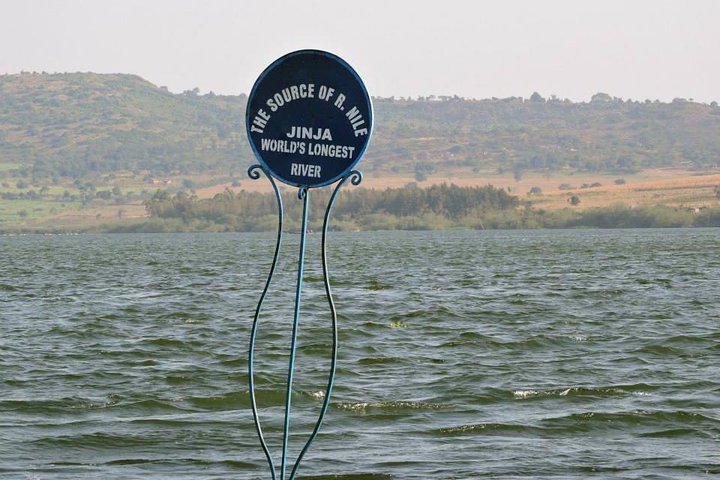
A Landmark That Keeps Changing Shape
The Source of the Nile sits at the northern edge of Lake Victoria in Jinja, about 80 kilometres east of Kampala along a tarmac highway that makes the trip an easy morning’s drive. Jinja itself — elevated to city status in 2020, and long the industrial heart of the Busoga sub-region — is a low, green, walkable place of wide avenues, jacaranda, corrugated-iron warehouses and some of the most intact colonial-era and Indian-influenced street architecture in East Africa. Hindu temples sit a few blocks from Art Deco shopfronts. The whole town has the slightly faded, slightly bohemian feel of a place that was once the country’s manufacturing capital and has spent the last two decades reinventing itself as its adventure capital instead.
The site’s modern history begins on 28 July 1862, when the British explorer John Hanning Speke stood at the lake’s outlet and identified it as the Nile’s long-disputed source, naming the cataract there Ripon Falls after the then under-secretary of state for India. Speke’s claim triggered one of the great scholarly feuds of the Victorian era — his former travelling companion Richard Burton disputed it bitterly — and the argument was not fully settled until long after Speke’s death. A monument at the water’s edge marks the spot today, alongside a more recent set of markers tracing the Nile’s course through the countries it feeds.
Ripon Falls itself no longer exists. The cataract Speke described — roughly five metres high and some 275 metres wide — was drowned in 1954 by the completion of the Owen Falls Dam, now the Nalubaale power station, whose reservoir raised the water level and smoothed the outlet into the wide, placid channel visitors see today. This is the first thing to understand about the Source of the Nile: it is a landscape that Uganda has repeatedly rebuilt. Downstream, the Bujagali Falls rapids went under in 2012 when the Bujagali hydropower dam filled, and the Isimba dam, operational since 2019 some 50 kilometres north, submerged five more rapids and permanently reshaped the stretch of river the rafting industry had been built around. Electricity and adventure tourism have been negotiating over this river for seventy years, and the negotiation is ongoing.
What survives is still formidable. Commercial rafting now runs on the surviving Grade 3 to Grade 5 water upstream of the Isimba reservoir, and the Nile remains one of the three or four genuinely world-class whitewater rivers on the planet — big-volume, warm, and forgiving enough that complete beginners regularly do the full day. Itanda Falls, still un-dammed, remains the most violent water on the run and the one most rafts portage around rather than through.
What There Is to Do
Most visitors begin at the Source of the Nile gardens on the Jinja bank, a landscaped terrace of lawns, craft stalls, coffee shops and restaurants stepping down toward the river. From the jetty, a short boat ride takes you out to the outlet itself — the moment the guide cuts the engine and points at the seam is the whole visit in miniature — often continuing to a spring bubbling up through the riverbed, where the guides invite you to feel the temperature difference between lake water and groundwater. Sunset cruises run from the same jetty and are, on a clear evening, worth rearranging a day for.
The adrenaline menu is the town’s real export. Full-day commercial rafting typically runs around USD 125 per person including lunch, safety kit and transfers, with half-day Grade 3–4 options from about USD 70 and operators ranging from roughly USD 110 at the budget end to USD 140 with the best-established outfits. A 44-metre bungee platform above the river at Nile High Camp charges around USD 115 a jump. Beyond that: kayaking courses, stand-up paddleboarding on the flat water, quad biking and mountain biking through the villages and sugarcane of the east bank, horseback riding along the river, and birding that regularly turns up African fish eagles, pied kingfishers and papyrus specialists within sight of town.
The cultural layer is easy to miss and shouldn’t be. Jinja’s Main Street and the old industrial quarter reward an unhurried walk; the Hindu temples reflect the Indian commercial community that built much of the city and was expelled in 1972; and the surrounding Busoga countryside — sugarcane, coffee, cocoa, fishing villages — is increasingly organised for visitors who want something slower than a raft.
Practical Notes for the Visitor
Entry to the Source of the Nile site costs in the region of USD 10 for international visitors, with substantially lower rates for Ugandan nationals (around UGX 5,000) and East African citizens (around UGX 10,000). The boat transfer out to the source point is charged separately, commonly around USD 15. Rates are revised periodically, and adventure operators price independently of the site fee, so confirm current figures when booking.
Jinja is comfortable year-round — it sits at about 1,150 metres and rarely gets uncomfortably hot — but the drier windows of December to February and June to August give the most reliable conditions for water activities and the best light for photography. The Nile’s flow is dam-regulated, so rafting runs all year regardless of season. Getting there is straightforward: roughly two hours from Kampala or Entebbe by road, with frequent coaches, shared taxis and private transfers, and the handsome cable-stayed Source of the Nile Bridge carrying the highway across the river just downstream of the outlet.
The site is also in the middle of a significant government-backed redevelopment — a project reported at around UGX 39 billion — intended to add a glass viewing bridge, a raised viewing deck, a modern pier and boat dock, restaurants, parking and family facilities. Visitors over the coming seasons should expect construction activity in places and a considerably more polished site when it is finished.
This Week in Ugandan Tourism
Free park entry, 25–27 September. The Uganda Wildlife Authority has confirmed its 2026 Open Park Days for 25 to 27 September, during which entry to national parks countrywide will be free. State Minister for Tourism Susan Nsambu Nakawuki announced the dates, with UWA’s acting commissioner for tourism and business development, Dorcus Rukundo, framing it as a domestic-tourism push — “Before we celebrate World Tourism Day, let us first explore Uganda.”
Mbale hosts World Tourism Day, 27 September. National celebrations move to Mbale this year under the theme “Digital Agenda and Artificial Intelligence to Redesign Tourism,” with Ssuna Ben, Spice Diana, Fik Fameica and Ykee Benda headlining. Siting the event in the Elgon region is a deliberate decentralisation play, spotlighting waterfalls, Mount Elgon National Park, coffee tourism and Bugisu cultural heritage rather than the usual savannah circuit.
Arrivals and receipts both up. Uganda recorded 793,815 international visitors between January and June 2026, up 3.7 percent year on year. More striking is the spend: tourism receipts rose 25.6 percent to roughly UGX 2.30 trillion, while average length of stay lengthened from 7.4 to 8.3 nights — a sign the market is moving toward higher-value, longer-staying visitors rather than simply more of them.
Busoga Coffee & Cocoa Tourism Festival, 18–20 September. Directly relevant to this week’s destination: the inaugural Busoga Coffee & Cocoa Tourism Festival runs at Jinja Showgrounds from 18 to 20 September, with more than 300 exhibitors expected. A “Nile Coffee Cruise” networking session on the river on 19 September brings together exporters, financiers and tour operators — part of Busoga’s bid to turn its agriculture into a visitor product.
Access and permits keep shifting. Uganda Airlines’ direct London Gatwick–Entebbe service and the new 20,000-square-metre Entebbe terminal (lifting capacity from two million to at least 3.5 million passengers a year) have materially improved inbound access, with Entebbe–Accra due 27 October and Entebbe–Kigali on 18 November. On permits, standard high-season gorilla permits hold at USD 800 with an April/May/November low-season rate of USD 600, while the gorilla habituation permit rises from USD 1,500 to USD 1,800 for foreign non-residents from 1 January 2027 — worth factoring into any 2027 itinerary priced today.
Go early. The boats leave the Jinja jetty from soon after dawn, the water is at its stillest, and the light along the eastern bank is worth the alarm clock. Ask the boatman to cut the engine at the outlet and just sit there for a minute without taking a photograph. The lake becomes a river in front of you, quietly, the way it has every morning for several thousand years, and then you can go and throw yourself off a bridge.



