Written By |
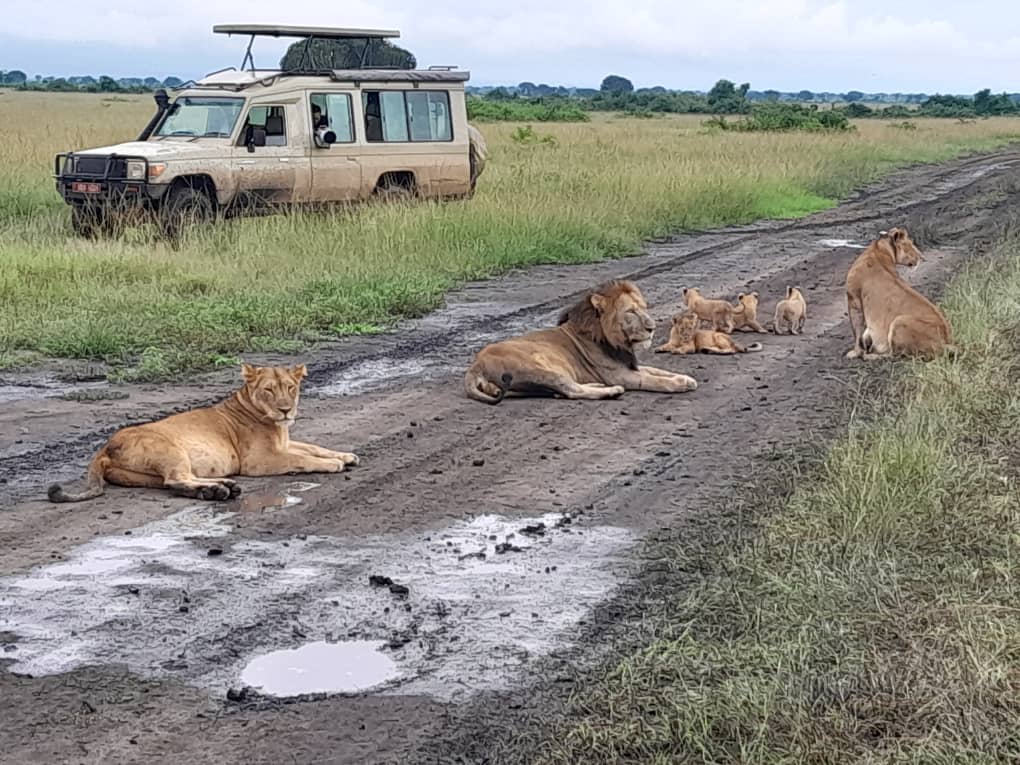
Somewhere down there, if the afternoon has gone well, a lioness is draped along the limb of a fig tree with her paws hanging loose in the air, entirely unbothered by gravity or by the Land Cruiser idling underneath her
TOURISM
The road drops out of the Kichwamba Escarpment just before dusk, and for a moment the whole floor of the Rift Valley opens beneath the tires: a green-gold plain stitched with crater lakes, threaded by a silver channel, and rimmed in the blue outline of the Rwenzori peaks. Somewhere down there, if the afternoon has gone well, a lioness is draped along the limb of a fig tree with her paws hanging loose in the air, entirely unbothered by gravity or by the Land Cruiser idling underneath her. This is Queen Elizabeth National Park, and it has always specialized in scenes that should not, by the ordinary rules of the animal kingdom, be possible.
Uganda's second-largest protected area sprawls across nearly 2,000 square kilometers of Kasese District in the country's west, a patchwork of savanna, wetland, forest and crater country wedged between Lakes Edward and George. It was carved out in 1952 as Kazinga National Park, named for the channel that still forms its beating heart, then rechristened two years later after a royal visit by the young Queen Elizabeth II. Seven decades on, the crown is gone but the crown jewel remains: a park so ecologically layered that a single day's drive can move a visitor from open grassland thick with Uganda kob to euphorbia forest, from a hippo-choked waterway to volcanic craters holding lakes the color of jade.
The Kazinga Channel is where most visits find their rhythm. The 40-kilometer waterway links the two great lakes and, along its banks, gathers what may be the highest concentration of hippopotamus on the continent — pods numbering in the hundreds, their grunts rolling across the water like distant thunder. A boat cruise along the channel in the low light of morning or late afternoon is as close as an African safari gets to a guarantee: buffalo herds wading to their bellies, elephants dusting themselves red at the shoreline, monitor lizards flattened on the mud, and overhead a traffic of pelicans, herons and the odd fish eagle folding out of the sky for a strike. Birders come to Queen Elizabeth for a reason that borders on the absurd — more than 600 species have been recorded here, north of ten percent of everything that flies on the African continent, including the shoebill stork in the Kyambura wetlands and flocks of lesser flamingo that occasionally paint the crater lakes pink.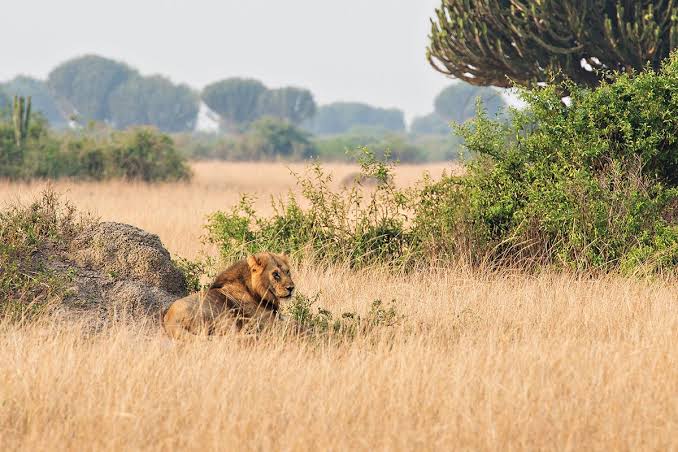
But the park's signature, the thing that gives it its magazine-cover fame, is thirty kilometers south in the Ishasha sector, hard against the Democratic Republic of Congo border. There, for reasons still debated by biologists — escaping the heat, escaping tsetse flies, or simply a learned habit passed down through generations — the resident lions climb. They lounge in the broad, low forks of candelabra and fig trees for hours at a stretch, four or five animals draped over a single limb like abandoned laundry, and the sight has become one of the most photographed behaviors in African wildlife tourism. It is also, this year, a more fragile thing to witness than it used to be. Uganda's newly released State of Wildlife Resources Report puts the national lion population at 291 animals, down nearly 22 percent from 373 just three years earlier — and within Queen Elizabeth specifically, researchers recorded a 45 percent decline over five years, driven chiefly by wire snares set for bushmeat that maim and kill lions as bycatch. Guides in Ishasha now talk about the tree-climbers with a mixture of pride and worry, aware that the animals drawing tourists from every continent are also, quietly, running out of runway. Elephants have fared better — the park's population remains Uganda's largest, part of a protected area total holding relatively steady even as the national picture shows a slight decline — and Kyambura Gorge, a forested slash in the earth nicknamed the "Valley of Apes," still shelters a small, habituated community of chimpanzees that visitors can track on foot beneath a canopy of colonizing figs.
Getting to Queen Elizabeth typically means a seven-to-eight-hour drive from Kampala through Mbarara or Fort Portal, a route increasingly treated as an attraction of its own thanks to roadside stops for Rwenzori coffee and views into the western crater fields; travelers short on time fly into the park's own airstrips at Mweya, Kasese or Kihihi from Entebbe. Entry costs USD 40 per day for foreign non-residents, USD 30 for foreign residents, and UGX 20,000 for East African citizens — modest by international park standards, though boat cruises, game drives, chimp permits and guided walks are priced separately. The dry seasons, roughly December to February and June to September, bring the best game viewing as animals cluster near permanent water, though the park's location straddling the equator means wildlife is visible year-round and the wetter months reward visitors with a greener, quieter landscape and superb birding. Mweya Peninsula, jutting into the channel itself, remains the park's lodging hub, ringed by savanna where kob rut in the open grass within sight of the rooms.
This Week in Ugandan Tourism
Queen Elizabeth is, this week, more than a destination — it is one of the headline acts in a national promotion. The Uganda Wildlife Authority has waived entrance fees at five protected areas from September 25 to 27, 2026, timed to coincide with World Tourism Day: Queen Elizabeth, Murchison Falls, Lake Mburo and Kidepo Valley National Parks, plus Pian Upe Wildlife Reserve. Officials are quick to note that "other fees apply" — guides, activities, transport and accommodation are unaffected — but the gesture has put a fresh flush of visitors through park gates this weekend.
The marquee World Tourism Day event itself lands on September 27 in Mbale, on the grounds of Mbale Secondary School, where the Ministry of Tourism is staging exhibitions and a regional conference under the theme of digital technology and artificial intelligence in travel, using the occasion to spotlight Mount Elgon, Sipi Falls and Eastern Uganda's coffee tourism circuit.
The timing follows a strong year for the sector: government figures put 2025 international arrivals at 1.642 million, up from 1.371 million in 2024, with tourism earnings near USD 1.62 billion. Earlier this month, on September 18, the Uganda Tourism Board hosted editors and media producers at a breakfast engagement in Kampala, where marketing chief Francis Nyende confirmed the board is courting sports federations to bring events tied to the 2027 Africa Cup of Nations, which Uganda will co-host — a signal that the tourism pitch to international visitors is being rebuilt well ahead of the tournament.
And in a longer-arc development still shaping the sector's direction, the Uganda Tourism Board formally joined the World Travel & Tourism Council this year as a destination partner, a move UTB chief executive Juliana Kagwa described as a platform to position Uganda as "competitive and sustainable on the world stage" — even as, in parks like Queen Elizabeth, the same growth in visitor numbers sits alongside a conservation report warning that the tree-climbing lions those visitors come to see are declining faster than almost anywhere else in the country.
For now, though, the lions are still there, still climbing, still making a nonsense of what a cat is supposed to do with an afternoon. Anyone who can get to Ishasha this week — with the gate fee waived and the light turning gold over the escarpment — will see exactly why Queen Elizabeth earned its name twice: once for a queen, and once for the sheer, improbable royalty of what still moves through its grass.



