Written By |
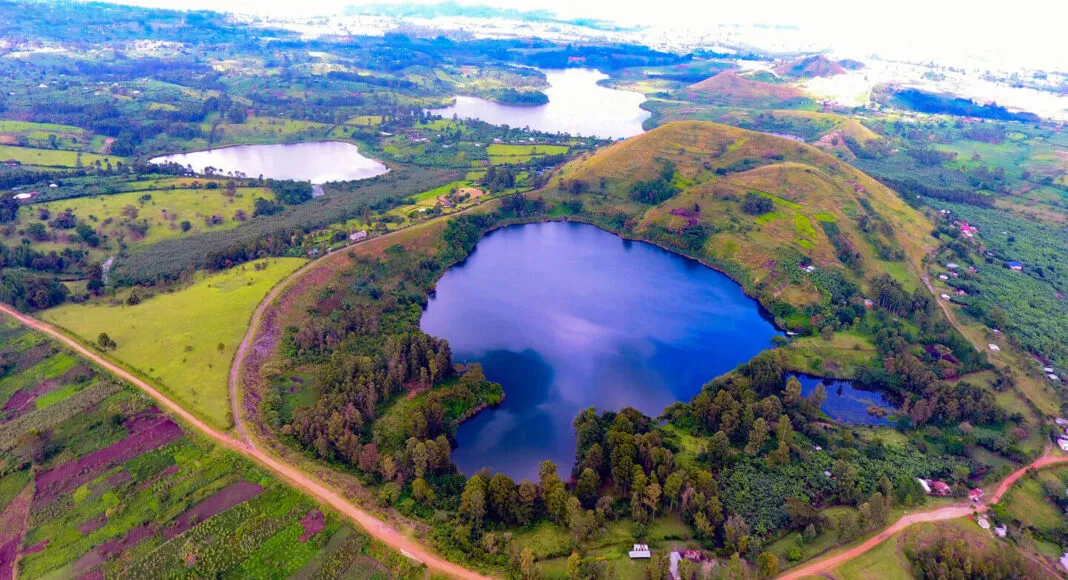
Fort Portal and the crater lakes of Tooro — a landscape of volcanic bowls, tea hills and royal drums in the shadow of the Mountains of the Moon
The road out of Fort Portal towards Kasenda does not announce what is coming. It climbs gently through tea, the bushes clipped flat and green as billiard baize, past children selling roasted maize and men pushing bicycles stacked improbably high with matoke. Then the ridge falls away on your left, and there it is: a perfect circle of water, several hundred feet below, so still and so deeply blue that the first instinct is to distrust it. This is Lake Nyinambuga — the view Ugandans carry in their wallets, engraved on the 20,000-shilling note — and it is only the first of roughly fifty such lakes scattered across the hills south and west of the city.
Fort Portal sits at around 1,500 metres in Uganda's far west, the administrative seat of Kabarole District and the ancient heart of the Tooro Kingdom. It was elevated to city status on 1 July 2020 and designated, uniquely among Uganda's cities, as the country's Tourism City. The title is not marketing puffery. Within ninety minutes of its roundabouts lie three national parks, the second-highest mountain range in Africa, one of the world's great chimpanzee forests, and a volcanic field of extraordinary beauty that most visitors drive straight past on their way somewhere else.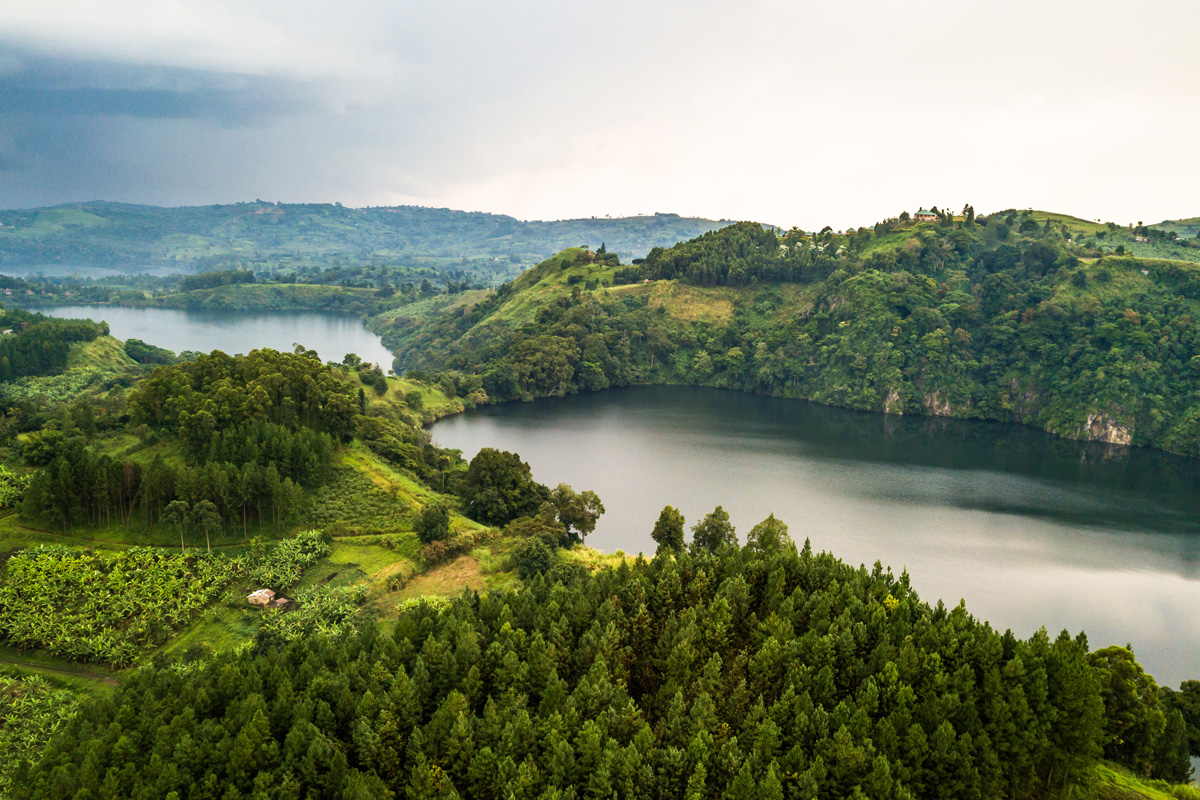
The crater lakes are the youngest part of this landscape and the most dramatic. Between roughly eight and ten thousand years ago — recent enough that the ancestors of the people farming these slopes today would have watched it happen — a series of violent phreatomagmatic explosions punched holes through the earth along the eastern shoulder of the Albertine Rift. Groundwater met rising magma, flashed to steam, and blew out craters in a matter of seconds. Rain and springs did the rest. What remains is the Ndali–Kasenda crater field, a cluster of more than thirty lakes within a ten-kilometre stretch, with further fields around Fort Portal town and southward towards Kasese.
Each lake has its own temperament. Nkuruba is ringed by a surviving fringe of natural forest where black-and-white colobus and vervets crash through the canopy at dawn, and a long-running community campsite has kept the trees standing. Kifuruka is small, shallow and fringed with papyrus, good for birds. Nyabikere — 'the lake of frogs' — earns its name after dark. Kyaninga, north-east of the city, is the deepest and the most theatrical: steep forested walls dropping to water so clear the far shore seems closer than it is, crossed by a suspension of wooden walkways from the cliff-top lodge. Crucially, many of these lakes carry no bilharzia risk, which makes them among the very few bodies of water in Uganda where swimming is straightforwardly safe. Ask locally before you go in.
The classic way to see them is not from a vehicle. A guided walk of three to four hours links a string of craters by footpath, threading between banana gardens and vanilla plots, and climbs to the viewpoint that everyone here calls Top of the World — a grassy shoulder from which, on a clear morning, you count lake after lake stacked into the distance with the snow of the Rwenzori floating above them. Guides come from the villages you walk through, which is precisely the point: this is one of the few Ugandan attractions where the money reaches the people whose land you are crossing more or less directly.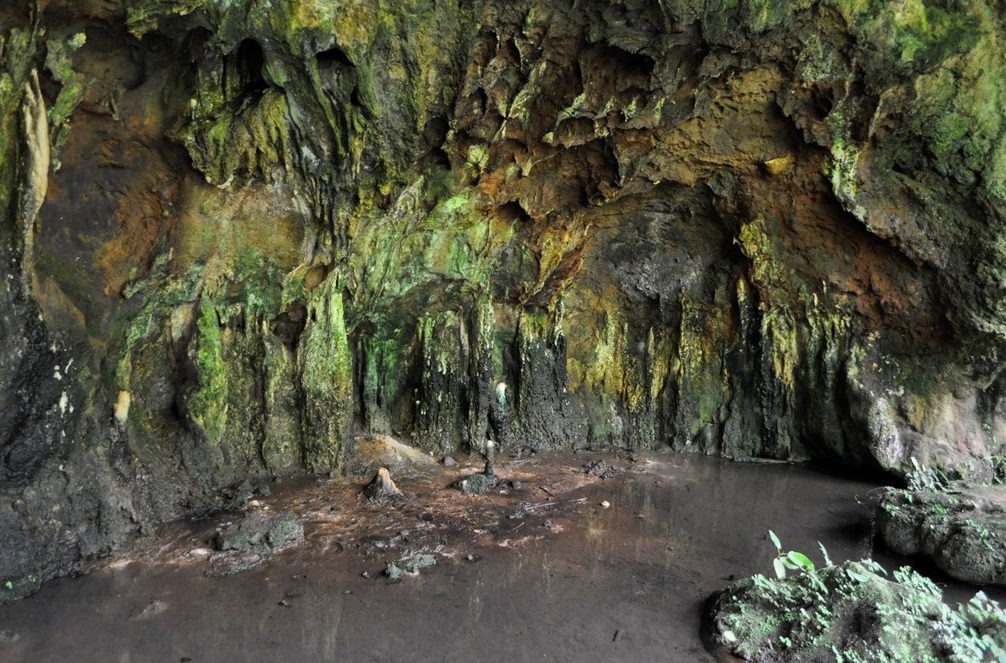
Fort Portal's other inheritance is a royal one. The Tooro Kingdom broke away from Bunyoro in the 1830s and survives today with its palace, the Karuziika, on a hill above the town — a domed, whitewashed building that looks out over the valley and is open to visitors with a guide. The kingdom's most famous modern fact is its monarch: Oyo Nyimba Kabamba Iguru Rukidi IV, crowned in 1995 at the age of three and one of the youngest reigning monarchs in the world. The royal tombs at Karambi, a few kilometres along the Kasese road, hold his predecessors.
Five miles out on the Bundibugyo road lie the Amabere ga Nyinamwiru — literally 'the breasts of Nyinamwiru'. They are not quite caves; the site is a mossy overhang behind a waterfall where mineral-rich water has built stalactites that drip a milky white calcite. The legend attached to them is one of Uganda's best: Nyinamwiru, daughter of the tyrant Bukuku, was mutilated by her father to prevent her marrying and bearing an heir who would depose him, and the rock is said to nurse the child she bore regardless. The falls and the short forest walk around them take under an hour. Entrance is modest — currently around UGX 7,500 for Ugandan adults, UGX 18,500 for East African residents and UGX 41,500 for non-East African visitors, with a reduced student rate — and a local guide is included.
Fort Portal is roughly 300 kilometres west of Kampala, a four-and-a-half to six-hour drive on tarmac via Mubende, and coaches run the route daily. The city also connects south to Kasese and Queen Elizabeth National Park, west to Semuliki and the Bundibugyo escarpment, and north towards Murchison Falls. Kibale National Park, where chimpanzee tracking is the headline activity, is about forty minutes away at Kanyanchu; Rwenzori Mountains National Park and Semuliki are each within two hours. That concentration is why so many itineraries use Fort Portal as a base rather than a stop.
The drier months — roughly December to February and June to August — give the firmest footpaths and the clearest mountain views, but the crater lakes are at their most photogenic in the shoulder seasons, when afternoon storms build over the Rwenzori and the light goes copper. This is western Uganda: rain is possible in any month, and a wet-weather layer and proper walking shoes matter more than they do on a vehicle-based safari. Accommodation spans genuine luxury (Kyaninga Lodge's crater-rim cottages, Ndali Lodge's terrace above Nyinambuga) through mid-range farm stays to community campsites at Nkuruba and Lake Nyabikere for a fraction of the price. Book crater-rim lodges well ahead in high season; the villages have room year-round.
Fort Portal City's own tourism plan is unusually specific about where it wants to be: more than 150,000 visitors a year by 2030, 25,000 local jobs, and over UGX 10 billion in annual tourism revenue for Kabarole. The Visit Tooro platform took that pitch to the Pearl of Africa Tourism Expo in May, bundling chimpanzee trekking, crater-lake walks and cultural tourism with dozens of local hospitality operators under a single banner — an attempt to sell the region as a destination in its own right rather than a fuel stop between gorillas and game drives.
Free park entry, 25–27 September. The Ministry of Tourism, Wildlife and Antiquities has confirmed three Open National Park Days this week, with entry free to both Ugandan and foreign visitors across the protected-area network. For Fort Portal-based travellers that means Kibale, Semuliki and Rwenzori gate fees waived — though activity permits such as chimpanzee tracking are charged separately as usual.
World Tourism Day lands in Mbale, 27 September. Uganda's national celebration closes a month-long programme at Mbale Secondary School Grounds under the global theme 'Tourism and Sustainable Transformation', with Uganda framing its own edition around the digital agenda and artificial intelligence in redesigning travel. The choice of Mbale continues the policy of rotating the national event into secondary destinations.
UTB courts the editors, 19 September. The Uganda Tourism Board convened editors and producers from the major media houses at the Kampala Serena Hotel for a breakfast on marketing direction, quality assurance and the regulatory environment. The framing — tell Uganda's story with us, not after us — points squarely at the run-up to AFCON 2027, which Uganda co-hosts with Kenya and Tanzania and which the sector is treating as its largest inbound opportunity in a generation.
Permit rules bed in. The Uganda Wildlife Authority's tariff revision, effective February 2026, holds high-season gorilla permits at USD 800 for foreign non-residents with a USD 600 low-season rate in April, May and November, and UGX 300,000 for East African citizens. Two procedural changes from 1 March have had more practical effect than the pricing: the seven-day reservation hold is gone, so permits now require payment in full at booking, and foreign visitors must book through a licensed Ugandan tour operator.
Tourism awards go to sustainability. The European Union Mission in Uganda and UTB used POATE 2026 to launch an awards programme recognising conservation, community tourism, hospitality and storytelling — a deliberate nudge towards the community-run model that places like Nkuruba have been operating, largely unsupported, for three decades.



