Written By |

In Kidepo Valley, Uganda's loneliest and most cinematic wilderness, rhinos have come home and an international airport is rising from the Karamoja plain
TOURISM
There is a moment on the approach to Kidepo Valley National Park — somewhere past Kotido, where the tarmac surrenders to red murram and the acacia thins into open grass — when the sky simply gets bigger. The Napore range folds away to the west. Ahead, the Morungole massif stands like a wall against South Sudan. And then the land drops open into a savannah so wide and so empty that the first instinct of nearly every visitor is to stop the vehicle, get out, and say nothing at all.
Kidepo has been called Africa's last true wilderness so often that the phrase has worn smooth, but the arithmetic behind it still holds. This is 1,442 square kilometres of semi-arid savannah wedged into Uganda's far north-eastern corner, sharing borders with South Sudan and Kenya, and reached from Kampala by a road journey that can stretch beyond ten hours. Fewer people visit Kidepo in a year than visit Queen Elizabeth National Park in a good month. That inaccessibility has been its curse commercially and its salvation ecologically — and in 2026, both halves of that equation are being rewritten at once.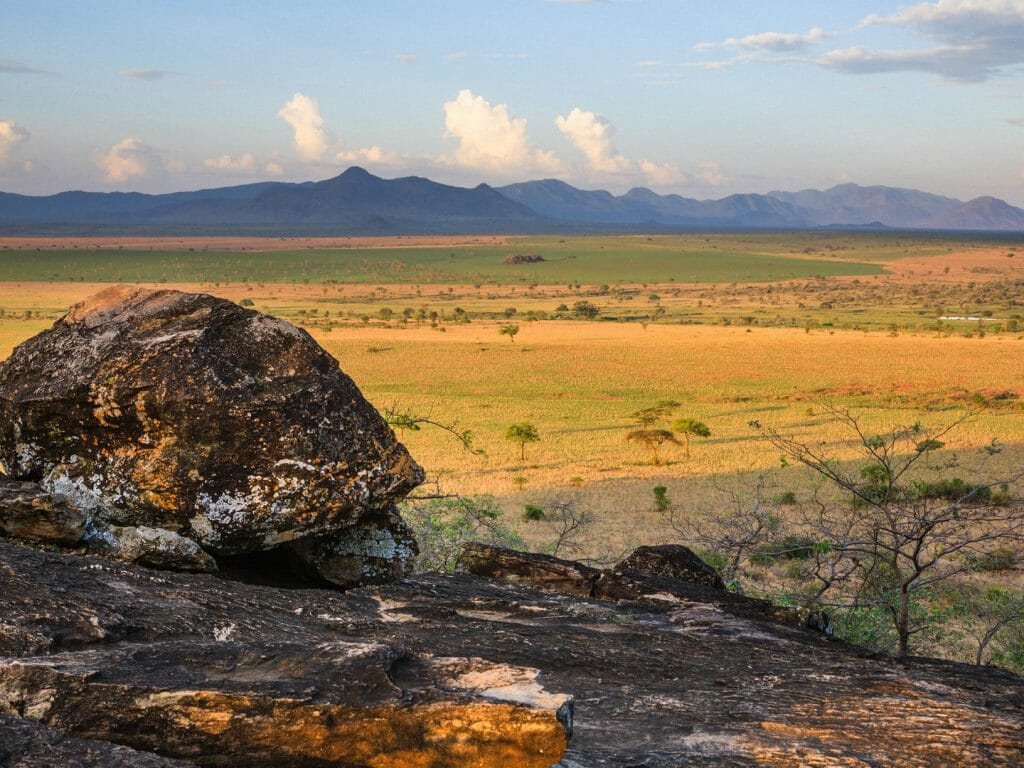
A Park Born With the Nation
Kidepo's history is bound up with Uganda's own. The British colonial administration gazetted the area as a game reserve in 1958, displacing the Dodoth pastoralists who grazed the plains and the Ik farmers who worked the higher slopes — a dispossession whose echoes still shape community relations here. Four years later, in 1962, the year Uganda raised its own flag, the reserve was elevated to national park status. It has carried the country's fortunes ever since: emptied out by poaching and insecurity through the 1970s and 1980s, quietly rebuilt across the 2000s, and now, cautiously, being marketed to the world.
The park is built around two river valleys that give it its character and its rhythm. The Narus Valley, in the south-west near the Apoka headquarters, holds water year-round in remnant pools and wetlands, and is where almost all game viewing happens. The Kidepo Valley to the north-east is drier, sandier, and starker — the Kidepo River itself runs only seasonally, leaving a broad bed of white sand fringed by borassus palms that looks, in the late afternoon, less like Uganda than like a stage set for a film about somewhere else entirely.
What Lives Here
Kidepo's wildlife list runs to 77 mammal species and roughly 476 birds, but the numbers understate how different the cast is from the rest of Uganda. This is the only Ugandan park where you can reasonably hope for cheetah. It is one of very few places in the country holding ostrich, greater and lesser kudu, Bright's gazelle, and the caracal. Buffalo move across the Narus in herds numbering in the thousands — the park's total population is estimated between 10,000 and 15,000 — and when they run, the dust column is visible from kilometres away.
The recovery stories are the ones that stay with you. Elephant numbers, driven down to around 200 by the early 1990s, are now estimated between 650 and 1,000. The Rothschild's giraffe population, reduced at its lowest ebb to a mere three animals, has been rebuilt past 50 through protection and translocation. Lions here have developed the same habit as their Ishasha cousins of draping themselves over rocky kopjes, though in Kidepo the perch is granite rather than fig branch. Leopard, spotted hyena, black-backed jackal and bat-eared fox fill out a predator guild that feels more Serengeti than Albertine Rift.
And since March of this year, Kidepo has held rhino for the first time in more than four decades. On 17 March 2026, the first two of a planned eight southern white rhinos arrived from the Ziwa Rhino Sanctuary in Nakasongola; four have now made the journey, with the remainder to follow. Uganda's last wild rhino was killed in the early 1980s. Their return to a park that watched them disappear is, by any measure, the most significant thing to happen to Ugandan conservation this decade.
Beyond the Game Drive
Kidepo rewards visitors who look past the wildlife. The Kanangorok hot springs, roughly ninety minutes north-east of Apoka and within sight of the South Sudanese border, bubble up through what the Karamojong call the place of black stones — the only thermal springs in the entire Karamoja region, and reached by a drive that doubles as one of the park's finest game transects. Higher up, the Morungole mountains hold the Ik, one of Uganda's smallest and most studied ethnic groups, hunter-gatherers-turned-cultivators who withdrew to the ridgelines to escape cattle raiding. Visiting requires a full day's strenuous hike and, more importantly, a guide arrangement that ensures the community is properly compensated rather than merely photographed.
Karamoja itself is increasingly the point rather than the detour. Manyatta visits, Karamojong dance, and the region's brutal, beautiful sorghum-and-cattle landscape have become part of the itinerary for operators working out of Moroto and Kaabong, and the cultural product here is now far stronger than it was even five years ago.
Practical Notes for the Traveller
Timing: the dry months from September through March are the prime window, with water scarce and game concentrated on the Narus pools. September is a particularly good bet — the rains have just eased, the grass is still green enough to photograph well, and the crowds, such as they ever are in Kidepo, have not yet arrived. April, May and the November short rains bring lush scenery, cheaper rates and harder driving.
Getting there: by road it is a committed 10-to-12-hour drive from Kampala via Gulu and Kitgum, or via Mbale and Moroto if you want the Karamoja route. By air, Aerolink operates scheduled flights from Entebbe to the Apoka airstrip, typically on Wednesdays, Fridays and Sundays, with a flight time of roughly two hours and fifteen minutes. Charter options serve the lodges directly.
Costs: under the Uganda Wildlife Authority conservation tariff, park entry for foreign non-residents has been running at USD 40 per person for 24 hours, with reduced rates for children aged 5 to 15 and free entry under five. Note that the tariff cycle turned over on 1 July 2026, so confirm current rates with UWA or your operator before budgeting. Gates open at 07:00 and close at 19:00; night drives must be booked in advance.
Sleeping: Apoka Safari Lodge, ten stone-and-canvas rooms set among the kopjes near park headquarters, remains the flagship. UWA's own Apoka Rest Camp offers bandas and camping at a fraction of the price, and Kidepo Savannah Lodge and Adere Safari Lodge sit outside the gates for mid-range budgets. Book early: the total bed count in and around Kidepo is smaller than a single mid-sized Kampala hotel.
This Week in Ugandan Tourism
Free entry to every national park, 25–27 September
The Uganda Wildlife Authority has confirmed its 2026 Open Park Days for 25 to 27 September, waiving entry fees at national parks countrywide for both Ugandans and foreign visitors. The three-day window runs straight into national World Tourism Day celebrations, hosted this year in Mbale on 27 September. UWA's acting Commissioner for Tourism and Business Development, Dorcus Rukundo, framed the initiative around domestic travel: before we celebrate World Tourism Day, she said, let us first explore Uganda. For anyone weighing a Kidepo trip, this is the cheapest gate you will ever walk through.
Kidepo International Airport breaks ground
Construction formally began in June 2026 on Kidepo International Airport in Karenga District, launched by President Yoweri Museveni. The USD 72 million project — financed through the Sharjah Chamber of Commerce and Industry in the UAE — includes a 3.6-kilometre asphalt runway capable of handling aircraft far larger than anything the current Apoka airstrip can accept. More than 1,600 Ugandans are already employed on site, and a parallel plan would upgrade Nadunget airstrip in Moroto. If delivered, it collapses a ten-hour drive into a short hop and fundamentally changes who can reach Karamoja.
Rhinos return to Kidepo after forty years
The translocation of southern white rhinos from Ziwa Rhino Sanctuary to Kidepo Valley National Park, which began on 17 March 2026, has now moved four of a planned eight animals. A separate January transfer sent four rhinos to Ajai Wildlife Reserve in the north-west. Uganda's national rhino population now stands at around 61, boosted by eight animals imported from South Africa in December 2025 to widen the gene pool. UWA has paired the moves with habitat preparation, drone-assisted monitoring and community engagement — and to date, not one of Uganda's reintroduced rhinos has been poached.
New UWA tariff cycle takes effect
The conservation tariff period that ran from July 2024 expired on 30 June 2026, and revised rates announced by UWA in February have now taken hold. Standard gorilla trekking permits for foreign non-residents sit at USD 800, with a low-season rate of USD 600 during April, May and November — the first time Uganda has formally discounted permits by season. The gorilla habituation experience in Bwindi's Rushaga sector is scheduled to rise to USD 1,800 from 1 January 2027. Travellers holding older quotes should re-confirm with their operators.
Uganda Airlines adds Accra and Kigali
The national carrier announced in August that it will open passenger and cargo service to Accra on 27 October 2026 and to Kigali on 18 November 2026. The Kigali sector is short but strategically useful, knitting together the two halves of the region's gorilla circuit and easing business and family traffic. It lands amid a broader scramble — reporting this year has tracked a queue of carriers seeking to launch Uganda routes, and operators have been vocal that thin domestic connectivity, not international lift, is what still keeps parks like Kidepo out of reach.



