Written By |

Murchison Falls National Park sprawls across roughly 3,840 square kilometres of north-western Uganda, straddling the Victoria Nile as it makes its unhurried journey toward Lake Albert and, eventually, the Mediterranean.
UGANDA TOURISM
You hear it before you see it. Long before the trail crests the last shoulder of rock, a low, insistent roar rises out of the gorge — a sound less like a waterfall than like something enormous breathing. Then the path opens, and there it is: the entire River Nile, the longest river on Earth, funnelled into a cleft barely seven metres wide, exploding through the gap in a white fury of spray before crashing forty-three metres into the pool below. Rainbows hang in the mist. The ground trembles underfoot. This is Murchison Falls, the beating heart of Uganda's oldest and largest national park, and on a clear July morning it is one of the most dramatic sights in all of Africa.
A Park Carved by Water and Time
Murchison Falls National Park sprawls across roughly 3,840 square kilometres of north-western Uganda, straddling the Victoria Nile as it makes its unhurried journey toward Lake Albert and, eventually, the Mediterranean. Gazetted in 1952, it is the country's oldest and largest protected area, and its landscapes shift with almost cinematic variety — from the dense, chimpanzee-filled Budongo Forest in the south to rolling savannah grasslands, borassus palm stands, and the papyrus-choked delta where the river spills into the lake.
The falls themselves carry a story stitched into the age of Victorian exploration. In 1862, the explorers John Speke and James Grant became the first Europeans to pass through the region. Two years later, Samuel Baker and his wife Florence charted the falls more thoroughly, and Baker named the cataract after Sir Roderick Murchison, then president of the Royal Geographical Society. The name stuck, though the raw spectacle it describes long predates any of its visitors: for millennia the Nile has been grinding this gap through the rift-valley rock, a slow act of geological violence that continues to this day.
Where the Wild Things Gather
What makes Murchison extraordinary is not only the falls but the sheer density of life the river sustains. The park is home to the classic cast of an African safari — lions moving through the golden grass of the northern Buligi sector, elephants crossing the tracks in loose family herds, buffalo, leopards, and a rich supporting cast of antelope including the Ugandan kob, Jackson's hartebeest, and oribi. Overhead and along the banks, more than 450 bird species make Murchison a birder's paradise, among them the prehistoric-looking shoebill stork that stalks the delta reeds.
The Nile below the falls holds one of the densest concentrations of hippopotamus and Nile crocodile anywhere on the continent. It is this stretch of water that gives the park its signature experience: the boat safari. Cruising upstream from Paraa toward the base of the falls, visitors drift within metres of yawning hippos and sun-basking crocodiles, while elephants and buffalo come down to drink at the water's edge. As the boat nears the cataract, the roar swells and the spray drifts across the deck — an encounter with raw natural power that few who make it ever forget.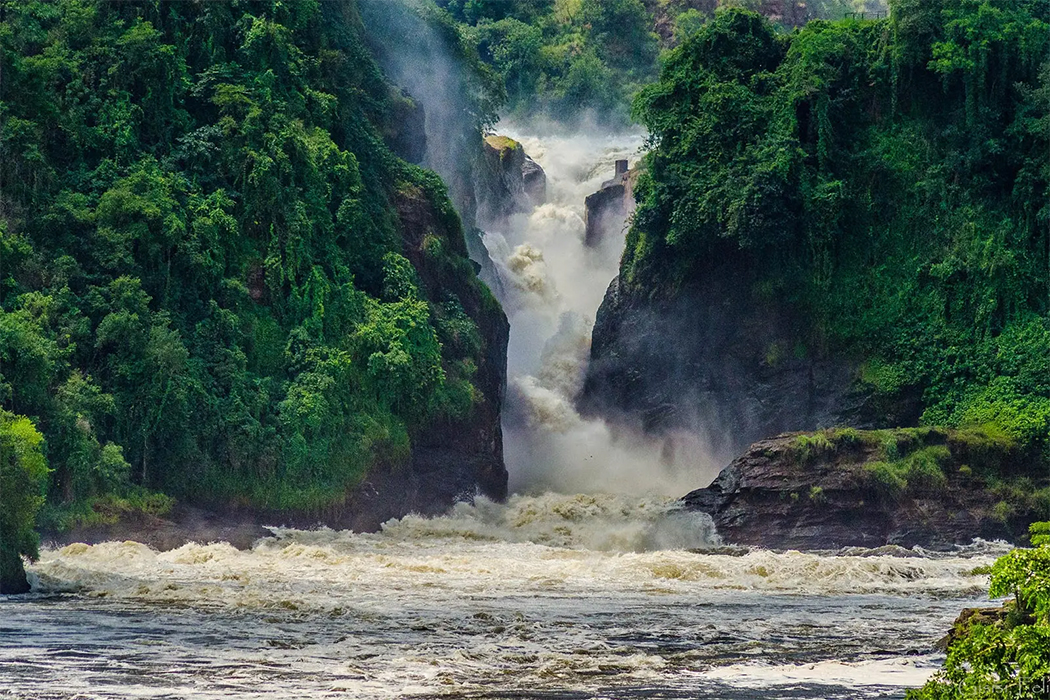
Planning Your Visit
Reaching Murchison is part of the adventure. The park lies roughly a five-to-six-hour drive north-west of Kampala, and the journey can be broken with a stop at the Ziwa Rhino Sanctuary — the only place in Uganda to track white rhino on foot. For those short on time, chartered flights serve the Pakuba and Bugungu airstrips inside the park.
Under the Uganda Wildlife Authority conservation tariff running through June 2026, daily park entry costs US$40 for foreign non-residents, US$30 for foreign residents, and UGX 20,000 for East African citizens, with reduced rates for children aged five to fifteen. Each ticket is valid for twenty-four hours, and fees can now be paid at the gates by card or by mobile money through MTN and Airtel. Signature activities carry their own modest charges on top of entry: guided game drives, the celebrated Nile boat cruise to the base of the falls, the short but steep hike to the top of the cataract (about US$15), guided nature walks, and — for chimpanzee tracking — a foray into the neighbouring Budongo Forest.
Timing matters. The dry seasons, from December to February and June to August, concentrate wildlife around the shrinking water sources and firm up the tracks for game drives, making them the most rewarding months for animal viewing. Paradoxically, the wet-season months bring the falls themselves to their most ferocious, when swollen water levels turn the cataract into a genuinely thunderous display. A July visitor, arriving now, gets close to the best of both worlds: reliable game viewing under mostly dry skies, with the river still running strong.
This Week in Ugandan Tourism
Uganda's tourism sector is enjoying an unusually buoyant stretch, and several developments are worth watching as the mid-year travel season peaks:
Rhinos have returned to Kidepo Valley. In a landmark conservation moment launched on 17 March 2026, white rhinos were reintroduced to Kidepo Valley National Park after more than four decades of local extinction — a major step in restoring one of Uganda's most iconic lost species to the wild north-east.
Uganda joined the World Travel & Tourism Council. The Uganda Tourism Board was formally welcomed as a WTTC Destination Partner, a significant vote of global confidence that positions the country more competitively on the international stage alongside the world's leading travel brands.
A Pan-African cultural-tourism alliance. UTB sealed a partnership with the Pan-African Tourism Board aimed at deepening cultural and heritage travel, an initiative framed around telling Africa's story in Africa's own voice and drawing visitors to Uganda's people, history and traditions.
'Best in Show – Africa' in New York. Destination Uganda took top honours at the 2026 Travel & Adventure Show in New York, recognised for the immersive, experiential quality of its offering — the kind of accolade that translates directly into North American interest.
Gorilla-permit prices in flux. Travellers eyeing Uganda's flagship gorilla experiences should note that the current UWA tariff cycle ends on 30 June 2026. Standard gorilla-trekking permits held at US$800 through that date, with the habituation experience at US$1,500; a new tariff — and widely anticipated increases — takes effect from 1 July 2026, so budgets for late-2026 trips may need revisiting.
Uganda's momentum shows in the numbers, too. Officials have set ambitious 2026 arrival and revenue targets on the back of rising wildlife populations, and the country's confirmed role as a co-host of the 2027 Africa Cup of Nations, alongside Kenya and Tanzania, promises a further surge of international attention in the years ahead.
At Murchison, that momentum has a soundtrack — the ceaseless thunder of a great river forcing itself through a gap in the rock, as it has for longer than any of us can imagine. Come for the lions and the hippos; stay for the sound of the falls.



