Written By |

At Mgahinga, three dormant volcanoes, eleven gorillas and a displaced people share thirty-four square kilometres
MGAHINGA GORILLA NATIONAL PARK, KISORO DISTRICT
The road out of Kisoro climbs for ten kilometres and then simply stops, because ahead of it three volcanoes have arranged themselves across the horizon like an argument nobody won. Muhabura wears cloud as a habit. Gahinga squats between its neighbours, broad and unhurried. Sabinyo — the name means "old man’s teeth" — breaks into a jagged crown of peaks so worn that the mountain looks less like geology than dentistry. Somewhere on their lower slopes, in a belt of bamboo that hisses when the wind moves through it, eleven mountain gorillas are having breakfast.
This is Mgahinga Gorilla National Park, and at 33.7 square kilometres it is the smallest national park in Uganda — small enough that you could walk across it in a morning, small enough that it fits inside a rounding error on Murchison Falls. It is also, arguably, the densest concentration of things worth seeing anywhere in the country. Gorillas and golden monkeys. Three summits over 3,400 metres. A hundred and fifteen bird species, two dozen of them found nowhere on earth but the Albertine Rift. And, threaded through all of it, the memory of the people who lived here first and were asked to leave.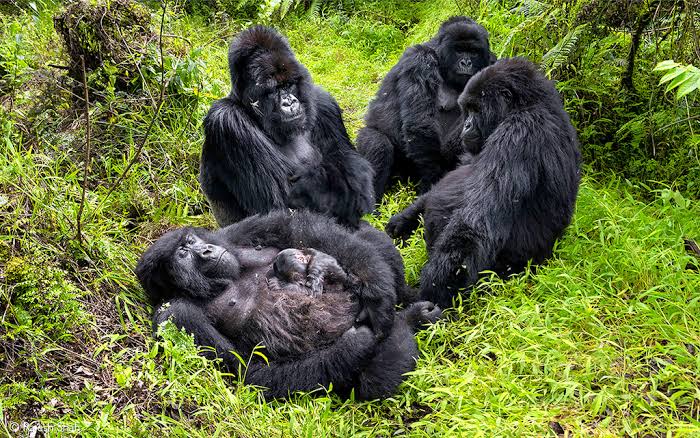
A sanctuary, a park, and a border that isn’t one
The British administration declared this corner of the Virungas a game sanctuary in 1930, and for six decades it held that ambiguous status — protected on paper, farmed and hunted in practice. Uganda gazetted it as a full national park in 1991, and the timing mattered. Mgahinga was not created to stand alone. It was created as Uganda’s contribution to the transboundary Virunga Conservation Area, stitched to Rwanda’s Volcanoes National Park along its southern edge and to the Democratic Republic of Congo’s Virunga National Park to the west.
The gorillas, of course, never consulted the map. The Virunga population moves freely across all three countries, and Mgahinga’s modest acreage functions less as a self-contained ecosystem than as one room in a very large house. This is why the park’s smallness is misleading. A gorilla family bedded down on Sabinyo’s Ugandan flank on Monday may be in Rwanda by Thursday, which is precisely the point of a transboundary park and also, occasionally, the frustration of visitors who arrive to find that Uganda’s only habituated family has stepped out.
That family is the Nyakagezi group, and it is one of the more unusual social arrangements in mountain gorilla research. As of 2026 the group numbers eleven, and it contains five silverbacks — an extraordinary count, given that adult males in this species typically cannot tolerate one another. Nyakagezi is led by the dominant silverback Mark, with his brothers Mafia, Rukundo and Ndugutse holding rank beneath him in a coalition that has, so far, refused to fracture. Only eight visitors are permitted to track them in a single day.
For years Nyakagezi were notorious wanderers, disappearing over the Rwandan border for months at a stretch and making Mgahinga a gamble rather than a destination. They have grown markedly more settled in recent seasons, and the park has quietly shed its reputation as the place where gorilla trekking happens in theory.
The golden monkeys, and the mountains above them
If the gorillas are Mgahinga’s headline, the golden monkeys may be its better story. This is the only place in Uganda where the species has been habituated, and the encounter is nothing like a gorilla trek. Where gorillas are still and enormous and faintly melancholy, golden monkeys are a riot — burnished orange flanks flashing through bamboo, twenty or thirty animals crashing between stems, entirely unbothered by the humans craning below. They are endangered, they are endemic to this narrow volcanic corridor, and an hour with them is a good deal noisier than an hour with a silverback.
Above the bamboo, the volcanoes offer the most under-sold hiking in East Africa. Mount Gahinga, at 3,474 metres, is the gentlest — roughly six hours up and down, finishing at a swampy crater on the summit. Muhabura is the hard one, a relentless cone with a small crater lake at the top and, on the rare clear day, a view that takes in the entire Virunga chain and a good portion of Rwanda. Sabinyo is the strangest: the route climbs a series of ladders bolted to rock, and the final summit is the exact point where Uganda, Rwanda and the DRC meet. You can stand in three countries at once, which is a novelty that survives the thin air.
Then there is the Batwa Trail, which is not an add-on. The Batwa lived in this forest as hunter-gatherers for millennia and were evicted when the park was gazetted, becoming conservation refugees in their own homeland. The trail is led entirely by Batwa guides who walk visitors through the forest they no longer inhabit — demonstrating hunting technique, medicinal plants, fire-making — and ends in the Garama Cave, once a royal refuge. It runs four to five hours and it is, by some distance, the most affecting thing on offer here. It also asks an uncomfortable question about who conservation is for, and it does not soften the answer.
Practical notes for the traveller
Mgahinga sits about ten kilometres south of Kisoro town in Uganda’s far south-west, roughly nine to ten hours’ drive from Kampala, or a short hop by air to Kisoro airstrip. Most visitors fold it into a Bwindi itinerary, which is sensible — the two parks are a few hours apart and complement each other well.
The drier months of June to September and December to February offer the firmest trails and the clearest volcano views, and September falls squarely in the better half of that. The Virungas make their own weather regardless; bring rain gear in any month, and expect cold nights at altitude. Golden monkey tracking and the Batwa Trail run year-round.
On fees: Uganda Wildlife Authority revised its primate tariff on 1 July 2026, and rates have moved. Volcano climbing and the Batwa Trail are each quoted at around USD 80 for foreign non-residents, USD 70 for foreign residents and UGX 50,000 for East African citizens, inclusive of park entry. Gorilla permits saw the largest change — the four-hour habituation experience rose from USD 1,500 to USD 1,800, while standard trekking permits for foreign non-residents are being quoted variously between USD 800 and USD 1,000 depending on source and season, with a reduced low-season rate in April, May and November. Note also that since 1 March 2026 UWA no longer holds permits unpaid: full payment is now required at the moment of booking. Given the spread in published figures, confirm current rates directly with UWA or a licensed operator before budgeting.
Book early regardless. With a single habituated family and eight permits a day, Mgahinga is the most supply-constrained gorilla destination in the country, and September is peak season.
This Week in Ugandan Tourism
Free park entry, 25–27 September. The Uganda Wildlife Authority has confirmed its 2026 Open Park Days for 25 to 27 September, waiving entry fees at national parks countrywide. Announced by State Minister for Tourism Susan Nsambu Nakawuki during a tour of Murchison Falls and Ajai Wildlife Reserve, the offer applies to Ugandans and foreigners alike, with no nationality restriction. Note that free entry covers gate fees, not gorilla or golden monkey permits.
World Tourism Day heads to Mbale, 27 September. National celebrations will be held at Mbale Secondary School grounds under the theme "Digital Agenda and Artificial Intelligence to Redesign Tourism." Siting the event in the east is a deliberate decentralisation push, spotlighting the Elgon region’s waterfalls, Mount Elgon National Park, coffee tourism and cultural heritage.
Half-year figures show receipts outpacing arrivals. Ministry of Tourism statistics record 739,815 international visitors between January and June 2026 — a 3.7 per cent rise year on year. Tourism receipts climbed far faster, up 25.6 per cent to roughly UGX 2.3 trillion, while average length of stay lengthened from 7.4 to 8.3 nights. Visitors are staying longer and spending more, which is the harder metric to move.
Uganda Airlines adds Accra and Kigali. Announced in early August, the carrier will begin four weekly flights to Accra from 27 October 2026 and daily service to Kigali from 18 November. Tourism operators have welcomed the Kigali link in particular — it shortens the connection into the shared Virunga circuit that Mgahinga anchors on the Ugandan side.
Permit rules tightened. Two changes now shape gorilla bookings: the 1 July tariff revision lifting habituation permits to USD 1,800, and the 1 March end of the seven-day unpaid hold. Operators report both are pushing itineraries to be locked in earlier, with peak-season permits moving six to twelve months ahead.



