Written By |

Mount Elgon spent a century being described as the quiet one. This month, Uganda's entire tourism calendar climbs its slopes.
Stand on the rim of Mount Elgon's caldera at first light and the thing that unsettles you is not the altitude. It is the scale of the absence. Where the summit should be, there is a bowl forty square kilometres wide, floored with tussock grass and steaming faintly where hot springs push up through the volcanic rock, ringed by a broken crown of peaks. Something enormous used to stand here. What remains is the negative space it left behind.
The Bamasaba, who farm the mountain's western slopes, have never needed the geology to explain it. To them the mountain is Masaba, their founding ancestor, and they do not so much live beneath it as descend from it. When a Mugisu says he is going up to Masaba, the grammar is genealogical before it is geographical. For most of the last thirty years this has been Uganda's most under-visited great mountain — overshadowed by the gorillas to the southwest and the Rwenzori's glaciers to the west. That changes on 27 September, when Uganda holds its national World Tourism Day celebrations in Mbale, at the mountain's foot, and points the full apparatus of the state's tourism machinery east for the first time.
A volcano built on an unreasonable scale
Mount Elgon is an extinct shield volcano straddling the Uganda–Kenya border, and its statistics tend to arrive in superlatives that need a moment's unpacking. Its base sprawls across roughly 4,000 square kilometres, the largest volcanic footprint of any mountain on earth — a distinction it holds not by being tall but by having erupted, over an estimated twenty-four million years, in broad low sheets rather than a steep cone. Erosion has since taken the roof off. Wagagai, the high point at 4,321 metres, sits on the Ugandan side and ranks eighth in Africa and fourth in East Africa, but it is a shoulder on the caldera rim rather than a summit in any dramatic sense. The walk to it is long rather than technical: no ropes, no ice, no permits beyond the park fee and a ranger.
Uganda gazetted its flank as a national park in 1993, protecting some 1,121 square kilometres, and UNESCO added the transboundary massif to its network of biosphere reserves in 2005. The ascent is really a journey through four worlds stacked on top of each other. You start in montane forest thick with podocarpus and wild olive, climb into a belt of bamboo that creaks and clatters in the wind, break out onto open heath, and finally arrive in Afro-alpine moorland — that strange high-altitude botanical garden of giant lobelia and tree groundsel that looks less like Africa than like a set designer's idea of another planet. Roughly three hundred bird species have been recorded, and the ones worth the altitude live near the top: Jackson's francolin, the moorland francolin, the black-collared apalis, and the lammergeier, which rides the thermals over the caldera on a three-metre wingspan and drops bones onto rocks to crack them open.
The larger mammals are present but shy — elephant, buffalo, bushbuck, giant forest hog — and the honest advice is that nobody should climb Elgon expecting a game drive. What they should expect is the caves. Generations of elephants have mined the mountain's salt-bearing volcanic caves with their tusks, walking hundreds of metres into the dark to do it; the most famous of these, Kitum, lies across the border on the Kenyan flank, but Uganda has its own in Khauka Cave on the Wanale ridge above Mbale and Tutum Cave on the Sipi route, both of them cool, dripping, and considerably older than any story told about them.
Four ways up, and one very good reason to stay low
Four trails lead to the caldera, and choosing between them is mostly a question of how much time you have. The Sasa Trail from Budadiri is the shortest and the cruelest, gaining altitude fast enough that most people feel it, and takes about four days round trip. The Sipi Trail from Kapkwai covers roughly 56 kilometres over four days and has the advantage of passing Tutum Cave and starting near the waterfalls. The Piswa Trail from Kapkwata is the gentlest, a seven-day, 49-kilometre amble through the northern forests that rewards patience with the best birding. The Suam route follows the gorge and the hot springs. All treks inside the park must be accompanied by Uganda Wildlife Authority rangers.
And yet a great many visitors never go up at all, which is not the failure of ambition it sounds like. Sipi Falls, a three-tiered cascade on the lower slopes near Kapchorwa whose main drop runs close to a hundred metres, sits just outside the park boundary and has quietly become the region's centre of gravity — abseiling down the rock face beside the water, short hikes linking the three tiers, and the coffee. Bugisu Arabica grows on these slopes between roughly 1,600 and 1,900 metres, and the farm tours around Sipi and Cheema village are the rare agritourism product that is genuinely worth doing: you pick, pulp, dry, roast over a fire and drink the result in an afternoon, usually in the company of the family that owns the trees.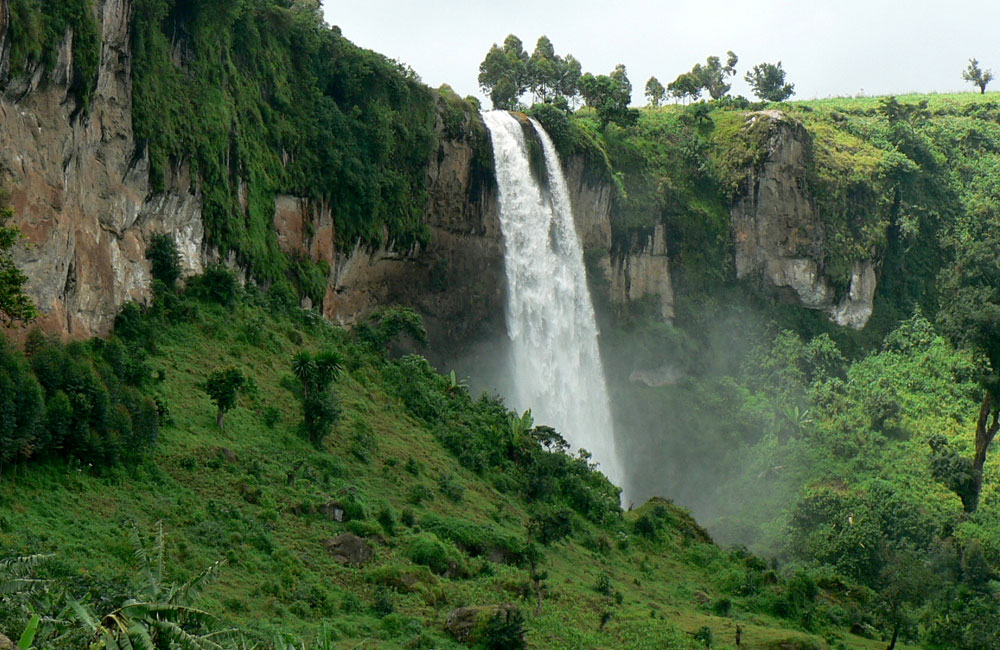
Practical information
Park entry for Mount Elgon has been running at around USD 40 per day for foreign non-residents, USD 30 for foreign residents and UGX 20,000 for East African citizens, with full guided trekking packages typically quoted from about USD 75 to USD 100 per person per day once ranger fees, camping and porters are included. Uganda Wildlife Authority revised its conservation tariffs for the 2026–2027 period, with several changes taking effect from 1 July 2026, so confirm current rates directly with UWA or a licensed operator before budgeting.
Mbale is the gateway, roughly 245 kilometres from Kampala on tarmac — four to five hours in normal traffic — with Budadiri about an hour further and Kapchorwa around ninety minutes north. The drier windows are June to August and December to March; the long rains fall March to May and a second wet season runs roughly September to November, which means anyone climbing this month should pack for mud and cloud and treat the summit as a bonus rather than a guarantee. Nights on the moorland drop below freezing regardless of season. A four-season sleeping bag is not optional, and gaiters are the single most useful thing in the bag.
This Week in Ugandan Tourism
Mbale takes the national stage (4 September). Tourism minister Tom Butime confirmed Mbale as host of Uganda's national World Tourism Day celebrations on 27 September, under the global theme "Digital Agenda and Artificial Intelligence to Redesign Tourism." A campaign branded Explore Uganda – Masaba Edition will bring media, influencers and operators into the Elgon region, and President Museveni is expected at the main event. Uganda Tourism Board chief executive Juliana Kagwa framed the choice bluntly, saying she had opened her tenure by visiting Mount Elgon and Sipi Falls and been struck by how few people outside Uganda knew such places existed.
Half-year arrivals up, park visits down. At the same launch, the ministry released figures showing 793,815 international visitors between January and June 2026, a 3.7% rise on the same period in 2025. Tourism receipts climbed 25.6% to roughly UGX 2.3 trillion and average length of stay lengthened from 7.4 to 8.3 nights. Butime paired the good news with a warning about a reported decline in national park visits, urging the sector to extract more value per visitor rather than chase volume.
Free park entry, 25–27 September. Uganda Wildlife Authority's Open Park Days return ahead of World Tourism Day, waiving entrance fees at eight protected areas — among them Murchison Falls, Queen Elizabeth, Kidepo Valley, Lake Mburo and Pian Upe Wildlife Reserve — for three days. State Minister for Tourism Susan Nsambu Nakawuki announced the window, with UWA's acting commissioner for tourism Dorcus Rukundo putting the pitch simply: explore Uganda before celebrating it.
Imbalu season runs through December. The Bamasaba launched the 2026 Imbalu circumcision season at Mutoto Cultural Centre in Mbale in early August before a crowd estimated above 50,000. Held only in even-numbered years, the initiation rite now rolls across Bugisu's 26 clans until December, with more than 10,000 candidates expected against about 6,024 in 2024 — meaning visitors to the Elgon region this month arrive mid-ceremony. The rite is sacred rather than staged; photography and attendance should be negotiated through local guides, not assumed.
Uganda Airlines adds Accra and Kigali. The national carrier has scheduled new services from Entebbe to Accra beginning 27 October and to Kigali from 18 November, extending its network across West and East Africa. Operators have welcomed the routes as a boost to regional connectivity and to Entebbe's standing as a gateway hub.
Fees, dates and schedules are current as of 12 September 2026 and should be confirmed with the Uganda Wildlife Authority, the Uganda Tourism Board or a licensed operator before travel.



