Written By |

In Kibale National Park, thirteen kinds of primate share one canopy — and the loudest of them are our closest relatives
The sound arrives before anything else does. It begins as a single rising whoop somewhere off the trail, climbs into a scream, and within seconds the whole forest is answering — a wall of hooting and drumming on buttress roots that seems to come from every direction at once. Your guide stops walking, tilts his head, and grins. Somewhere in the green above the Kanyanchu trail, roughly a hundred chimpanzees have decided it is time to say something.
This is Kibale National Park, 766 square kilometres of moist evergreen forest draped across the western Ugandan highlands between Fort Portal and the northern edge of Queen Elizabeth National Park. Ecologists tend to describe it in superlatives, and for once the superlatives are earned: Kibale holds one of the highest densities and diversities of primates anywhere on the African continent — around thirteen species sharing a single canopy — alongside some 371 recorded bird species, 351 species of tree, and roughly 77 mammals in total. But the animal that fills the buses and the lodges is the East African chimpanzee, and Kibale has more of them than anywhere else in Uganda: an estimated 1,200 to 1,450 individuals.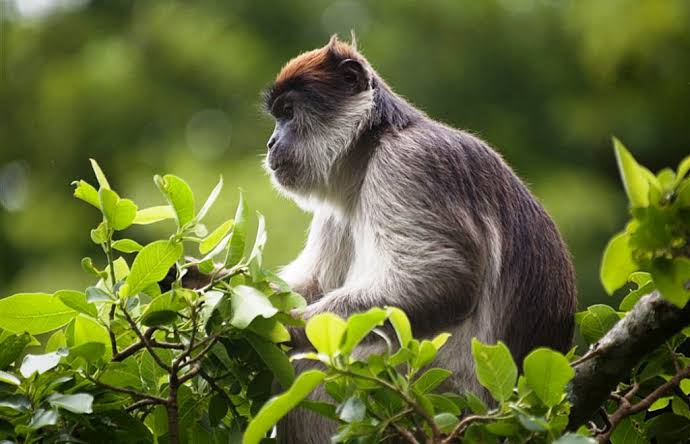
A Forest of Neighbours
What makes Kibale unusual is not simply the number of primates but how visibly they coexist. Walk a morning transect and you may pass grey-cheeked mangabeys arguing in the mid-storey, a troop of red colobus flowing across a gap in the canopy, black-and-white colobus draped over branches like discarded scarves, and red-tailed monkeys shadowing the group at a nervous distance. L'Hoest's monkeys, blue monkeys and olive baboons round out the cast. The forest sits between roughly 1,100 and 1,600 metres in elevation, and that altitudinal range — combined with a transition zone where lowland rainforest gives way to montane forest — is a large part of why so much can live here at once.
Kibale is also, quietly, one of the most intensively studied forests in the tropics. The Kibale Chimpanzee Project has followed the Kanyawara community for decades, and deeper in the park's centre the Ngogo Chimpanzee Project monitors what is believed to be the largest chimpanzee community ever recorded — a group that at its peak numbered close to 200 animals before splitting into two. Ngogo's chimpanzees became unexpectedly famous through the Netflix series Chimp Empire, which introduced a global audience to the politics, alliances and territorial violence of a society that behaves unnervingly like our own. That research presence matters for visitors, too: decades of habituation work are precisely why a tourist can stand thirty metres from a wild chimpanzee at all.
What a Visit Actually Looks Like
Almost every visitor begins at the Kanyanchu Visitor Centre, the park's tourism hub just off the Fort Portal–Kamwenge road. Guided chimpanzee treks leave twice daily, at 8:00 a.m. and 2:00 p.m., in small groups with a ranger-guide, and typically last two to four hours depending on where the chimps have chosen to spend the morning. Four habituated communities are available around Kanyanchu, and the park reports sighting rates in the region of 85 per cent — high, but not a guarantee, which is worth remembering. Once the group is located, visitors get one hour with them.
For those who want more than an hour, the Chimpanzee Habituation Experience is Kibale's signature offering: a full day in the forest from dawn nest-departure to dusk nest-building, alongside the researchers and trackers doing the slow work of accustoming a community to human presence. It is limited to a handful of visitors at a time and it is the closest a non-scientist gets to the daily rhythm of a chimpanzee community.
Beyond the chimps, the Bigodi Wetland Sanctuary — a roughly four-square-kilometre community-managed reserve about four kilometres from park headquarters — is one of Uganda's genuine community-conservation successes. A raised boardwalk carries walkers through papyrus swamp and gallery forest that shelters some 138 bird species, sitatunga antelope, otters, bush pigs and several of the same primates found inside the park. It is guided by local residents, and the revenue funds village projects; it is also, birders will tell you, better value than almost anything else in the region. Night walks, the Kihingami wetland, and craft villages around Bigodi fill out an itinerary that comfortably supports two or three nights.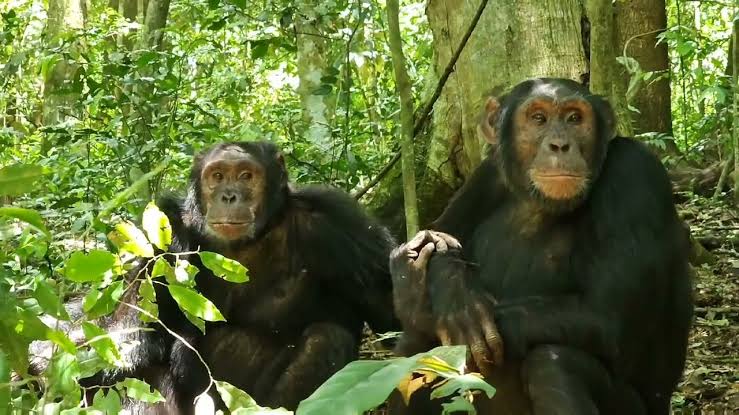
Practical Notes for 2026
Chimpanzee trekking permits at Kibale are currently priced by the Uganda Wildlife Authority at USD 250 for foreign non-residents, USD 200 for foreign residents, and UGX 180,000 for East African citizens. UWA has retained its discounted low-season rate of USD 200 for foreign non-residents during April, May and November — a meaningful saving for travellers with flexible dates. The full-day Habituation Experience runs at USD 300, a rate scheduled to apply at Kibale from January 2027; travellers booking ahead should confirm current figures directly with UWA, as permit pricing has moved more than once in the past two years. Park entry is charged separately from the trekking permit.
The driest months — and therefore the easiest walking — are January and February, and again June and July, though Kibale trekking runs year round and sightings hold up reasonably well through the wetter months. The trade-off in the rains is mud and leeches rather than absent chimpanzees. Kibale sits roughly 320 kilometres west of Kampala, a five- to six-hour drive on tarmac via Mubende to Fort Portal, from which the park is under an hour. It also sits at the heart of a natural western circuit: Queen Elizabeth to the south, the Rwenzori Mountains to the west, Semuliki beyond them, and the Tooro crater lakes on the doorstep. Very few visitors come to Kibale alone, and very few regret pairing it. Bring long trousers, closed boots, a waterproof, and a genuine willingness to walk off-trail; gardening gloves are the unglamorous local secret for grabbing thorny undergrowth.
This Week in Ugandan Tourism
Free national park entry, 25–27 September. The Uganda Wildlife Authority has launched its 2026 Open Park Days, waiving entry fees at national parks for three days from 25 to 27 September. The offer is open to Ugandans and foreign visitors alike, and is pitched squarely at building domestic tourism. UWA's Acting Commissioner for Tourism and Business Development, Dorcus Rukundo, framed it at the launch as an invitation to Ugandans to see their own country first. Note that free entry covers park access, not gorilla or chimpanzee permits.
World Tourism Day heads to Mbale, 27 September. Uganda's national World Tourism Day celebrations will be held in Mbale City this year under the theme "Digital Agenda and Artificial Intelligence to Redesign Tourism." Hosting in the east is a deliberate decentralisation play, showcasing the Elgon region's waterfalls, coffee tourism, cuisine and cultural heritage. A regional tour precedes the main event, which culminates in a concert headlined by Ssuna Ben, Spice Diana, Fik Fameica and Ykee Benda.
Arrivals up 3.7 per cent in the first half. Uganda received 793,815 international visitors between January and June 2026, a 3.7 per cent increase on the same period in 2025. The figure builds on a record 2024, when arrivals reached 1.37 million and tourism earnings rose 26 per cent to USD 1.28 billion — a sector now supporting more than 800,000 jobs and contributing roughly 3.2 per cent of GDP directly.
New air links into Entebbe. Uganda Airlines has confirmed two new regional routes: Entebbe–Accra begins 27 October 2026 with four weekly frequencies, and a daily Entebbe–Kigali service starts 18 November. Domestically, Air Serv launched scheduled Entebbe–Arua flights in August, four times weekly, opening the West Nile sub-region — and Murchison Falls' northern approaches — to a much shorter journey than the road allows.
Permit system evolves at UWA. Following announcements by UWA Executive Director Dr James Musinguzi in April, the authority has been rolling out newly habituated gorilla groups, a rare African golden cat tracking activity, and streamlined permit payment handling. Twenty per cent of permit revenue continues to flow directly to neighbouring communities, funding schools and clinics — the mechanism most often credited for Uganda's mountain gorilla population climbing from around 400 in 2010 to over 500 today.



