Written By |
A night at Kampala’s Ndere Centre, where a country of many tongues learns to hear itself
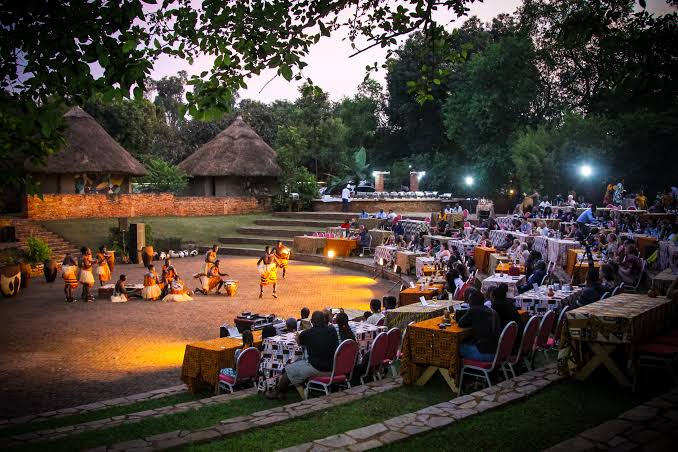
The drums start before the lights do. Somewhere behind the stone terraces of an open-air amphitheatre in Kisaasi, a hand strikes goatskin and the sound arrives in your chest a half-beat before it reaches your ears. Seven hundred seats fall quiet. Then the engoma come in layers — low, mid, high — and Uganda begins to introduce itself, one kingdom at a time.
Ndere Cultural Centre sits on nine acres of manicured green off the Ntinda–Kisaasi road, about twenty minutes from central Kampala when the traffic is merciful and rather longer when it is not. By day it is an unhurried garden compound of lawns, mature trees, a guesthouse and a restaurant — the sort of place office workers drift to for a late lunch. Three evenings a week it becomes something else entirely: the closest thing Uganda has to a national stage.
A troupe born under a mango tree
The story begins not with the buildings but with a schoolteacher. In 1984, Dr Stephen Rwangyezi founded the Ndere Troupe, an ensemble named for the endere — the traditional flute — chosen because the instrument appears, in one form or another, in almost every culture on earth. The symbolism was deliberate. Rwangyezi had grown up watching traditional dance dismissed by colonial and missionary authority as backward, even ungodly, and he wanted an argument rather than a complaint: put the dances on a stage, perform them superbly, and let the audience draw its own conclusions.
The troupe rehearsed, in the founding legend, under a mango tree. It grew into Uganda’s most travelled cultural export, touring Europe, North America and Asia, performing at state functions and international festivals, and — as recently as May this year — appearing at DanceAfrica at the Brooklyn Academy of Music in New York. In 2003, the troupe’s success made a permanent home possible, and the Ndere Centre was opened in Kisaasi by President Museveni. What had been an itinerant company acquired an address.
The repertoire is the real achievement. Uganda recognises some fifty-six distinct ethnic communities, and the troupe performs more than forty authentic dances drawn from across them — not a fused pan-African pastiche, but discrete traditions kept in their own idiom. On any given night you might see the Baganda’s Bakisimba, a graceful royal-court dance whose hips trace the rhythm of abundance and peace; the Banyankole’s Ekitaguriro, in which dancers lift their arms into the long curve of Ankole cattle horns; the Acholi courtship dance Larakaraka, a percussive negotiation between rows of young men and women; the Runyege and Entogoro of Bunyoro and Tooro; the Amaggunju, danced historically for an infant kabaka; and the Karimojong and Kigezi dances that carry the flint and altitude of Uganda’s far corners.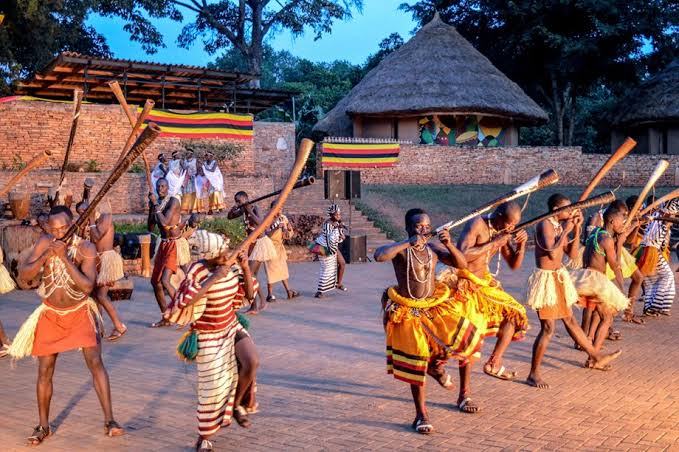
The art of being explained to
What separates a night at Ndere from a hotel-lobby floor show is the narration. Between numbers, a host — often Rwangyezi himself in earlier years — steps forward and explains what you are about to watch: which people it belongs to, what occasion called for it, what the movement means, what the joke is. The commentary is witty, faintly subversive and genuinely instructive, and it turns the evening into something closer to a lecture that happens to have a twenty-piece percussion section. Audiences are teased, invited on stage, and taught to clap in patterns most of them have never attempted.
The set pieces are memorable on their own terms. A dancer balances a tower of clay pots on her head and keeps dancing while more are added. Drummers play nine drums at once. A child, no older than eight, performs a solo that draws the loudest ovation of the night. Whether you arrive knowing a great deal about Uganda or nothing at all, you leave able to name at least three peoples you could not have named before — which, in a country where ethnic identity has so often been political weather, is not a small thing.
Planning a visit
Performances run three nights a week: the Sherehe Show on Wednesdays at 7:00pm, Ndere Friday Night at 7:00pm, and the Katika Sunday family show at 6:00pm. Each runs roughly three hours. Current admission is UGX 55,000 for Ugandan nationals, UGX 95,000 for international visitors, and UGX 30,000 for children aged three to twelve; an optional buffet and barbecue dinner is about UGX 60,000 and is worth taking, both because the food is good and because eating on the lawn before the show is half the pleasure. Prices move, so confirm when you book.
Come early. Gates open well before the drums do, and the hour of daylight before curtain — wandering the gardens, finding a seat on the stone terracing, ordering a drink as the sky goes orange over the trees — is the part regulars protect. Bring a light jacket: Kampala sits at 1,200 metres and the amphitheatre is open to the sky, so evenings cool quickly once the sun is gone, and a rain shower is always possible. The venue is a natural first or last night on a Uganda itinerary, since it is close to the Entebbe road and gives arriving visitors a map of the country’s cultures before they set off for Bwindi or Murchison, or a way for departing ones to tie the journey together. Photography is generally welcome; a tripod and a fast lens will serve you better than a flash.
A house with a mortgage
There is a shadow over the lawns. In 2019 the Ndere Centre borrowed from the Uganda Development Bank to fund expansion — a resort in Kisoro, a hotel at Bbira on the Mityana road — and then the pandemic closed every theatre on earth. A facility of roughly UGX 6.8 billion swelled with arrears to around UGX 10.5 billion, and Rwangyezi has spent much of the last two years appealing publicly for the Centre to be saved from foreclosure. Cabinet has intervened more than once, including a proposal for government to take up shares in the troupe, and the President has directed a bailout; reporting through 2025 indicated the commitment had not yet been fully honoured, and the matter remains unsettled.
It is an uncomfortable footnote to a forty-year achievement, and it is also a fair illustration of a structural problem: Uganda markets itself hard on gorillas and rivers, and rather less hard on the living culture that a visitor can reach in twenty minutes from a Kampala hotel. Cultural tourism generates no permit revenue and no trophy photograph, and it is correspondingly easy to leave off a balance sheet. The most useful thing a traveller in Kampala can do about any of this is buy a ticket.
This week in Ugandan tourism
UTB briefs national editors ahead of AFCON 2027 — 18 September
The Uganda Tourism Board hosted a media engagement breakfast at the Kampala Serena Hotel on Friday, bringing together editors and producers from the country’s major newsrooms. UTB’s heads of marketing, quality assurance and legal fielded questions on standards and the regulatory environment, with much of the discussion pointed at how Uganda packages and commercialises its tourism story before co-hosting the 2027 Africa Cup of Nations.
Free entry to national parks, 25–27 September
The Uganda Wildlife Authority has confirmed its 2026 Open Park Days, waiving entrance fees at selected protected areas — among them Murchison Falls, Queen Elizabeth, Kidepo Valley, Lake Mburo and Pian Upe Wildlife Reserve — from 25 to 27 September. The scheme is aimed squarely at domestic travellers and typically fills gates fast; go early and expect company.
World Tourism Day heads to Mbale, 27 September
National World Tourism Day celebrations culminate in Mbale City on 27 September under the theme “Digital Agenda and Artificial Intelligence to Redesign Tourism.” The month-long programme has focused on how technology can sharpen destination marketing, bookings, visitor information and data analysis — and, not incidentally, puts the eastern circuit around Mount Elgon and Sipi Falls in the national spotlight.
State of Wildlife Resources report launched; Ishasha partnership signed
UWA has published its State of Wildlife Resources in Uganda Report 2026, broadening the traditional wildlife census into a fuller national biodiversity account covering flora, fungi, invertebrates, amphibians, reptiles, birds and bats alongside large mammals. Separately, UWA and the Wildlife Conservation Society have signed a ten-year Conservation Management Partnership for the Ishasha sector of Queen Elizabeth Protected Area, home of the tree-climbing lions.
Gorilla revenue tops UGX 110 billion as new booking rules bed in
UWA reports roughly UGX 110 billion earned from gorilla tourism, part of about UGX 162.5 billion from Bwindi and Mgahinga combined. Under the tariffs introduced this year, a gorilla permit runs USD 800 for foreign non-residents in high season and USD 600 in the April, May and November low-season window, with the habituation experience at USD 1,800. Note the change that catches people out: since 1 March the old seven-day reservation hold is gone, and permits must be paid in full at the time of booking, through a licensed Ugandan operator.



