Written By | Torch Media Africa
A radio telescope in the South African desert has just pulled the faintest signal in cosmology out of raw data — and the observations had been sitting on a hard drive, unloved, since 2018
SCIENCE AND TECH
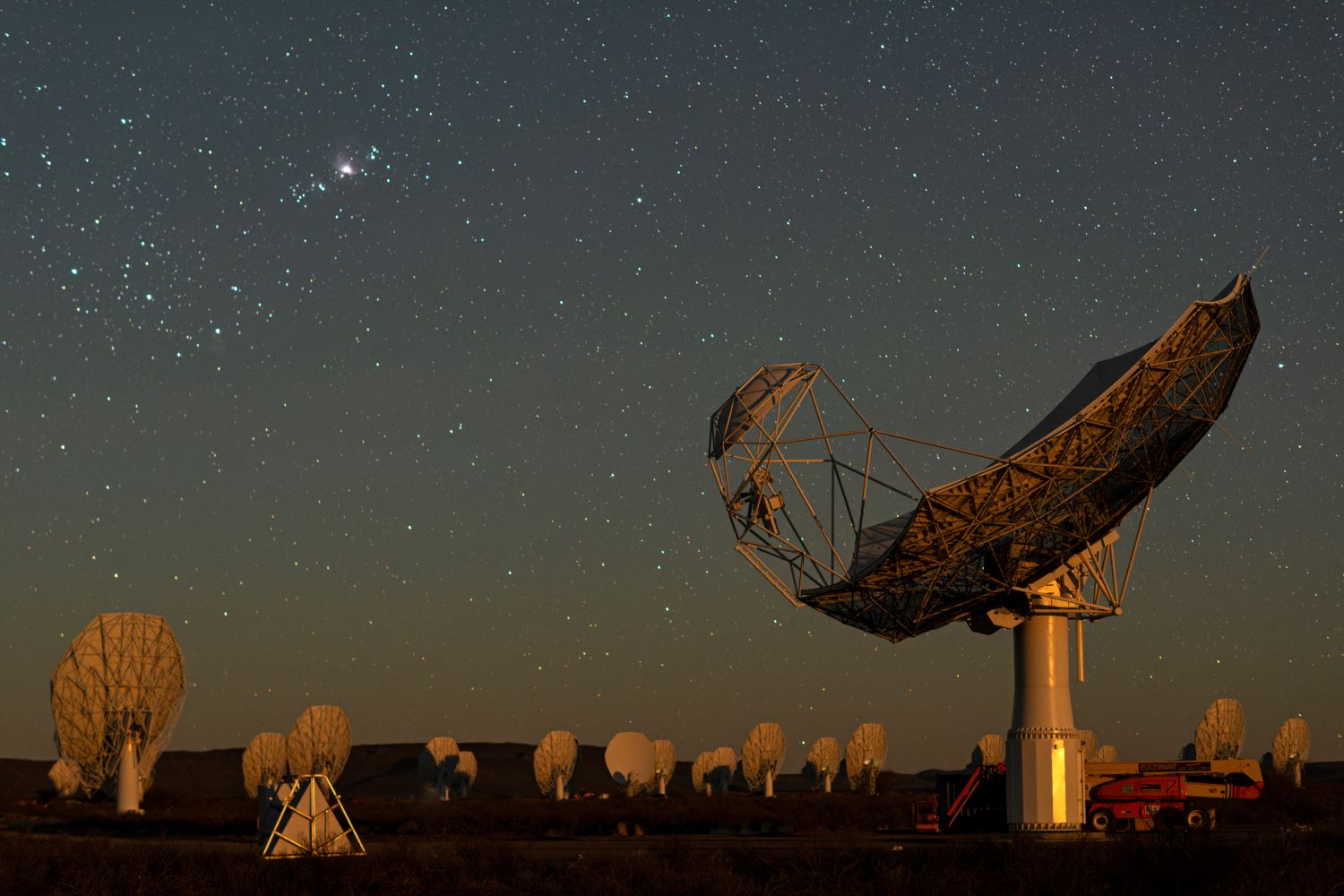
Somewhere out in the scrubland of the Karoo, where the nearest town has one petrol station and mobile phone signals are effectively outlawed by law, sixty-four white dishes have spent years listening to a whisper that set out on its journey before the Earth had finished forming.
Last week, the people listening finally admitted they had heard it.
An international team led out of the University of the Western Cape and the University of Manchester has announced the direct detection of the faint radio hum of hydrogen gas billions of light years away — using nothing but South Africa's MeerKAT radio telescope. No optical galaxy survey to lean on. No cross-referencing against somebody else's catalogue of known galaxies. Just raw radio data, a mountain of computing, and years of stubbornness.
The result, published on 1 September in The Astrophysical Journal Letters under the deceptively dry title "A direct detection of neutral hydrogen intensity mapping on Mpc scales at z ≅ 0.32 and z ≅ 0.44," may turn out to be one of the most consequential things the telescope has ever done. And here is the twist that has astronomers grinning into their coffee: the data were collected in 2018, for an entirely different purpose, and then left alone.
The faintest thing anyone has ever tried to hear
To understand why this matters, you need to understand what hydrogen sounds like.
Hydrogen is the most common substance in the universe — roughly three quarters of all ordinary matter is the stuff. Neutral hydrogen atoms, drifting in the vast spaces between and around galaxies, occasionally undergo a tiny quantum flip. The electron reverses its spin relative to the proton. When it does, the atom releases a photon at a very specific wavelength: 21 centimetres.
Astronomers call this the 21-centimetre line, and it is the closest thing the cosmos has to a universal radio station. Any hydrogen atom, anywhere, at any time in cosmic history, broadcasts on it. As the universe expands, that broadcast gets stretched to longer wavelengths on its way to us — which means the amount of stretching tells you exactly how long the signal has been travelling. Tune your dish to one frequency and you are looking at one slice of cosmic history. Tune it to another and you have travelled through time.
There is one problem. The signal is preposterously, almost insultingly faint.
Not faint like a distant star is faint. Faint like a single conversation held in a stadium during a rock concert. The Milky Way's own radio glow, the synchrotron roar of our galaxy's magnetic fields, sits on top of the cosmic hydrogen signal and is orders of magnitude louder. Add to that the radio emission of thousands of bright foreground galaxies, the electronic quirks of the telescope itself, and the ever-present contamination of human technology — satellites, aircraft transponders, radar, the leakage from somebody's badly shielded electronics forty kilometres away — and the task starts to look absurd.
"Hydrogen intensity mapping has long been seen as a promising way to map the Universe efficiently, but the signal is extremely faint and difficult to isolate from foreground emission, human-made radio-frequency interference, and instrumental effects," said Dr Sourabh Paul, the study's lead author, who holds positions at both Manchester and the University of the Western Cape. "Detecting it directly with MeerKAT shows that this technique is becoming a practical tool for cosmology."
Why not just count the galaxies?
The traditional way to map the universe is to photograph galaxies one at a time, measure how far away each one is, and build a three-dimensional model from millions of individual dots. It works. It has given us the cosmic web — that eerie filamentary structure of galaxy superclusters strung across empty voids like foam in bathwater. But it is slow, and it is expensive, and every galaxy you fail to detect is a hole in your map.
Hydrogen intensity mapping throws that approach out. Instead of resolving individual galaxies, it deliberately blurs them together and measures the total glow of hydrogen in each patch of sky. You lose the ability to say "that's a galaxy, and there's another one." What you gain is speed — enormous, survey-crushing speed. Instead of counting trees you measure the brightness of the forest, and for questions about the large-scale shape of the cosmos, the forest is what you actually wanted all along.
The catch has always been that nobody could cleanly extract the signal at these distances without help. Earlier detections leaned on optical surveys: astronomers would take a catalogue of galaxies whose positions were already known from telescopes working in visible light, then look for a statistical correlation between those positions and the radio data. It works, but it is a crutch. If your radio measurement only becomes visible when you hold it up against somebody else's optical map, you have not really proven that radio alone can do the job.
This team removed the crutch.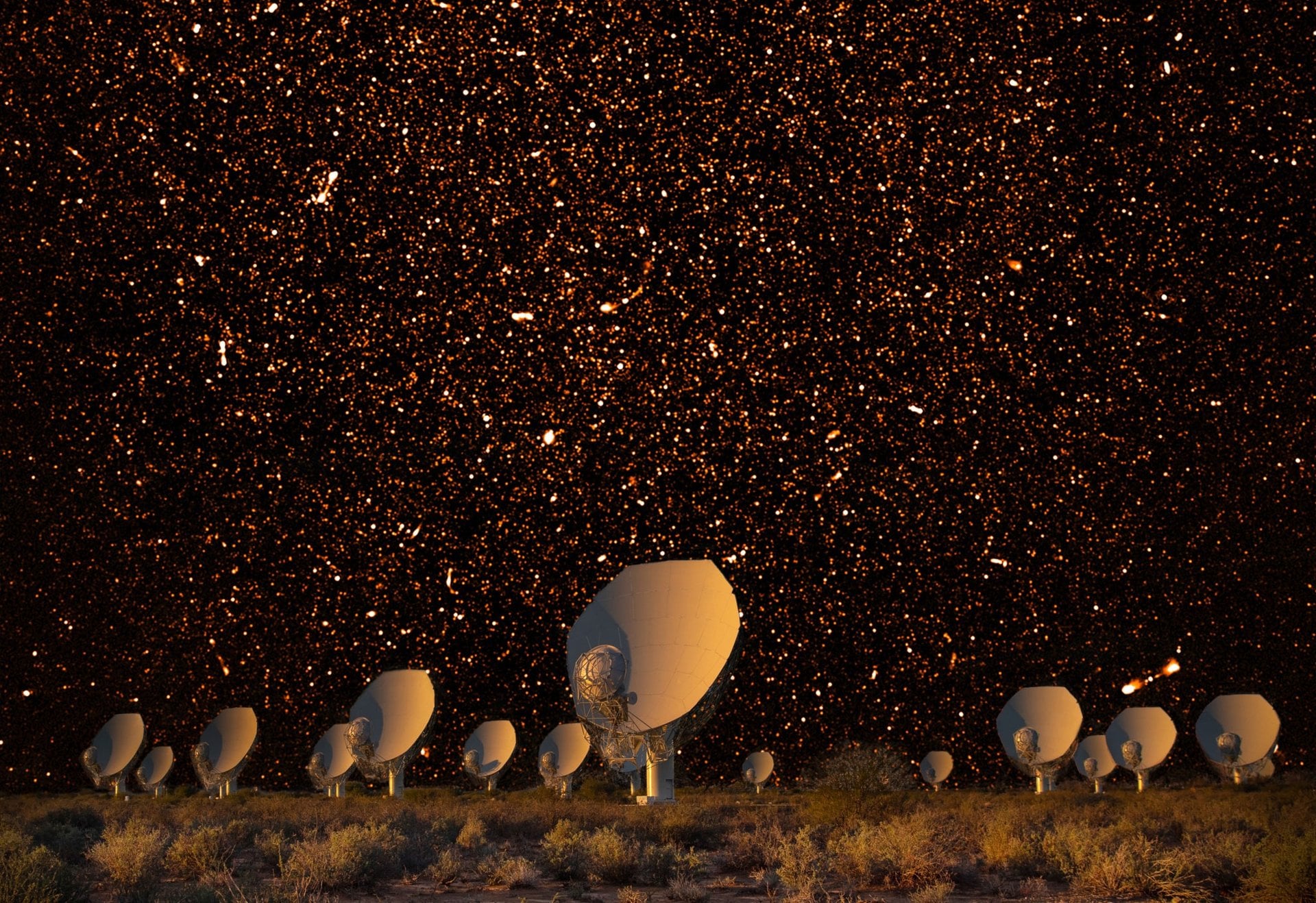
Ninety-six hours, two slices of time
The numbers are worth sitting with. The team analysed roughly 96 hours of MeerKAT observations of a patch of sky known to astronomers as the DEEP2 field. From that, they pulled the hydrogen signal out at two separate points in cosmic history, corresponding to light that has been travelling for approximately four to five billion years before landing on the Karoo.
Put differently: those radio waves left their hydrogen atoms at a time when the Sun and the Earth did not yet exist. They have been in transit ever since, through the expansion of space itself, arriving at last at a set of dishes in the Northern Cape built by a country that only got its first democratic election in 1994.
The measurements trace hydrogen structures across scales of several million light years — roughly the distance between the Milky Way and the Andromeda galaxy, our nearest large neighbour. That is the scale at which gravity organises matter into the cosmic web, and it is precisely the scale cosmologists need to test their theories about dark matter and dark energy.
MeerKAT itself is not a monster by the standards of single-dish astronomy. It comprises 64 dishes, each 13.5 metres across, arranged in the Karoo desert and operated by the South African Radio Astronomy Observatory. Its data were processed for this study on ilifu, the research cloud infrastructure run by the Inter-University Institute for Data Intensive Astronomy — a reminder that modern astronomy is at least as much a computing problem as an optics problem.
The eight-year-old data that turned out to be treasure
Here is the detail that has quietly electrified the field. The observations were not designed for this.
They were taken in 2018, when MeerKAT had only just begun science operations, for entirely different scientific purposes. They sat in an archive. And then a team came along with a new analysis method and found that the signal had been in there the whole time, buried under the noise, waiting for someone with the right technique.
"This was a challenging data analysis process, requiring a detailed understanding of the many sources of contamination that can affect such a faint measurement," said Professor Mário Santos of the University of the Western Cape. "It is particularly remarkable that the data used in this study were taken in 2018, when MeerKAT had only just started science operations. There is now a rich trove of MeerKAT data waiting to be explored with this method."
That last sentence is the part that should make you sit up. It implies there may be a backlog of undiscovered cosmology sitting in archives right now — years of observations taken for other reasons, containing a signal nobody knew how to extract until this month.
Expert perspective: the road to the world's biggest telescope
Professor Laura Wolz of the Jodrell Bank Centre for Astrophysics at Manchester, a co-author on the paper, framed the result as a stepping stone rather than a destination.
"MeerKAT continues to open new windows for cosmology," she said. "The fact that this signal can be extracted from observations that were not originally designed for hydrogen intensity mapping is very encouraging. It shows the enormous scientific value of MeerKAT data and points the way to future observations with SKAO."
SKAO is the Square Kilometre Array Observatory — the largest radio telescope project in human history, currently under construction across sites in South Africa and Australia. MeerKAT is a precursor: its 64 dishes are slated to be folded into the array's mid-frequency instrument, SKA-Mid, alongside well over a hundred additional dishes. Hydrogen intensity mapping is expected to be one of SKAO's flagship science drivers, and until now the technique has been mostly promise and forecast.
Dr Zhaoting Chen, a co-author now at the University of Edinburgh who completed his PhD at Manchester in 2024, explained why the technique matters for understanding galaxies rather than just geometry.
"Neutral hydrogen is one of the key ingredients for understanding how galaxies form and evolve," Chen said. "With intensity mapping, we do not need to detect every individual galaxy. Instead, we can measure the collective signal from hydrogen across large cosmic volumes, giving us a new way to study both galaxy evolution and the underlying matter distribution of the Universe."
Hydrogen is the fuel. Stars form when clouds of it collapse. A map of where the hydrogen is, and how much of it there is at different epochs, is effectively a fuel gauge for cosmic star formation across billions of years.
The bigger prize: dark energy
Behind all of this sits the biggest unsolved problem in physics. The expansion of the universe is accelerating, and nobody knows why. The placeholder name for whatever is causing it is dark energy, and it is thought to make up the large majority of the energy budget of the cosmos.
The way to study dark energy is to measure how cosmic structure has grown over time, with enormous precision, across enormous volumes. Galaxy surveys can do this, but covering the necessary volume galaxy-by-galaxy is punishing. Intensity mapping trades detail for coverage — and coverage is exactly what dark energy studies are starved of. Long-standing forecasts in the field have suggested that a sufficiently large intensity-mapping survey with a full SKA-class instrument could produce constraints on dark energy competitive with the flagship optical surveys.
Those forecasts assumed the technique would eventually work. This month, at these distances, using radio data alone, it did.
What this means for you
No, this will not change your commute. But it changes three things that will outlive most of what else was announced this week.
First, it validates a method. Cosmology has spent a decade arguing about whether hydrogen intensity mapping could ever be cleaned up enough to be trusted. That argument now has a data point on one side of it. Every major radio observatory currently being designed will read this paper.
Second, it is a demonstration that the Global South is not a junior partner in this. The telescope is South African. The lead institution on the paper is South African. The computing infrastructure is South African. The detection was made from a desert in the Northern Cape by a collaboration in which African universities are principals, not sample-collectors. For a continent that has spent much of the last century being described as a place where science happens to people rather than a place where people do science, that distinction is not decoration.
Third, and most practically: it suggests that a great deal of science is already sitting in archives, paid for, collected, and waiting. In an era of tight research budgets, the cheapest telescope is the one you already built.
The bottom line
A quantum flip in a hydrogen atom, four billion years ago, in gas so thin it would qualify as a laboratory vacuum on Earth. A photon released, stretched by the expansion of space across an unimaginable gulf, arriving at a dish in the Karoo in 2018 and being recorded alongside billions of louder, more interesting-looking things.
And then, eight years later, a group of people with the right mathematics found it in the noise.
The universe has been talking the whole time. We are only now learning how to listen properly — and the first serious lesson has been taught from a desert in South Africa.



