From black holes ten times the sun's mass to monsters millions of times heavier, astronomers have found they all follow the exact same hidden trigger before unleashing jets of plasma across the cosmos — and it could rewrite how we hunt for the universe's most dramatic events.
For decades, black holes have kept one of their most spectacular secrets close to the chest: why do some of them erupt in blazing jets of plasma the instant they start feeding, while others gorge in silence for months or years before finally lashing out?
Now, a pair of astrophysicists say they've cracked it — and the answer applies to every black hole in the universe, no matter its size.
In a study published this month in the journal Nature Astronomy, researchers Andrew Mummery of Princeton's Institute for Advanced Study and Adelle Goodwin of Curtin University in Australia report the discovery of a universal trigger point for black hole jet formation: a precise accretion rate, the same fraction of a black hole's theoretical feeding limit, that flips the switch on a jet regardless of whether the black hole weighs as much as ten suns or hundreds of millions of them.
Astronomers are calling it, only half-jokingly, the universal rule for black hole "burps."

THE MAGIC NUMBER: 2%
Every black hole has what's known as its Eddington limit — the maximum rate at which it can theoretically swallow surrounding matter before the sheer radiation pressure generated by all that infalling material pushes back and halts further feeding. It's essentially the black hole's built-in speed limit for a meal.
What Mummery and Goodwin found is that jets — tightly focused, near-light-speed streams of plasma blasted outward from a black hole's poles — don't appear at just any point during that feeding process. They appear at one specific, repeatable threshold: roughly 2% of the Eddington limit, or as the paper puts it in technical terms, a critical accretion rate of approximately 0.02 times the Eddington luminosity.
Cross that 2% threshold on the way down from a much more voracious feeding frenzy, and a black hole launches a jet — like clockwork, whether it's a modest stellar-mass black hole left over from a collapsed star or a supermassive giant anchoring the center of a galaxy.
"We really wanted to figure out this massive puzzle," Mummery said, describing years of frustration among astronomers trying to explain why some supermassive black holes seem to launch jets the moment they start feeding on nearby material, while others hold back for months or years before an outburst arrives, seemingly out of nowhere.
HOW DO YOU CATCH A BLACK HOLE IN THE ACT?
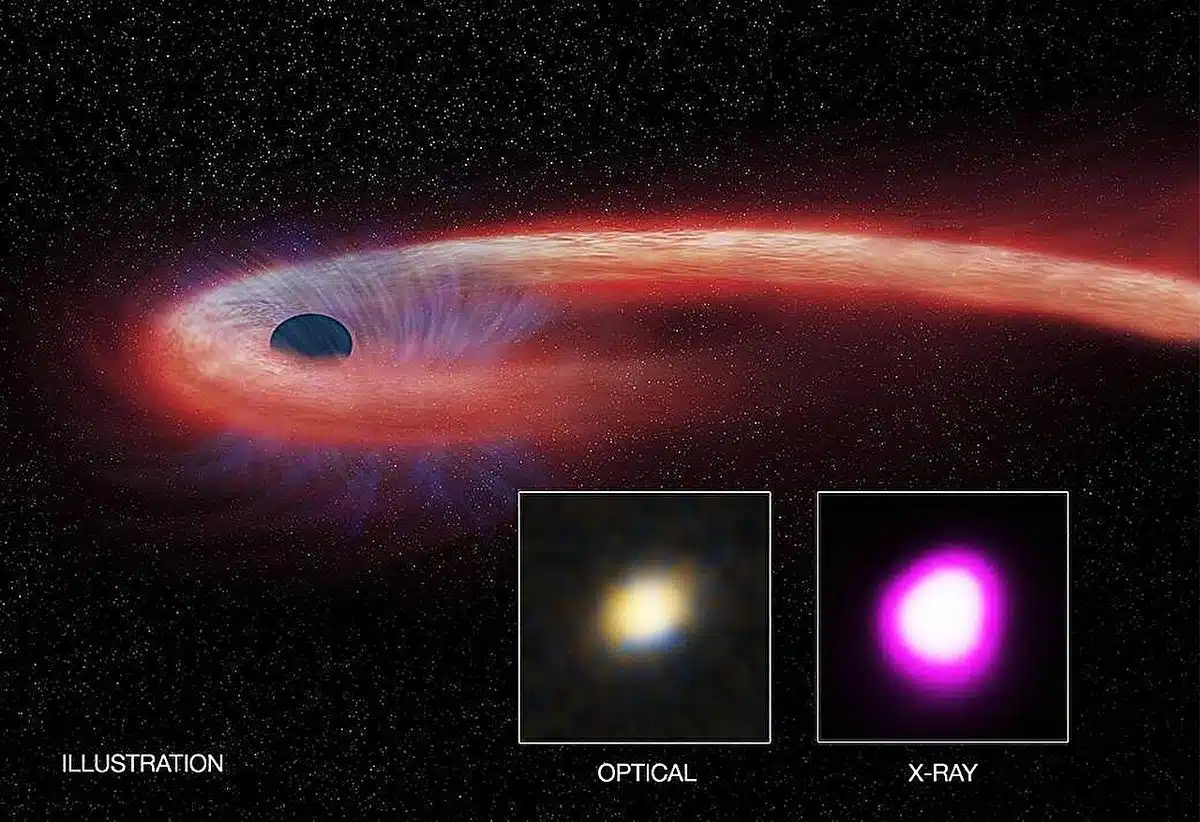
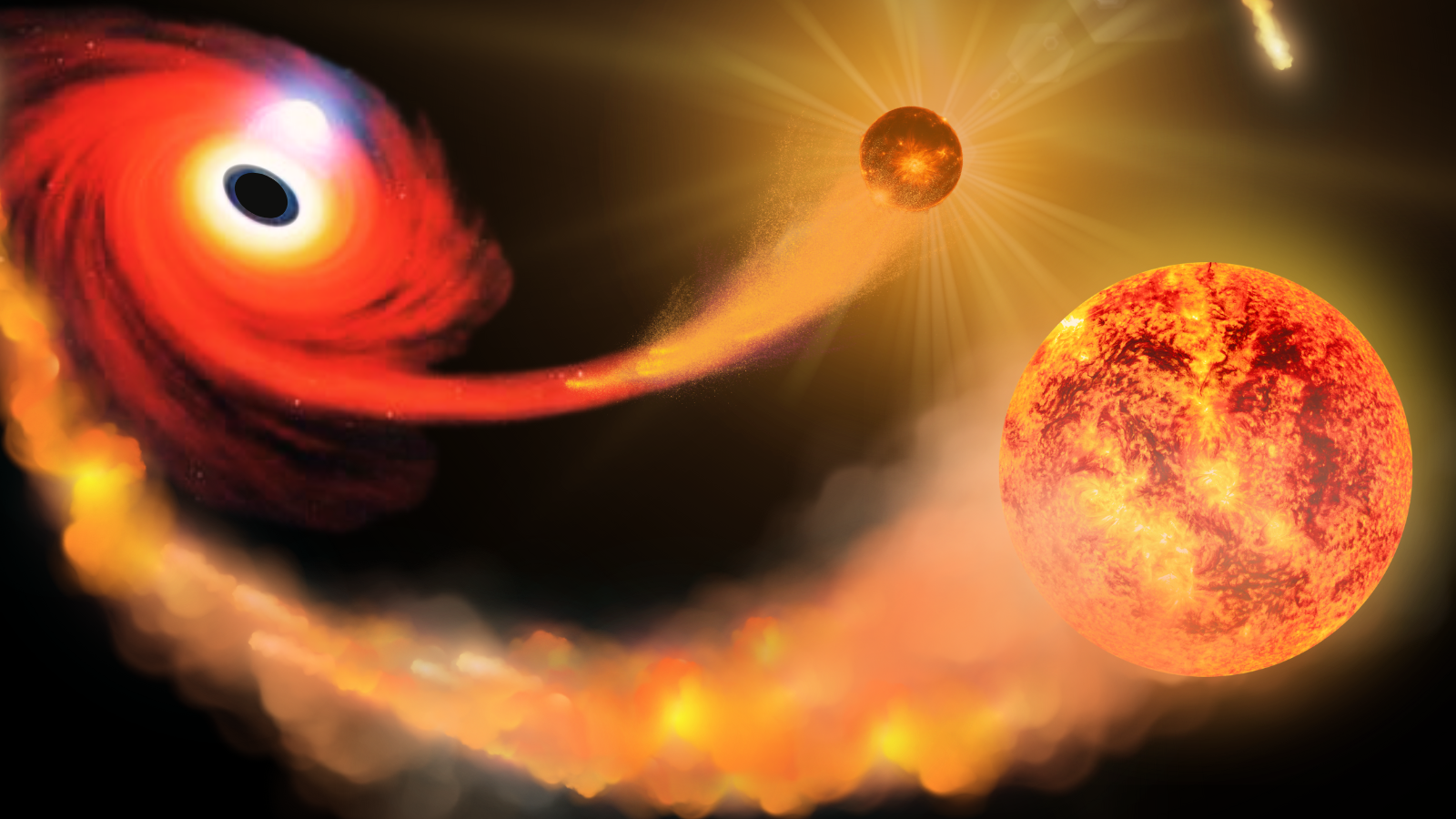
Supermassive black holes usually feed slowly, over cosmic timescales — millions of years — which makes catching the exact moment a jet switches on almost impossible to observe directly. So Mummery and Goodwin turned to one of astronomy's most violent natural experiments: tidal disruption events, or TDEs, in which an unlucky star wanders too close to a black hole and is ripped apart by its gravity.
"When a black hole tears apart a star, it does not swallow everything neatly," Goodwin explained. Much of the shredded stellar material doesn't fall in at all — it's flung violently back out into space, while the rest spirals inward and feeds the black hole in a fast, dramatic burst that can be tracked in near-real time.
Crucially, TDEs compress a feeding process that would normally play out over millions of years into a tidy window of just a few years — giving astronomers an accelerated, front-row view of accretion rates rising, peaking and falling, along with the resulting jets, if any appear.
The team combed through data on 20 known tidal disruption events, narrowing their focus to 10 with sufficiently high-quality, multi-wavelength observations. That meant coordinating data from optical, ultraviolet, X-ray and radio telescopes scattered across the globe — facilities in the United States, Australia, India and South Africa, along with space-based observatories — all trained on the same fading stellar wreckage at different points in the electromagnetic spectrum.
What emerged was a strikingly consistent pattern: every TDE that produced a jet did so right around that same 2%-of-Eddington threshold — regardless of the black hole's mass. The researchers also identified two distinct phases in which outflows can appear: one during the initial super-Eddington phase when the black hole is feeding faster than its theoretical limit, and a second, delayed outflow precisely at that critical low accretion-rate threshold as the feeding frenzy winds down.
WHY "SCALE INVARIANT" IS SUCH A BIG DEAL
In physics, few things are more satisfying than finding a rule that doesn't care about size. Mummery and Goodwin describe their threshold as "scale invariant" — meaning the same 2% trigger point governs jet formation whether you're looking at a black hole a few times heavier than the sun or one with the mass of hundreds of millions of suns, sitting at the center of a galaxy.
That's a big deal because stellar-mass and supermassive black holes have historically been studied as if they might follow somewhat different physical rules, given how differently they're formed and how different their environments are. Confirming that the same jet-triggering mechanism applies across that entire mass range — a difference of many millions in scale — suggests the physics governing how black holes convert infalling matter into blazing jets of plasma is fundamentally universal, hard-wired into the basic mechanics of accretion itself rather than being a quirk of any particular black hole's size or setting.
EXPERT PERSPECTIVE
Astronomers not involved in the study have called the result an important, long-sought piece of the puzzle in understanding accretion physics — the study of how matter spirals into black holes and, sometimes, gets violently redirected back out. Jets from black holes are already known to be among the most energetic phenomena in the universe, capable of blasting material across thousands of light-years and shaping the growth of entire galaxies by regulating star formation in their surroundings.
Having a predictable, repeatable trigger point changes the game for observational astronomy. Rather than blindly monitoring feeding black holes and hoping to catch a jet by chance, researchers can now calculate roughly when a given black hole's accretion rate should cross that 2% Eddington threshold — and point their telescopes at exactly the right moment.
That predictive power matters enormously for an already strained global network of observatories, where time on premier instruments is scarce and expensive. Knowing when to look, rather than constantly watching and hoping, could dramatically improve the success rate of catching these outbursts as they happen — rather than piecing together what occurred after the fact from a fading afterglow.
THE SQUARE KILOMETRE ARRAY CONNECTION
The timing of this discovery lines up neatly with a new generation of instruments coming online in the next few years. The Square Kilometre Array, an enormous international radio telescope project spanning sites in Australia and South Africa, is scheduled to begin science operations in 2028 and will be, by a wide margin, the most sensitive radio observatory ever built.
Researchers say the newly identified universal threshold gives future SKA campaigns a genuine predictive edge: rather than surveying broad swaths of sky and hoping to stumble across a jet-launching event, astronomers can now target specific black holes at the specific moments their accretion rates are calculated to cross that critical 2% line — turning a game of cosmic chance into something closer to a scheduled appointment.
WHAT THIS MEANS FOR YOU
It's fair to ask why a rule about black hole feeding habits, discovered by combing through the wreckage of shredded stars, should matter to anyone who isn't an astrophysicist. A few reasons it's worth paying attention to:
A universe that makes a little more sense. Black hole jets are among the most powerful forces shaping galaxies, including our own Milky Way, which has a supermassive black hole at its center. Understanding the rules that govern them helps explain how galaxies grow, how stars form (or don't) in their vicinity, and how the broader structure of the cosmos has evolved over billions of years.
Better, faster science for your tax dollars. Publicly funded observatories — including NASA and international radio and X-ray facilities — operate on limited, competitive observing time. Discoveries like this one make that public investment go further by helping scientists know when and where to look, rather than burning valuable telescope time on guesswork.
A preview of bigger discoveries to come. This finding arrives as astronomy heads into an unusually eventful stretch, with new instruments like the Square Kilometre Array and ongoing observations from the James Webb Space Telescope continuing to upend assumptions about how the universe's most extreme objects behave. Expect this "universal threshold" to become a standard tool cited in black hole research for years to come.
THE BOTTOM LINE
For years, black holes seemed to march to wildly different drumbeats — some erupting the instant they started feeding, others staying eerily quiet for years before an outburst without warning. Mummery and Goodwin's research suggests there was a hidden metronome all along, ticking at exactly 2% of each black hole's Eddington limit, indifferent to whether the object in question is a stellar leftover or a galaxy-anchoring giant.
It's a tidy, satisfying answer to a genuinely massive puzzle — and, fittingly for a discovery born from watching stars get violently torn apart, it promises to help astronomers catch the universe's next big outburst before it happens, instead of scrambling to explain it after the fact.
Published By | Tech Wiz