SCIENCE & TECH
They were so small that for sixty years nobody thought they were anything at all.
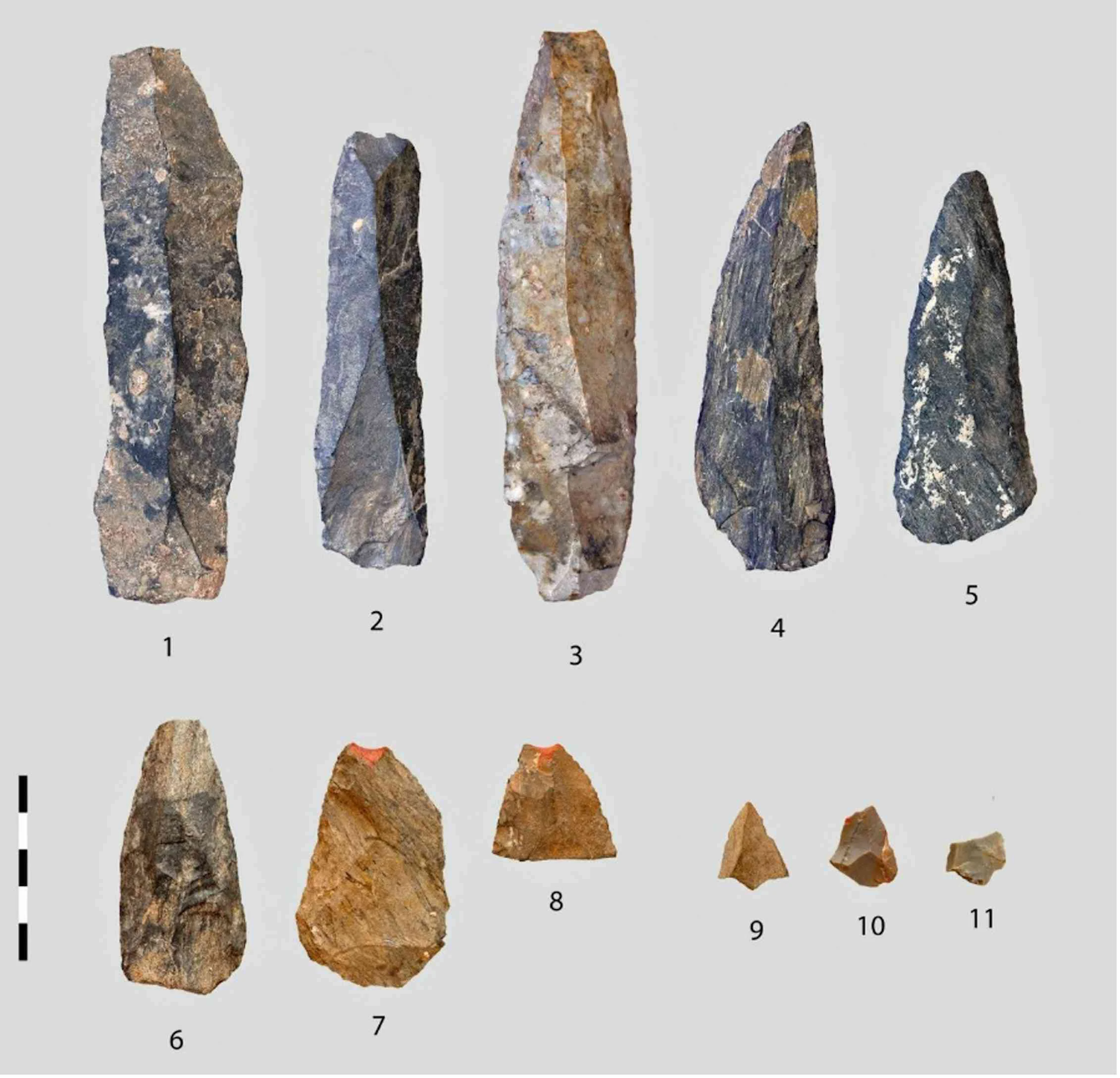
Slivers of stone, less than two centimetres wide, weighing a few grams each — the kind of thing an excavator sweeps into the "debris" tray without a second glance. Unretouched. Unshaped. Junk, essentially. Waste flakes from the real work of making the big, impressive blades that Obi-Rakhmat is famous for.
Except they are not junk. They are ammunition. And according to a study published in PLOS One and pushed into wide circulation across science media this weekend, they are 80,000 years old — which would make them, by a very long way, the oldest arrow-scale projectile points ever identified in Eurasia.
The finding, written up for a general audience by the study’s co-authors Hugues Plisson and Andrey I. Krivoshapkin, does something that archaeology papers rarely manage: it takes a story we have all absorbed since school — modern humans left Africa, walked north, arrived in Europe, replaced the Neanderthals — and quietly kicks a leg out from under it.

A cave that has been talking for sixty-four years
The Obi-Rakhmat rock shelter sits at 1,250 metres altitude at the south-western end of the Talassky Alatau range of the Tien Shan mountains in Uzbekistan. It was discovered in 1962, and the most recent excavation campaigns have been led by archaeologist Andrei Krivoshapkin.
What makes it extraordinary is the depth of its memory. The site preserves a stratigraphic sequence more than ten metres thick, spanning roughly 80,000 to 40,000 years ago, containing a remarkably consistent stone-tool industry of points, large blades and bladelets. Forty thousand years of continuous human occupation, layered like a book.
And in one layer, dating back around 70,000 years, sits something that has bothered specialists for two decades: the skull remains of a child showing a mixture of features — some considered Neanderthal, some anatomically modern. A combination that, as the researchers carefully note, could be the result of hybridisation.
In other words, Obi-Rakhmat was already a place where the neat categories of human prehistory fell apart. Now it has done it again.
The things nobody bothered to look at
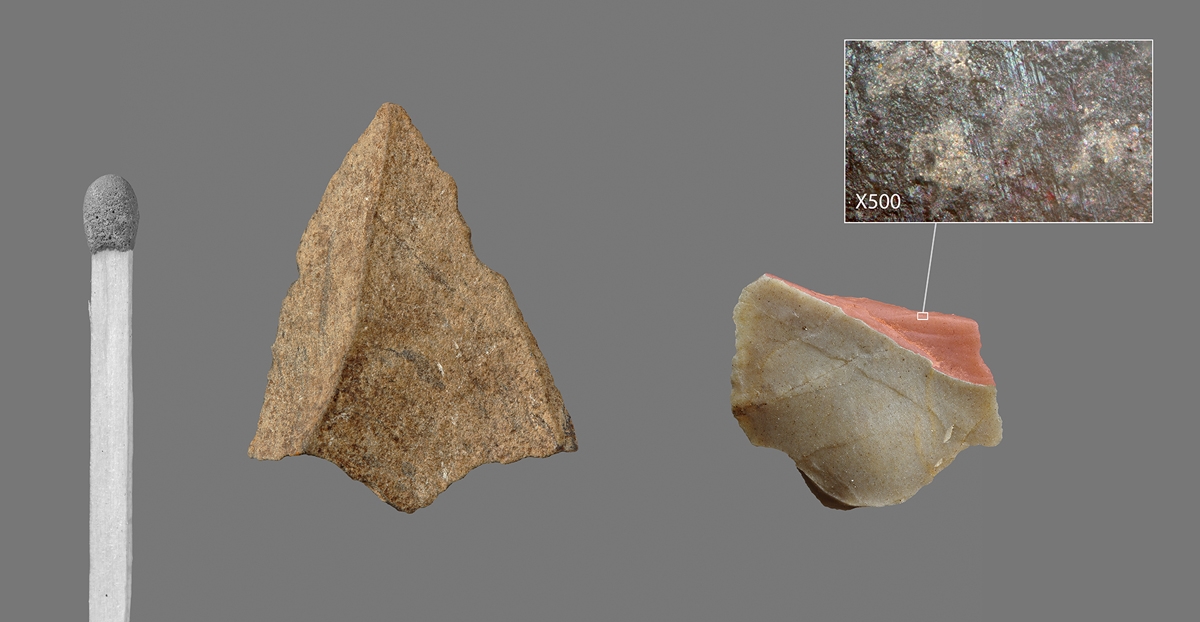
The international, multidisciplinary team working the oldest layers went looking not at the impressive tools but at the litter around them. Using macroscopic and microscopic analysis of impact marks — the specific fracture patterns a stone point acquires when it slams into an animal at speed — and comparing them against experimental reference material produced in the lab, they identified tiny, unretouched, triangular projectile points hiding in the assemblage.
The damage is the evidence. These pieces were not dropped or discarded. They hit something, hard.
And their size is where the argument becomes forensic rather than speculative. Less than two centimetres wide. A few grams. Brittle. Utterly unsuitable for mounting on a heavy spear shaft — they would shatter. But the width of their cutting edges corresponds precisely to the diameter of arrow shafts documented ethnographically for low-poundage bows.
Why size is the entire argument
This is the part of the study that turns an interesting observation into a claim with teeth, and it is worth following, because it is pure physics.
Thrown piercing weapons are systems, and their parts are not interchangeable. A hand-held or hand-thrown spear delivers enormous impact force, and the point must survive it — so mass is the design priority. Mass gives you robustness, impact force and penetration. If your spearhead shatters on a bison, you are not just out one tool; depending on the bison, you may be out one hunter.
A light projectile shot from a distance works on the opposite principle. Its kinetic energy is far lower and comes mainly from speed, not mass — and speed bleeds away fast along the trajectory and inside the target. So penetration depends on sharpness, not bulk. And that speed cannot be achieved by a human arm alone. It requires a throwing instrument: a launcher, a bow, something that stores and releases energy.
Arrowheads and spearheads are therefore built to different specifications and cannot be mounted on the same shafts. The shaft dimensions and elasticity are themselves ballistic parameters. As the authors put it, the logic works like palaeontology: the shape of a tooth tells you the diet and hints at how the animal moved. The shape of a point tells you what kind of weapon it was part of.
Which means these micro-points are not ambiguous. They are the wrong shape, the wrong mass and the wrong fragility for anything but a fast, light, launched projectile.
The smoking gun: they also made spearheads
The obvious objection is the cheap one: maybe they made small points because they had to. Poor raw material. Small flakes. Making do.
The study demolishes this on two fronts.
First, Obi-Rakhmat is swimming in good-quality stone. The same people were producing large blades from it. There was no shortage.
Second — and this is the detail that should end the argument — microscopic examination of the same assemblage found much more robust retouched points, 15 to 20 times heavier and three to four times thicker, in the size class of spearheads or javelin heads. And those, too, show impact damage consistent with use as axial projectile points.
So the inhabitants of this cave were not making tiny points because that was all they could manage. They were running two entirely different weapon systems side by side: heavy points for close, high-force work, and micro-points for something light and fast. That is not improvisation. That is a toolkit.
And that toolkit has a signature
Here is where the anthropology gets uncomfortable for the traditional model.
Returning to the wider literature and to their own prior work on Middle Palaeolithic tools, the team found that the presence, in a single assemblage, of several distinct types of projectile point and insert — some of them microlithic and made deliberately for that purpose — is known only at Homo sapiens sites. The oldest documented occurrences are in South Africa, at Sibudu cave, in the Pre-Still Bay and later cultural layers, dating back more than 77,000 years.
The Neanderthal record looks fundamentally different. Stone points damaged by use as projectile heads are rare, and when they do appear they tend to be large, and they do not differ meaningfully in size, manufacture or type from points used for entirely different jobs — gathering plants, butchering carcasses. One tool, many uses.
The authors are careful here, and their caution is worth repeating rather than skipping. Given the 14,000 kilometres between South Africa and Central Asia, the dates involved, and the genuine differences in manufacture between Obi-Rakhmat’s unretouched knapped points and Sibudu’s shaped stone and bone points, they judge that independent invention is the most likely explanation. Nobody is claiming a technology transfer across a continent.
The 6,000-kilometre coincidence that cannot be a coincidence
And then comes the part that made the story travel.
The Obi-Rakhmat micro-points have no known equivalent anywhere in the Eurasian Middle Palaeolithic — with exactly one exception. In 2023, traceology specialist Laure Metz identified essentially identical projectile points at Grotte Mandrin in the Rhône Valley in southern France, in a layer dated to roughly 54,000 years ago. That work, led by Metz and CNRS researcher Ludovic Slimak and published in Science Advances, argued that the earliest modern humans in Europe had mastered bow-and-arrow technology — pushing the age of archery in Europe back by more than 40,000 years. More than 1,500 of the tiny points were recovered from the Mandrin layer. A Homo sapiens milk tooth was found in the same layer, in a cave otherwise occupied by Neanderthals before and after.
The two sets of points are separated by more than 6,000 kilometres and 25,000 years. And according to the new study, the resemblance is so complete that they could be swapped between sites and nothing but the stone itself would give away the substitution.
Not just the shape. The manufacture — including the meticulous preparation of the striking platform, which takes real expertise — and the function.
Genetics turns up at the same address
The second reason this study is landing hard is that it agrees with a completely independent line of evidence that was not looking for it.
Recent work by palaeogeneticists Leonardo Vallini and Stéphane Mazières has defined the Persian Plateau — on whose north-eastern edge Obi-Rakhmat sits — as a population hub where the ancestors of all present-day non-Africans lived between the early phases of the expansion out of Africa and the later, wider colonisation of Eurasia. A resource-rich holding area where a small population could recover from the genetic bottleneck of leaving Africa, where groups could meet, mix — and innovate.
Stone tools and genomes, two disciplines that did not consult each other, pointing at the same map coordinates. The authors flag this convergence explicitly, and note that the respective publication dates rule out either study having influenced the other.
The ghost in the machine: why we got this wrong
The study contains a pointed passage that is really about the history of the discipline rather than the history of humans.
The entire chronological and cultural framework of prehistory — the sequences, the stage names, the evolutionary models built on top of them — was constructed in Western Europe, largely in France, in the second half of the nineteenth century. It was linear and it was Eurocentric: Cro-Magnons descended from Neanderthals and laid the foundations for a civilisational superiority that the region was, at that moment, rather keen to claim. It took a century to establish the African origin of Homo sapiens.
And the awkward facts have been piling up for a while. The earliest evidence of Homo sapiens in Australia dates back around 65,000 years — ten millennia before Europe. The alignment between the earliest European Upper Palaeolithic settlements and those in the Levant, supposedly their closest relatives, has never been satisfactory. Which is why a Central Asian origin, proposed by Slimak in 2023, has stayed on the table.
The sceptics, and what is still unproven
This is not a settled case, and honest reporting requires saying so.
The Mandrin bow-and-arrow interpretation was criticised when it appeared — a formal critique was published in 2024 questioning whether the evidence justified invoking the bow specifically. That criticism was normal science, and the authors of the new study say so plainly: it is what happens when a proposal deviates sharply from established knowledge. Their argument now is that the criticism failed to reckon with the Mandrin hypothesis’s predictive power — it predicted that such points should turn up elsewhere, and they have.
The authors themselves keep a careful line. One could debate exactly what instrument launched arrows tipped with such tiny points, they write; the bow is, in their phrase, in filigree. It may be more cautious to speak only of "shooting." But even that cautious version contrasts sharply with everything known about Neanderthal hunting weapons and their design.
It is also worth noting for readers what this study is not. Nobody has found an 80,000-year-old bow. Wood does not survive. The case rests on ballistics, on impact damage, and on the striking match with Mandrin — a strong circumstantial case, not a preserved weapon in a display cabinet.
What this means for you
You are unlikely to lose sleep over Central Asian microliths. But three things here matter beyond the trench.
First, your family history may have a chapter you did not know about. If this reading holds, the ancestors of every non-African alive today did not simply march from Africa to Europe. They spent a very long stretch established in the heart of the Eurasian continent — the Persian Plateau and its edges — before expanding west. Central Asia stops being a corridor people passed through and becomes a place where people lived, adapted and invented.
Second, it changes the picture of who our ancestors were when they met the Neanderthals. Not wandering newcomers with sharpened sticks, but people arriving with a mature, specialised ranged-weapon technology tens of thousands of years old — and, critically, the cognitive habit of designing different tools for different jobs rather than one tool for everything. That distinction may matter more than any single artefact.
Third — and this is the lesson for anyone in any field — the evidence was sitting in the trays the whole time. For six decades, these points went unrecognised because they were tiny, unretouched and often broken. Now that criteria for identifying them exist, the authors expect them to start appearing at sites right across the map between Central Asia and the western Mediterranean. Museum drawers from Tashkent to Toulouse may already contain the rest of the story.
The bottom line
A cave in Uzbekistan. Forty thousand years of continuous occupation. A child’s skull that refuses to be either one species or the other. And in the deepest layers, a scatter of stone slivers too small to bother with, each one carrying the microscopic scar of a high-speed impact.
If they really are arrowheads, then 80,000 years ago, in the foothills of the Tien Shan, somebody was already doing the thing we thought started in Europe 45,000 years ago.
The oldest weapons ever mistaken for rubbish may have just rewritten where we come from.
Published By | Tech Wiz