Written By | Torch Media Africa
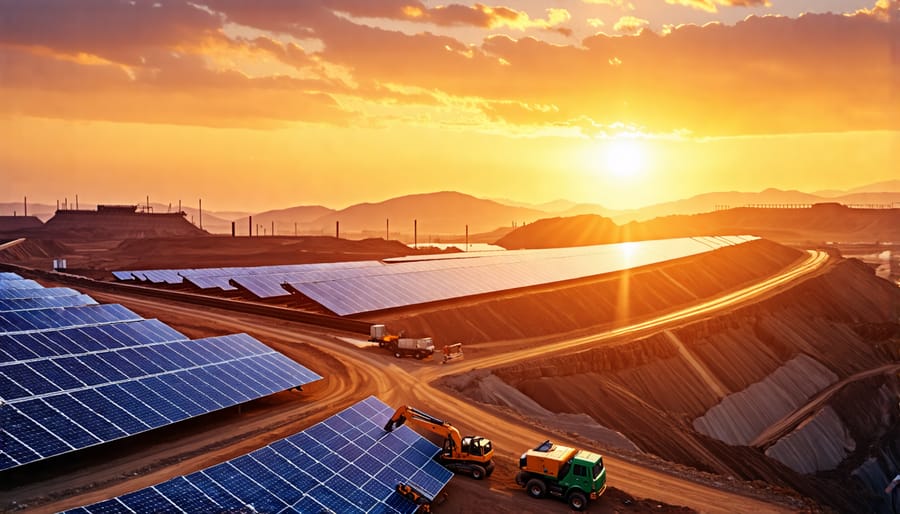
Unlike traditional silicon solar panels, perovskite solar cells are lightweight, flexible, and capable of converting sunlight into electricity with remarkably high efficiency
LONDON / TOKYO / BEIJING
For more than a century, perovskite existed largely as a little-known mineral studied mainly by geologists and crystallographers. Today, it has become one of the most important materials in the global race for clean energy.
In 2026, scientists and manufacturers say perovskite solar technology is moving beyond laboratory experiments and entering commercial deployment — a development that could significantly change the economics of solar power.
Unlike traditional silicon solar panels, perovskite solar cells are lightweight, flexible, and capable of converting sunlight into electricity with remarkably high efficiency. When combined with conventional silicon in tandem designs, researchers have now achieved efficiency levels above 34 percent in laboratory conditions — significantly higher than the roughly 22–24 percent efficiency of most commercial silicon panels.
Breaking Solar Efficiency Barriers
For decades, solar researchers operated under what is known as the Shockley–Queisser limit — a theoretical efficiency ceiling for conventional single-junction solar cells. Perovskite-silicon tandem technology has challenged those assumptions.
By layering perovskite materials on top of silicon cells, engineers can capture different wavelengths of sunlight simultaneously, significantly improving power generation efficiency.
Recent breakthroughs have accelerated the field. Researchers and manufacturers across China, Japan, Europe, and the United States have repeatedly set new performance records, while companies are increasingly investing in large-scale production facilities.
The Biggest Challenge: Durability
For years, the greatest weakness of perovskite technology was not efficiency but durability.
Early perovskite cells degraded rapidly when exposed to heat, humidity, and continuous sunlight — conditions unavoidable in real-world environments.
However, recent research suggests that problem is gradually being overcome.
Multiple research teams have published findings showing significant improvements in stability under extreme testing conditions, with some devices retaining most of their efficiency after thousands of hours of operation.
While scientists caution that matching the 25-year lifespan of conventional silicon panels remains a challenge, the pace of improvement has raised confidence that commercial viability is approaching faster than previously expected.
Commercialization Has Begun
The most significant development is not merely scientific — it is commercial.
Several companies have already begun shipping commercial perovskite-based modules, while major manufacturers are preparing larger production lines.
The transition from laboratory prototypes to commercial products signals growing confidence that the technology is mature enough for real-world applications.
Industry analysts now project rapid market growth over the next decade as manufacturing scales and production costs decline.
A Global Competition for Solar Leadership
The race to dominate perovskite technology has become increasingly international.
Chinese companies and universities currently lead many efficiency records and manufacturing efforts. Japanese researchers continue exploring alternative designs, while European and American institutions remain major contributors to both research and commercialization.
Governments are increasingly treating advanced solar technologies as strategic industries due to their importance in future energy systems.
Challenges Still Remain
Despite the excitement, experts warn that important obstacles remain.
Long-term reliability data is still limited compared to traditional solar panels. Environmental concerns also remain because many high-efficiency perovskite formulations contain lead-based compounds.
Manufacturing at industrial scale while maintaining consistent performance is another challenge companies continue working to solve.
What It Means for Consumers
For homeowners and businesses, perovskite technology may not immediately replace conventional solar systems.
Early products are expected to remain relatively expensive while manufacturing expands. However, analysts believe costs could fall significantly over time as production scales.
Higher efficiency could ultimately mean smaller installations generating more electricity, potentially reducing both space requirements and overall energy costs.
The Bigger Picture
Scientists argue that more efficient solar technology could play a critical role in addressing climate change.
Global climate targets require massive expansion of renewable energy capacity over the coming decades. More efficient solar cells could help generate more power while reducing land use, material requirements, and installation costs.
The technology that once existed mainly in research laboratories is increasingly becoming part of mainstream energy planning. For a mineral discovered centuries ago, perovskite may soon become one of the defining materials of modern energy.
The solar revolution is no longer theoretical. It is beginning to arrive.



