GREENBELT, MARYLAND
It began, as the best space stories often do, with two amateurs and a hunch.
In 2024, an Australian backyard astronomer named Trevor Barry and a French observer named Jean-Paul Oger uploaded images of Saturn to a public database run out of a Spanish university. They were doing what thousands of amateur planetary photographers do every clear night — stacking frames, sharpening detail, chasing a planet that never quite sits still. But in those images, along the smudged southern edge of the ringed giant, something was undulating. A faint wavy band. Not a storm. Not a smear. A ripple with an unsettling regularity to it.
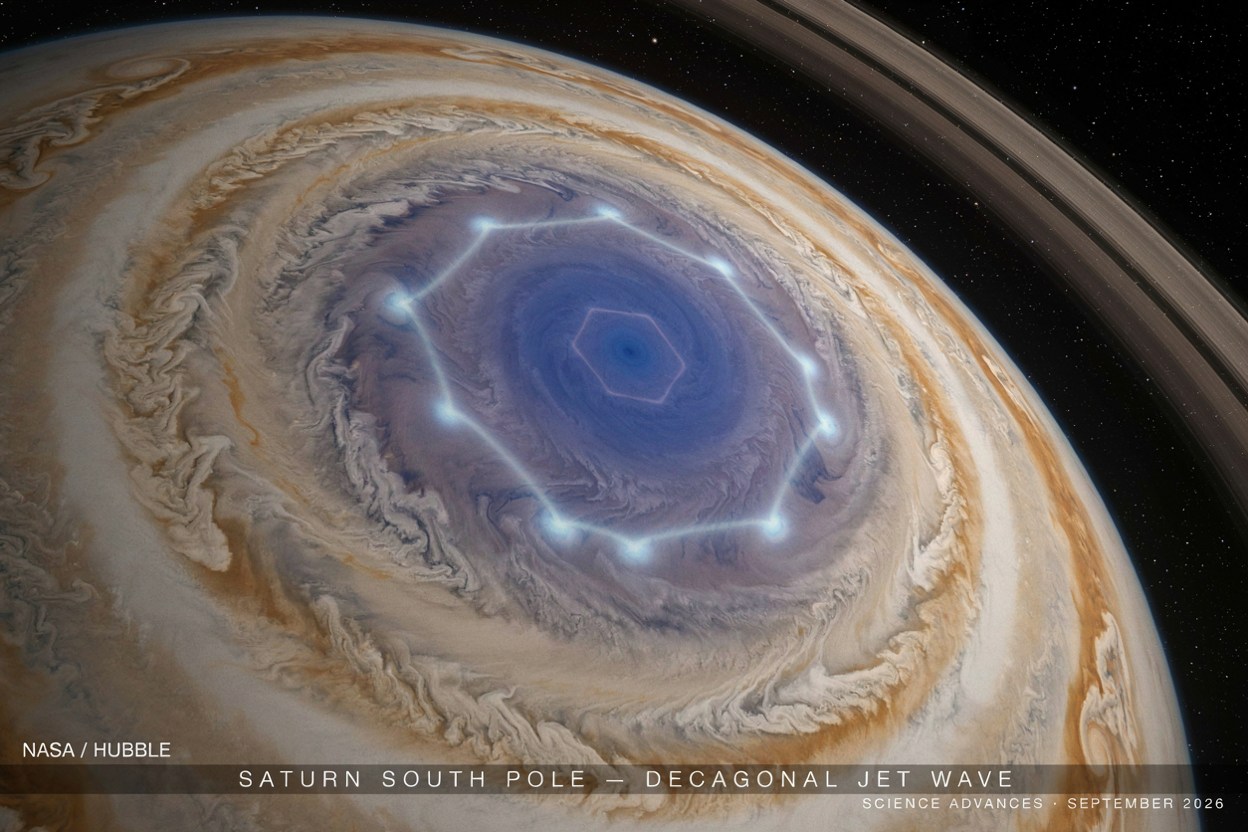
Two years later, NASA has put a name to what they saw, and the name is a jaw-dropper: a decagon. A ten-sided geometric shape, roughly 104,250 miles across, spinning in the clouds above Saturn's south pole. Confirmed by the Hubble Space Telescope. Published in the journal Science Advances. And, according to the astronomers who found it, apparently getting stronger by the year.
It is one of the largest and strangest weather features ever documented on another world — and it did not exist, at least not visibly, when NASA's Cassini spacecraft was flying laps around Saturn a decade ago.
A Shape You Could Drop Earth Into — Eight Times Over
The numbers are the kind that make you stop and read them twice.
The decagon measures roughly 104,250 miles (about 167,820 kilometres) from side to side. Each individual side of the polygon runs approximately 10,425 miles (16,782 kilometres) — which is to say that a single straight edge of this thing is longer than the entire diameter of planet Earth. You could line up more than eight Earths across the width of the full shape and still have room to spare.
The winds sculpting it are moving at something in the neighbourhood of 400 kilometres per hour — roughly 250 miles per hour, comfortably faster than the strongest sustained winds ever recorded in a terrestrial hurricane. And unlike a hurricane, this is not a storm that will blow itself out in a week. It is a standing wave locked into one of Saturn's planetary jet streams, a river of wind circling the pole that has apparently decided, for reasons unknown, to stop flowing in a circle and start flowing in a ten-sided loop.
It also drifts. Slowly. The whole structure migrates eastward at about 6 miles per hour — walking pace. A shape wider than eight Earths, strolling around a planet.
Hubble Was Pointed at the Wrong Pole for 36 Years
To understand why this discovery landed like a thunderclap, you have to know about the hexagon.
Since NASA's twin Voyager spacecraft swept past Saturn in the early 1980s, astronomers have known about a six-sided cloud pattern wrapped around the planet's NORTH pole. It is one of the most famous features in the solar system — a shape so improbably geometric that for decades it fuelled conspiracy theories, magazine covers and more than a few late-night internet rabbit holes. It has sat there, essentially unchanged, for more than forty years.
And ever since, planetary scientists have wondered: where's the matching one in the south?
"Given Saturn's symmetry in its north-south jet stream system, we have been searching for a counterpart to Saturn's northern hexagon on the south pole in Hubble images since 1990," said Agustín Sánchez-Lavega, the lead author of the new study and a researcher at the University of the Basque Country in Spain. "Images from NASA's Cassini spacecraft, which orbited Saturn between 2004 and 2017, showed no inkling of a long-lived formation, either."
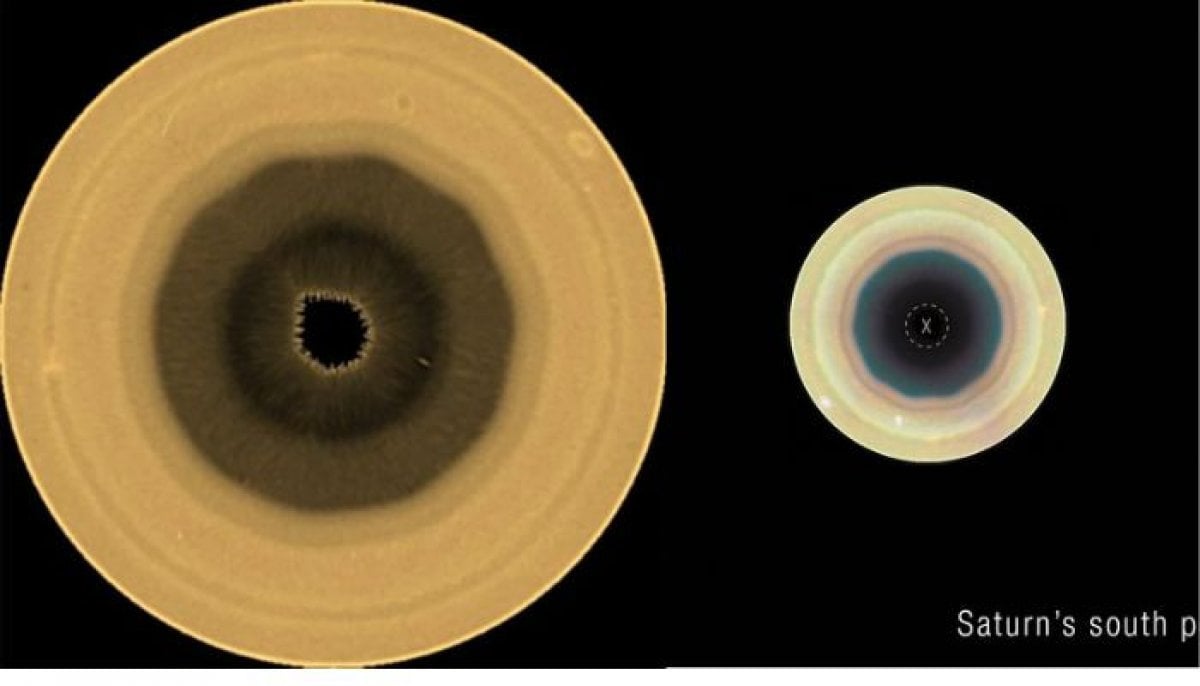
Read that again. Cassini spent thirteen years in orbit around Saturn. It flew closer to that south pole than any human machine ever has or likely will for generations. It saw a swirling polar vortex down there — but nothing with the crisp, ruled-edge geometry of the northern hexagon. Nothing like a decagon.
So either the decagon was hiding, or it simply wasn't there yet.
The Seasons Pulled Back the Curtain
There is a mundane reason nobody spotted this sooner, and it comes down to the fact that Saturn, like Earth, has seasons — they just last about seven of our years apiece, because a Saturnian year runs roughly 29 Earth years.
For long stretches of that cycle, one pole tilts away from us and is effectively invisible from Earth. It has only been recently, as Saturn's slow seasonal march swung the southern hemisphere back into view, that telescopes on the ground — and amateurs like Barry and Oger — could get a clean look at what was happening down there.
That is why the amateurs mattered so much. Sánchez-Lavega's institution runs the Planetary Virtual Observatory Laboratory, a website that accepts planetary images contributed by observers all over the world. It is, in effect, a crowd-sourced weather station for the outer solar system. It was in that pile of amateur imagery, first in 2024, that the wavy band showed up. Additional ground-based images through 2025 hinted more and more strongly at something with ten distinct sides.
Then came Hubble. From above Earth's turbulent atmosphere, Hubble delivers image sharpness the ground simply cannot match, and it can watch through a full rotation of Saturn without the blurring that ruins ground-based detail. The observations came from Hubble's Outer Planet Atmospheres Legacy programme — OPAL — which has been photographing the outer planets once a year for more than a decade.
Sifting back through the OPAL archive, the team found the decagon's fingerprints going back to 2023, faint at first, sharpening over time. The shape wasn't hiding. It was being born.
"We've Never Seen Anything Quite Like This"
For Amy Simon, the OPAL programme's principal investigator at NASA's Goddard Space Flight Center in Greenbelt, Maryland, that timeline is the real headline.
"We've never seen anything quite like this in Saturn's southern hemisphere," Simon said. "The northern hexagon has been there every time we've looked for more than 40 years. This feature is different — it appears to be strengthening, giving us the rare opportunity to watch a giant atmospheric pattern develop."
That is an extraordinary sentence for a planetary scientist to be able to say. Astronomers almost never get to watch a solar system feature form. They arrive late, always, to phenomena that took shape a million years or a billion years before anyone had a telescope. Here, apparently, they walked in during the opening credits.
Simon put the obvious question plainly. "The most intriguing part to me is that this seems to have just formed recently. The question is, why did it suddenly form now when we haven't seen one before?"
Nobody has an answer yet.
Not Just Clouds — This Thing Has Depth
One of the most important findings in the Science Advances paper is easy to miss because it sounds technical. It isn't. It's the difference between a pattern painted on a surface and a structure with roots.
Hubble observes through multiple filters, and different wavelengths of light penetrate to different altitudes in Saturn's atmosphere. When the team compared the decagon's apparent position across those filters, it shifted slightly — but it was still there. The wave shows up at multiple altitudes.
In plain English: the decagon is not a thin scum of ammonia ice cloud floating on top of something else. It is a vertically extended atmospheric structure, a column of organised motion reaching down through layers of the planet's air. Whatever is driving it is not a surface phenomenon. It is coming from somewhere deep.
That vertical extent is the single strongest argument that this is a genuine planetary-scale wave rather than a trick of light or a short-lived cloud arrangement.
The Hexagon Just Got Demoted
There is a quiet casualty in all this, and it is Saturn's most famous feature.
For forty years the northern hexagon has been sold to the public — reasonably enough — as a one-of-a-kind marvel, a shape unique in the known universe. The decagon changes that framing entirely. As Sánchez-Lavega put it, the finding shows that the "unique" hexagon is not as extraordinary as scientists had thought.
The two shapes are cousins, not twins. Both sit on planetary jet streams. But the hexagon is practically stationary and has been rock-steady for four decades, while the decagon drifts eastward and appears to be bigger and considerably more unstable. One is a fixture; the other is a work in progress.
And that difference is where the science gets genuinely interesting. If a giant planet can spontaneously grow a ten-sided wave where a six-sided one was expected, then the number of sides isn't a magic property of Saturn — it's an outcome. It depends on how fast the jet stream is running, how wide it is, and how the wave that rides on it fits around the pole. Change the conditions, change the polygon. That turns a solar-system curiosity into a physics problem with a knob you can turn.
"When we started the OPAL programme, we expected compelling surprises, but we didn't know what to expect specifically," said Mike Wong, a study co-author at the University of California, Berkeley. "A lot of the discoveries we see coming from OPAL are not just based on one observation, but on years and years of data. Regular observations over time are enabling a lot of new findings."
What This Means For You
It is fair to ask what a ten-sided cloud pattern 800 million miles away has to do with anyone's Tuesday. The honest answer is: more than you'd think, and less than a headline would like to claim.
The useful part is the physics. Saturn's polygons are jet-stream waves — the same broad class of phenomenon as the meandering jet stream that decides whether your week brings a heatwave, a downpour or nothing much at all. Earth's polar vortex, the ring of fast circulating air over our own poles, is a close relative. When it wobbles or splits, cold air spills southward and North America and Europe get the kind of winter that makes the news.
Earth's atmosphere is a maddening thing to study in isolation, because it is cluttered — oceans, mountains, continents, cities, all of it interfering. Saturn is a control experiment: an enormous rotating ball of gas with no land, no sea and no terrain, where the pure dynamics of rotating fluids play out at a scale you can photograph from Earth. Every time scientists work out why a jet stream on Saturn does something surprising, the equations get a little better tested. Those are, ultimately, the same families of equations sitting inside weather and climate models.
There is a second, softer point worth making. This discovery started with two hobbyists uploading pictures to a website. Professional astronomers had been actively hunting for a southern counterpart to the hexagon since 1990 and hadn't found it; amateurs with backyard telescopes caught the first hint. If you have ever wondered whether citizen science is a nice gesture or an actual scientific instrument, the answer is now sitting in Science Advances with a NASA press release attached.

What Happens Next
The team is not done. They plan to keep watching Saturn to answer the obvious follow-up: does the decagon settle into a stable, long-lived configuration like the hexagon in the north, or does it keep evolving — or fall apart altogether?
The authors say more work is needed from Hubble, from NASA's James Webb Space Telescope, and from computer modelling before anyone can say how the decagon formed, how long it might last, and how it really compares to its northern counterpart. Webb, working in the infrared, can probe altitudes and temperatures Hubble cannot, and may be able to sound out how deep this structure really goes.
Meanwhile, Hubble itself deserves a mention. The telescope has been operating for over three decades, long past the point where anyone expected headline discoveries from it. The decagon exists as a documented finding specifically because somebody had the patience to photograph the same planets, the same way, every year, for more than ten years. That is not glamorous work. It is exactly the kind of work that catches a solar system in the act of changing.
The Bottom Line
A shape wider than eight Earths, drawn by 250mph winds, spinning above the south pole of Saturn — a shape that seemingly was not there twenty years ago, that Cassini flew past without seeing, and that is currently getting sharper rather than fading.
It was found by amateurs, confirmed by a 36-year-old space telescope, and it has quietly rewritten one of the best-known facts in planetary science: Saturn's hexagon is no longer unique.
As for what conjured a ten-sided giant out of a swirl of ammonia ice on the far side of the solar system — the people with the Hubble time, the Science Advances paper and the NASA badges will tell you the same thing, without embarrassment. They don't know yet.
Which is, for anyone who still finds the universe worth looking at, about the best news there is.
Published By | Tech Wiz