TECH & SCIENCE
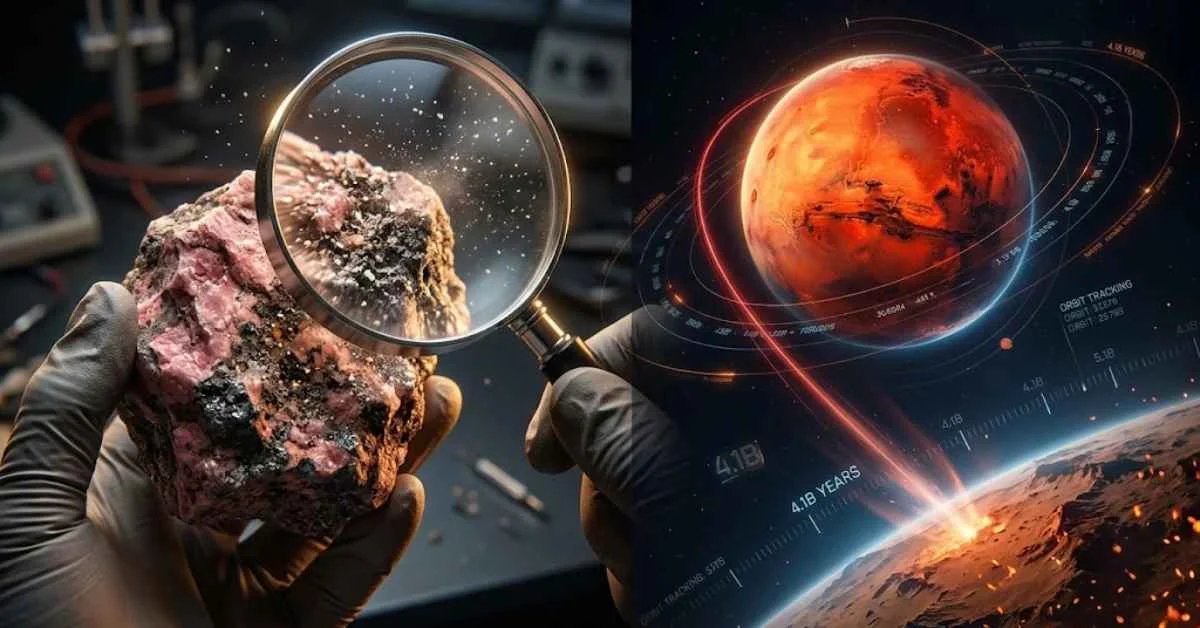
A rose-coloured, two-pound meteorite picked up from a salt plain in Mali has turned out to be one of the oldest pieces of Mars ever held by human hands — and scientists say it reveals a wetter, wilder Red Planet.
Imagine holding a piece of another world in your hand — a rock that cooled from molten magma before life on Earth had even begun. Now imagine it was found lying on the ground in the Sahara.
That is the astonishing story of Teghaza 001, a meteorite that NASA says is among the oldest Martian rocks ever found on Earth. This week, a NASA-funded study led by scientists at the agency’s Jet Propulsion Laboratory (JPL) revealed that the stone formed more than 4.1 billion years ago, and that it carries a hidden record of water soaking through the crust of early Mars.
One of the scientific reviewers who checked the work, according to lead author Yang Liu, called it a “Rosetta Stone for Mars.” After reading the details, it is easy to see why.
From the Sahara Sand to a Science Lab
The story begins in 2022, in the Sahara Desert of Mali, near a salt plain that gave the rock its name. It was reportedly found by nomadic prospectors — meteorite hunters who scour the desert for space rocks to sell. Weighing about 800 grams, close to two pounds, and rose-coloured, it did not look like much. At the time of discovery, nobody knew its age or where it came from.
Researchers at the University of New Mexico took the first crucial step. By measuring the rock’s oxygen isotopes — a chemical fingerprint that differs from planet to planet — they identified it as Martian. It was a shergottite, the most common class of Martian meteorite, and joined a catalogue of only around 435 known Martian rocks.
That, everyone thought, was that. Another Mars rock, interesting but not extraordinary. They were wrong.

‘It Was Only After We Started Looking Closely’
“It was only after we started looking closely that we realized this meteorite is really unique,” said Liu of NASA’s JPL, the lead author of the study published in the journal Science.
The team found unusual textures and minerals that Liu had not seen in Martian meteorites before. Crucially, the stone contains tiny zircon crystals — durable minerals that act as natural clocks, locking in the age of the rock in their atomic structure.
To read those clocks, the team turned to Caltech geochemist Francois Tissot. His lab uses a technique called in-situ rubidium-strontium dating, which analyses individual mineral grains directly on the rock’s surface. Older methods often involve dissolving a sample in acid, destroying it. Tissot’s method targeted microscopic grains across a patch smaller than a fingernail, leaving the meteorite intact for future scientists.
“Right now, we are one of very few labs in the world able to perform this kind of age-dating,” Tissot said.
The verdict: Teghaza 001 formed more than 4.1 billion years ago, placing it among the most ancient Martian rocks ever studied on Earth. It is a fragment of the primordial Martian crust — material from the planet’s infancy, when Mars was still cooling from its fiery birth.
Why This Rock Is Different
Mars meteorites of this age are vanishingly rare. NASA points to two famous peers. The first is ALH 84001, a Martian meteorite of similar age found in Antarctica, made up almost entirely of a single mineral. The second is “Black Beauty,” a meteorite that is a jumble of small volcanic fragments and formed much later, about 2.1 billion years ago.
Teghaza 001 is the only one of the three with this particular mix of igneous — volcanic — minerals, which records how Mars’s crust cooled from magma. In geologist-speak, it offers a clean look at how a young planet built its outer shell.
Lee Saper, the study’s second author — formerly a JPL postdoctoral scholar and now at NASA’s Ames Research Center — put it simply: “This is really our first piece of Martian crust from a part of Mars we’ve never had a sample of before.”
That last point matters. Every Martian meteorite we have arrived by chance, knocked off the planet by an asteroid impact and flung across space until it landed on Earth. We cannot choose where they come from. Teghaza 001 delivers a sample from a region that had never been represented in our collections.
A Wetter Mars, Billions of Years Ago
The rock’s most exciting secret is about water. The mineral chemistry, texture and isotopes show that after the stone formed from cooling magma, water seeped through it, altering its minerals about 4.1 billion years ago.
That points to a more dynamic water cycle on early Mars than scientists had previously understood — water moving through the crust, not just pooling on the surface. And the timing is striking: it was happening around the time Mars was losing its ancient atmosphere to space, the process that eventually turned a once-wetter world into the cold, dry desert we see today.
A separate paper published in Science Advances in June described the meteorite’s water content, adding another layer to the picture. Together, the studies suggest Teghaza 001 recorded the interactions between water and rock during one of the most pivotal chapters of Mars’s history.

Tracking It Home
Perhaps the most thrilling part: scientists think they know roughly where it came from. Using data from NASA’s Mars Reconnaissance Orbiter, the team compared the meteorite’s mineral signature with the Martian surface and found 13 possible locations matching its chemistry and mineralogy.
All lie in the heavily cratered southern highlands — the oldest terrain on the planet. A powerful impact most likely blasted the rock into space from one of those spots, starting a journey that ended, millions of years later, in the Sahara.
This detective work is a template for the future. Match a meteorite to its home on Mars, and you can link laboratory-grade measurements with orbital maps of a real place — an ability no rover alone can offer.
A Planet-Sized Puzzle
For decades, scientists have argued over how warm and wet early Mars really was. Orbiters have photographed dried-up river valleys and delta-like deposits. Rovers have found minerals that only form in the presence of water. Yet the details — how long the water lasted, how deep it ran, how it interacted with the crust — remain hotly debated.
Teghaza 001 adds hard laboratory evidence to that debate. Unlike remote observations, a physical rock can be analysed atom by atom, its isotopes counted and its crystals dated. That is why meteorites punch far above their weight in planetary science: each one is a free sample return mission, delivered by nature.
The catch is that nature is a terrible courier. Most meteorites land in oceans, forests and ice sheets, and only a tiny fraction are ever recovered. The deserts of North Africa and the ice of Antarctica are the great hunting grounds, because dark rocks stand out against pale backgrounds. Every new Martian find in those regions is a small miracle of timing and persistence.
It also shows how much value remains in samples already sitting on shelves. The rock was found four years ago, and it has taken until now for its full story to emerge. Who knows what other quiet stones in museum drawers might be waiting for a closer look?
Expert Perspective
“We’ve only scratched the surface,” Liu said, a pun that probably wasn’t entirely unintentional. The team stresses that the meteorite has many secrets left, and that the non-destructive dating method means plenty of material remains for other labs and techniques.
Tissot’s work is notable for another reason. Because only a few laboratories can do this kind of dating, the study is as much a story about a new scientific tool as about a rock. If the technique spreads, other precious samples — including those eventually returned from Mars — could be dated without being consumed.
It is worth adding some scientific caution. Meteorites are random samples, and one rock, however special, cannot tell the whole story of a planet. The 13 candidate source regions are matches in mineralogy, not proof of origin. Researchers will want more samples and more analyses before rewriting the textbooks.
What This Means for You
Mars is where humanity hopes to send its next great wave of explorers and, one day, perhaps settlers. Understanding how, when and why it lost its water helps us judge where life might have once existed, and where future missions should dig. Water is the first ingredient on any list for habitability.
It also says something about Earth. Our own planet’s oldest rocks have been largely erased by plate tectonics and erosion. Mars, with no such recycling, kept its early records. In a sense, Teghaza 001 gives us a glimpse of what the earliest days of a rocky planet looked like — including our own.
And there is a human lesson here. This was no billion-dollar space mission. It began with desert prospectors, passed through university labs and ended in one of the world’s most prestigious journals. Sometimes the cosmos delivers its greatest treasures to our doorstep, and we only need to look closely.
The Bottom Line
Teghaza 001 has gone from desert curiosity to scientific superstar. At more than 4.1 billion years old, with a mix of minerals unlike its famous cousins and a record of ancient water, it offers a rare window into the birth of the Red Planet’s crust.
With NASA still planning missions to bring pristine Martian samples back to Earth, this humble two-pound stone shows what such samples could reveal. Until then, scientists will keep poring over every grain. As Liu put it, they have only scratched the surface — and the Red Planet’s oldest stories are only beginning to be told.
Published By | Tech Wiz