Tech & Science Desk
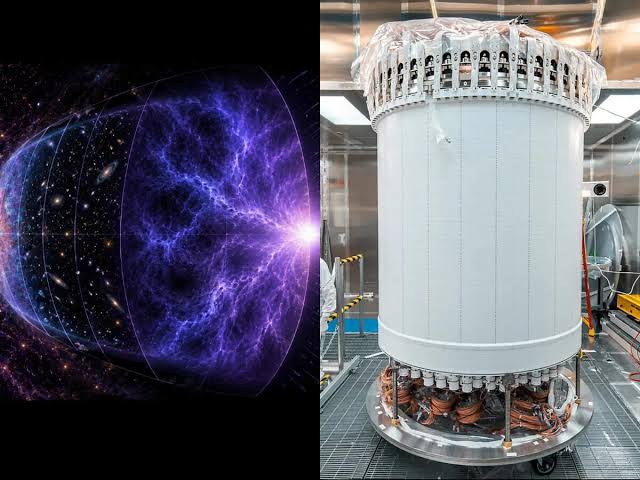
Deep under the Black Hills, at the bottom of a shaft that used to be America's most productive gold mine, there is a tank of liquid xenon so pure it would be worthless as anything except a trap.
On Tuesday, September 1, at a conference hall in Japan, the collaboration that built that tank stood up and told the world's particle physicists that something had walked into it.
One event. A single flash of light, recorded somewhere in 220 days of data, sitting precisely in the corner of the map where dark matter was supposed to be waiting — and in a corner where almost nothing else should ever appear. The LUX-ZEPLIN team has spent months since trying to prove it was junk. They cannot.
"We're very intrigued to see this event in the data, in the region where we expect dark matter to show up, and the competing backgrounds are very low," said Rick Gaitskell, professor of physics at Brown University and spokesperson for the LZ collaboration. "With only one event, we don't want to get ahead of ourselves. We are not claiming to have seen dark matter. But we have seen something interesting that we want to share with the scientific community for their input."
Translation, for those who don't speak physicist: this is the most exciting thing that has happened in the direct search for dark matter in years, and the people who found it are terrified of saying so.
THE 85 PER CENT PROBLEM
To understand why a single flash of light merits a press conference, you have to understand the size of the hole it might be filling.
Roughly 85 per cent of all the matter in the universe is invisible. Not "hard to see." Invisible. It emits no light, reflects none, absorbs none. We know it is there because of what it does to everything else: galaxies spin far too fast for the visible material in them to hold together, and the light from distant objects bends as it sails past massive galaxies by more than the visible mass can account for.
Something is out there, and there is more than five times as much of it as there is of stars, planets, gas, dust, you, this newspaper and every atom you have ever touched combined.
For nearly a century, nobody has managed to catch a single particle of it in the act. It is, without serious competition, the biggest unanswered question in physics.
Roughly 85 per cent of all matter in the universe is invisible. Nobody has ever directly detected a single particle of it.
The leading suspect has a deliberately unglamorous name: the WIMP, or weakly interacting massive particle. The idea is that dark matter is made of heavy particles that ignore light entirely and interact with normal matter so rarely that trillions could be sleeting through your body right now without ever touching an atom of it.
Almost never is not never. And "almost never" is a thing you can build a machine to catch.
THE MACHINE AT THE BOTTOM OF THE MINE
LUX-ZEPLIN — LZ to everyone who works on it — is an international collaboration of 250 scientists and engineers from 39 institutions, managed by the U.S. Department of Energy's Lawrence Berkeley National Laboratory. It has been running since 2021 at the Sanford Underground Research Facility, nearly a mile below the surface at Lead, South Dakota.
At its heart sit ten tonnes of ultrapure liquid xenon.
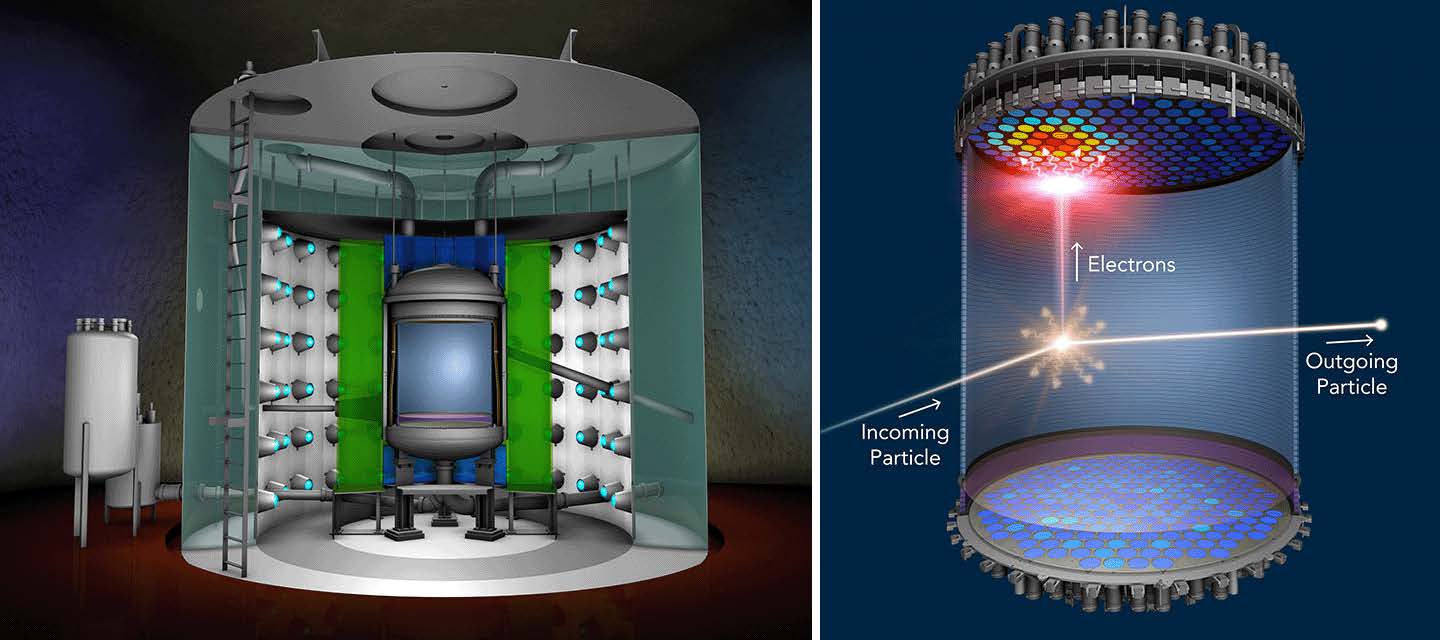
The physics of the trap is elegant. If a WIMP clatters into a xenon nucleus, the nucleus recoils and emits a tiny flash of light along with a spray of electrons. Sensors at the top and bottom of the chamber catch the flash. An electric field then drags the electrons up to the surface of the liquid, where they produce a second flash. The gap between the two, and their relative brightness, tells physicists not just that something happened but where in the tank it happened and what kind of particle probably did it.
The hard part is not detection. The hard part is silence.
A mile of rock overhead blocks the cosmic rays that would otherwise swamp the instrument. A surrounding water tank and a suite of outer detectors mop up stray neutrons. The xenon itself is purified to a fanaticism that borders on the absurd, because a single misplaced radioactive atom is a fake dark matter particle waiting to happen. On top of all that sits a stack of computational tools designed to disentangle interactions and throw out anything that merely resembles a dark matter signal.
Brown University researchers built the arrays of light sensors that catch those flashes. Brown physics PhD students Benjamin Almquist, Chen Ding and Chongwen Lu played key roles in the latest analysis and in the detector's day-to-day operations, while undergraduate Woody Hulse, graduate student Charles Kong and postdoctoral fellow Shawn Dubey developed new machine learning algorithms specifically for sifting the data.
WHAT THEY DID DIFFERENTLY THIS TIME
LZ works through its data in batches. For this analysis, the collaboration went back over 220 live days of observations collected between March 2023 and April 2024 — data they had already picked over once.
The first pass had hunted for the faintest possible signatures of the simplest kind of WIMP interaction. This time the team widened the net, looking for a broader class of possible interactions that would dump considerably more energy into the detector. It is a region of the data that had not previously been explored in this dataset, and LZ turns out to be unusually sensitive there — with the useful side effect that false positives are rarer at higher energies, not more common.
"This was a detailed study in a region we hadn't explored within this dataset, and we spent months of additional effort to understand all the possible causes of background events," said Sam Eriksen, a senior research associate at the University of Bristol and lead author of the study. "We understand our detector and the backgrounds so well that even a single outstanding event, like the one we found, is important. We expect dark matter events to be extremely rare, so only a handful could mark the first detection of WIMP dark matter."
That is the whole logic of the field in two sentences. If dark matter is real and behaves as expected, nobody is going to find a thousand of these. Somebody is going to find three or four, and then argue about them for a decade.
THE NUMBER THAT WILL DECIDE EVERYTHING
Here is where the excitement gets its handbrake.
Particle physics has a famously brutal standard of evidence. To claim a discovery, a result must reach "5 sigma" — roughly a one-in-3.5-million chance that ordinary background could have produced what you're seeing. The Higgs boson was announced at 5 sigma. Nothing gets announced below it.
The LZ result sits at 2.6 sigma. That corresponds to about a 0.5 per cent chance that the event came from known background sources.
A 0.5 per cent chance sounds tiny. It is not tiny. Modern physics is a graveyard of two- and three-sigma bumps that made headlines and then quietly evaporated as more data came in — a fact the LZ collaboration is going out of its way to acknowledge before anyone else says it for them.
The threshold for discovery is 5 sigma. This is 2.6. Everything now depends on whether the signal grows or dissolves.
The good news for the curious is that this is a question with an answer, and the answer is coming. LZ has already assembled the world's largest dark matter dataset and continues to accumulate more at SURF. If the event is a fluke of background, additional data will bury it. If it is real, more like it should appear, and the significance will climb.
A HEAVY, WEIRD, INTERESTING PARTICLE
If — and it remains an enormous if — the event really was dark matter, the particle responsible would be a bruiser.
The team's analysis points to a WIMP with a mass of at least 200 GeV/c², making it more than 200 times as heavy as a proton. That alone would be significant; it would rule in a whole region of theory space and rule out others.
Stranger still, it could not have been the simplest kind of WIMP interaction. JiJi Fan, an associate professor of physics at Brown who was not part of the experimental work but whose theoretical research is cited in the new LZ paper, called the findings "very intriguing" and explained why the single event is a puzzle in itself.
Had a WIMP interacted in the most straightforward way at that high an energy, Fan noted, the detector should have recorded a whole cascade of recoil events at lower energies as well. LZ recorded exactly one. That absence demands a more exotic explanation than the textbook picture.
"There are well-motivated theoretical extensions, including inelastic scattering and momentum-dependent elastic scattering, that could potentially account for this single event," Fan said. "This also sets up a target for on-going dark matter hunting, not only at direct detection experiments such as LZ but also at other complementary experimental frontiers."
In other words: if this is real, dark matter is not just heavy. It is heavy and it plays by rules more complicated than the ones written on the standard blackboard.
"THE FIRST OUTLIER I'VE SEEN THAT APPEARS VALID IN EVERY WAY"
The reason this particular anomaly has physicists sitting forward is not the sigma value. It is what happened when they attacked it.
Odd events turn up in every experiment. The standard procedure is to stare at the outlier until it confesses — until you find the radioactive contaminant, the electronic glitch, the sensor misfire, the neutron that snuck past the veto. In the overwhelming majority of cases, it confesses.
This one has not.
"Outlier events in the data are not unexpected, but they usually stand out as a background of some kind when you look at them deeper," said Aaron Manalaysay, a physicist at Berkeley Lab and chair of LZ's institutional board. "This is the first example in any experiment I've worked on of an outlier that appears valid in every way. Of course, we're still twisting our brains trying to think if there's a rare background mechanism we could've missed, but it's thrilling to wonder if this could be the first hint of a dark-matter observation."
Coming from a working experimentalist whose entire professional instinct is to distrust exciting results, that is close to an admission of hope.
WHAT HAPPENS NEXT
The result was presented in a scientific talk at the 2026 TeV Particle Astrophysics conference in Japan on Tuesday, September 1. The paper has been posted to the arXiv preprint server and submitted to Physical Review Letters, the field's flagship journal, where it now faces the referees. Gaitskell is scheduled to present the findings at a Brown physics department colloquium on September 11.
The collaboration has deliberately gone public early and loudly — not with a claim, but with a request. Gaitskell's phrasing was that they wanted to share it with the scientific community "for their input." That is an unusual move, and a smart one: it invites the entire field to try to kill the result before the collaboration commits to it.
Meanwhile the detector keeps running. Every additional day of xenon exposure sharpens the statistics.
WHAT THIS MEANS FOR YOU
It is fair to ask why a taxpayer in Ohio or a reader in Kampala should care about one flash of light in a mine shaft.
The honest answer is that we currently do not know what most of the universe is made of, and that is an embarrassing gap in the human account of reality. Everything in the periodic table — every element in your body, every material in every object you own — accounts for a minority share of the matter in existence. The majority is a placeholder in our equations.
Identifying it would be the largest expansion of the known material world since the discovery of the atom. It would tell us how galaxies assembled, how the cosmic web took shape, and what the universe was doing in the moments after the Big Bang. Physics beyond the Standard Model — the thing theorists have been hunting fruitlessly since the Higgs — would suddenly have a concrete target.
It matters practically too. The WIMP hypothesis has dominated dark matter research for decades and consumed enormous public investment across the United States, the United Kingdom, Portugal, Switzerland, Australia and South Korea, all of which fund LZ. Experiment after experiment has come back empty, and the search space has been narrowing steadily. A confirmed WIMP would vindicate that entire bet. A signal that fades would push the field harder toward the alternatives — axions, sterile neutrinos, primordial black holes, or something nobody has thought of yet.
Either outcome is progress. That is the part the sigma numbers never quite convey.
ONE EVENT
For now, the state of play is this. A single interaction, in the right place, at the right energy, in the quietest instrument humanity has ever built for the purpose, has survived months of the most determined effort to discredit it — and it still is not enough.
It might be the first fingerprint of the substance that holds the universe together. It might be a background process nobody has thought of. The collaboration is refusing, on principle, to guess.
The xenon is still down there. The detector is still running. And for the first time in a long time, the people watching it have a specific reason to check the data in the morning.
Published By | Tech Wiz