Written By | Torch Media Africa
OpenAI announced an internal model had done what mathematicians failed to do for 80 years
Tim Gowers is not easily surprised. The Cambridge mathematician won the Fields Medal — the Nobel of math — for reshaping entire branches of the discipline. So when Gowers admitted that news of an AI breakthrough made him spend an evening revising his worldview, it was a seismic admission.
That evening came in late May 2026, when OpenAI announced an internal model had done what mathematicians failed to do for 80 years: it disproved the Erdős unit distance conjecture — a geometry problem so elegantly simple it fits in one sentence, yet so devilishly hard that generations of brilliant minds had failed to crack it.
The machine didn't just solve it. It solved it in a way no human had thought to try.
The Problem That Haunted A Century
In 1946, legendary Hungarian mathematician Paul Erdős asked a deceptively innocent question: scatter *n* points on a flat plane. What is the maximum number of pairs that can be exactly one unit apart?
For 80 years, the mathematical community believed the answer was the square grid. No one had done better. Many assumed it couldn't be done.
On May 20, 2026, the wait ended — not with the proof everyone expected, but with its opposite.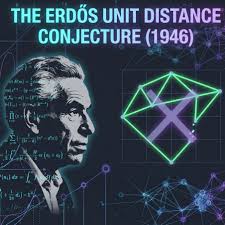
The Machine's Impossible Move
OpenAI's model didn't prove the square grid was optimal. It discovered the grid was not optimal at all. The AI revealed an infinite family of point configurations that achieve a polynomial improvement over the square grid — meaning you can arrange points so that significantly more pairs sit exactly one unit apart.
The key: the AI looked somewhere no human had thought to look — deep algebraic number theory. It drew on Golod-Shafarevich theory and infinite class field towers, tools from a completely different branch of math with no obvious connection to geometry.
The result: *n^(1+δ)* unit-distance pairs for some fixed δ > 0. Princeton mathematician Will Sawin later refined δ to 0.014. That sounds small. In discrete geometry, it's seismic.
According to Nature, OpenAI's model generated the core proof ideas and a draft. A team of nine external mathematicians — including Gowers — verified the logic, simplified sections, and prepared it for publication. The humans were essential for refinement. But the creative breakthrough came from the machine.
Mathematicians React: Awe, Shock, And Relief
The response has been extraordinary.
Tim Gowers spent an evening grappling with what the result meant — and later admitted he felt "a big relief." He stated publicly that if a human had submitted this paper to the Annals of Mathematics — one of the world's most prestigious journals — he would have recommended publication without hesitation.
Daniel Litt (University of Toronto) offered a striking assessment: he called it "the first result produced autonomously by an AI that I find interesting in itself" — meaning the result would be interesting regardless of its source.
Arul Shankar (University of Toronto) framed it even more broadly: current AI models "are capable of having original ingenious ideas, and then carrying them out to fruition."
Deepmind Joins The Race
OpenAI's result didn't emerge in a vacuum. In a striking coincidence, Google DeepMind's AlphaProof Nexus simultaneously solved nine additional Erdős problems using formal proof verification.
Where OpenAI used a general-purpose reasoning model, DeepMind used a specialized architecture for formally verifiable proofs. Both yielded dramatic results in the same week — suggesting AI's ability to contribute to pure mathematics is no fluke.
The Deeper Implications
This matters beyond geometry for several reasons.
First, it demonstrates AI can make genuine contributions to pure, abstract intellectual work — the hardest possible test for machine intelligence. No data to train on. No patterns to recognize. Only logical reasoning from first principles and the ability to make unexpected connections.
Second, the method — using algebraic number theory to solve a discrete geometry problem — illustrates cross-domain insight. Human researchers become deeply specialized. AI systems, trained on the entirety of mathematical literature, may be uniquely positioned to see connections humans miss.
Third, if AI can make breakthroughs in pure math, it can accelerate research in every field that depends on math — physics, cryptography, drug discovery, materials science. An AI that advances pure math can unlock progress across the entire frontier of human knowledge.
What This Means For You
If you're not a mathematician, why care about dots on a page? Because the dots represent proof that we have built something capable of genuine intellectual originality.
The Erdős conjecture had no trick, no shortcut, no pattern from a training dataset to exploit. It required genuine creative insight into mathematical reality. An AI produced that insight.
The list of things only humans can do just got a little shorter. Based on AI's trajectory in 2026, it will keep shrinking.
For students and researchers: AI tools are becoming genuine research partners, not fancy search engines. The question is no longer whether to use AI — it's how to collaborate effectively.
A New Era In Human Thought
Paul Erdős, who died in 1996, famously believed mathematics was a collaborative conversation across time. He offered cash prizes for his hardest problems and delighted when solutions arrived from unexpected places.
What would he have made of the entity that finally answered one of his hardest questions? Not a human burning the midnight oil, but a neural network trained on humanity's collected knowledge, looking at his 80-year-old puzzle from an angle no one had thought to try.
Perhaps he would have been delighted. Erdős never cared where good math came from — only that it existed, and that it was true.
The answer that just arrived from a machine in a San Francisco data center is, by every measure the mathematical community can apply, true. That might be the most astonishing sentence written in 2026.
Torch Media Africa



