Written By | Torch Media Africa
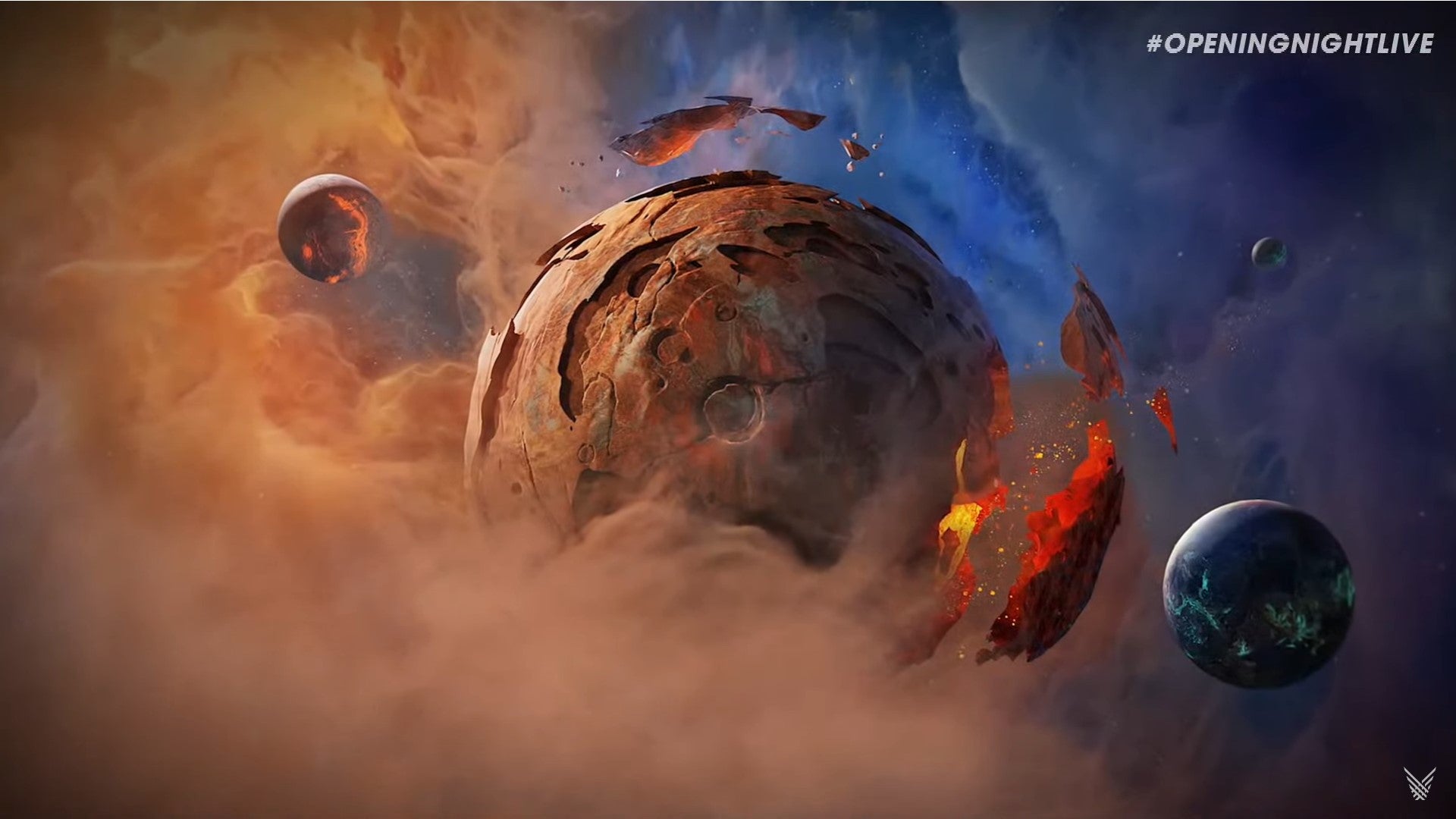
New supercomputer simulations say the Moon may not have been slowly assembled from a glowing ring of rubble at all.
Science & Space Desk
Picture the worst day our planet ever had. About 4.5 billion years ago, before there was an ocean, before there was a single living cell, before there was anything that could have watched, a world roughly the size of Mars came in at an angle and hit the young Earth.
Scientists call that intruder Theia. The collision was so violent that it liquefied rock, flung a colossal quantity of debris into orbit and permanently reorganised our planet. Out of that wreckage came the Moon - the thing that pulls our tides, steadies the tilt of our axis, lights our nights, and has been sitting in our sky for the entire history of life.
For a quarter of a century, the standard picture has been that the Moon took its time. Debris went into orbit, formed a ring, and the ring gradually clumped into a satellite. Now a new set of the most geologically detailed impact simulations ever run has produced a result that sounds like science fiction.
In some of the runs, a complete, intact Moon emerged within about five hours.
One afternoon. Earth acquired a satellite and an almighty headache in the same sitting.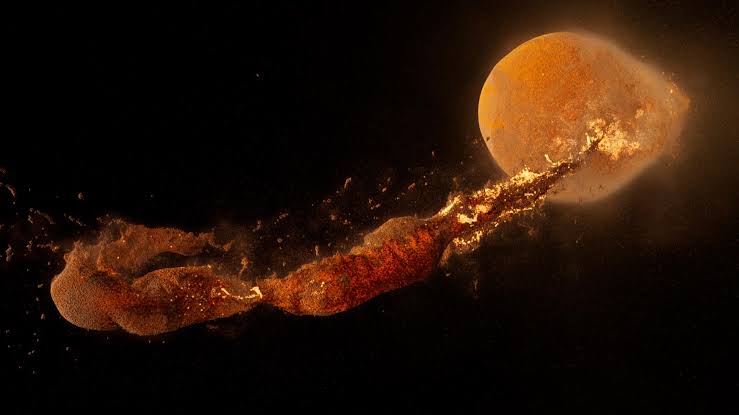
The paper, and who wrote it
The work was led by Dr Adeene Denton, formerly a NASA Postdoctoral Program fellow at Southwest Research Institute in Texas and now a postdoctoral researcher in the institute Solar System Science and Exploration Division. It was carried out in collaboration with scientists at the University of Arizona and published on September 1 in The Astrophysical Journal Letters, under DOI 10.3847/2041-8213/ae91e9. The simulation methods themselves were developed at the University of Bern and the University of Arizona.
One of the co-authors is Dr Erik Asphaug of the University of Arizona - a name that matters here, because Asphaug co-wrote the foundational 2001 paper on the giant impact with Dr Robin Canup, now vice president of the Solar System Science and Exploration Division at SwRI in Boulder, Colorado. In other words, the new study is in part a re-examination by the same lineage of researchers who built the textbook version in the first place.
The thing everybody had left out
Every simulation of the Moon-forming impact for the past two decades has modelled two enormous blobs of rock and iron slamming together. What almost none of them modelled was how strong that rock actually was.
The reasoning was intuitive. Material strength - the resistance of rock to being deformed and broken - is an obvious factor when you are modelling a modest asteroid strike. But the Moon-forming impact released so much energy that the strength of the rock was assumed to be a rounding error, drowned out by sheer violence. Everyone left it out. Denton and her colleagues put it back in.
Models have evolved to include material strength, Denton said in a statement released with the study, something that is really important when you are studying collisions between smaller bodies like asteroids, or for her previous paper on the formation of the Pluto and Charon system. We were not sure if it would matter for the Moon or not, she said. When we did the simulations, we found it actually matters quite a bit.
The team went a step further than simply switching strength on. They used modern computational methods that incorporate temperature-dependent geologic strength for the first time in a Moon-formation simulation. That single addition turned out to open a door nobody had realised was there.
Hot rock is weak rock - and that changes everything
The physics is not complicated, even if the code is. Hot bodies are weaker than cold ones. Heat a rock and it deforms more easily, absorbs momentum differently, and shatters on different terms.
Now add the timeline. Protoplanets are born ferociously hot from the energy of their own assembly, and they cool as they age. That means the internal temperature of Earth and Theia at the moment of impact is not a free parameter you can pick at random. It is a proxy for when the collision happened.
And what Denton team found is that Moon formation is extraordinarily sensitive to that temperature. We discovered that the preexisting geology of the Mars-sized proto-Moon matters, she said. When you simulate the Earth and the Moon as colliding bodies with geologic properties, it changes how the Moon forms out of that impact - something, she noted, that researchers had previously considered unnecessary to model at all.
The temperature of two rocks on one specific afternoon may be the closest thing we have to a clock for the birth of the Moon.
Two very different versions of the same catastrophe
The simulations split into two broadly different outcomes, and the split is what makes this a story rather than a footnote.
In one family of runs, Theia is destroyed outright and the impact throws up a massive disk of debris that circles the Earth and assembles into a Moon over an extended period. Depending on how hot the Earth and Theia are prior to the collision, Denton said, the impact can destroy Theia and produce this massive disk of debris that eventually forms the Moon.
In the other, the process is almost obscenely fast. But when I used the same parameters as original impact modeling - down to the equal temperature structures inside both bodies - within around five hours, an intact Moon emerged, Denton said.
Reporting on the study, Space.com set out the timing implication as follows: if Theia were colder, implying the impact occurred later in solar system history, perhaps 100 to 150 million years after the birth of the planets, the debris ring would have formed in a way that allowed the Moon to accrete gradually, and because Theia was stronger, more of it would have survived intact to merge with Earth. A warmer Theia striking less than 60 million years after the planets formed, on that account, produces the fast route - a Moon assembled almost immediately while Theia itself is obliterated.
Intact-Moon outcomes had been glimpsed before. NASA-led simulations in 2022 raised the possibility that the Moon came together from debris in a matter of hours. What is new here is the mechanism. This is the first work to show that material strength and temperature are central to whether the Moon forms intact or is assembled out of a processed protolunar disk.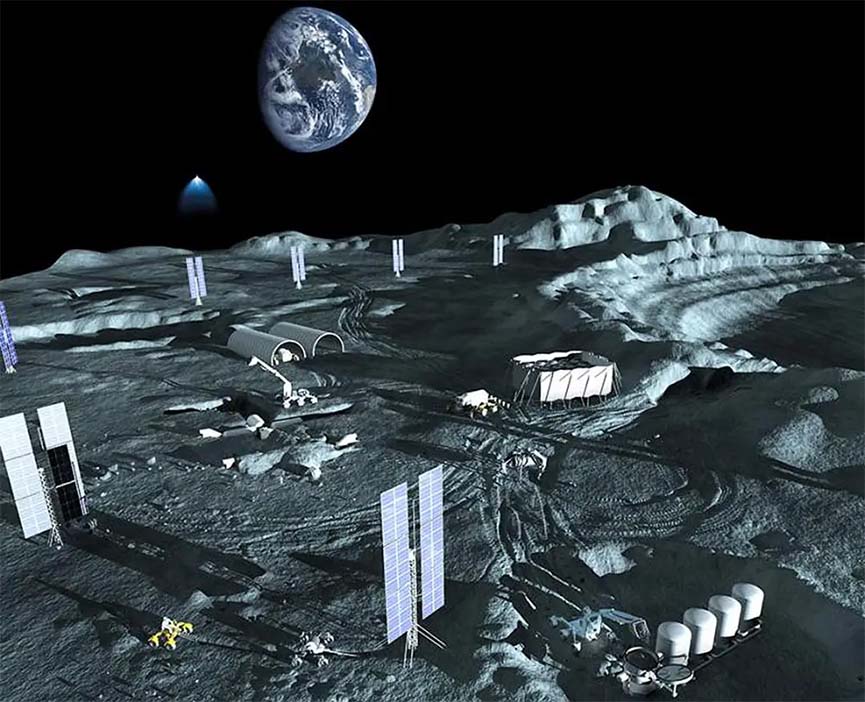
Expert perspective: why a planetary scientist called this exciting
Perhaps the most notable endorsement comes from the researcher whose 2001 model this work revisits. Canup was not involved in the new study, which makes her assessment worth quoting at length.
These surprising and exciting new results imply a potential connection between the physical properties of the Moon today, including perhaps its volatile content, and the thermal state of the Earth and Theia at the time of the giant impact, Canup said. This in turn might help scientists better constrain when the Moon-forming event occurred.
Unpack that and you find the real prize. Volatiles are the easily vaporised substances - water and other light compounds - whose abundance in lunar rock has been measured, argued over and re-measured for fifty years. If the Moon volatile inventory is a fingerprint of how hot the colliding bodies were, then lunar chemistry becomes a thermometer. And because temperature tracks age, a thermometer becomes a calendar.
That would be a genuine advance. The date of the giant impact is one of the largest remaining uncertainties in the early history of the solar system, with credible estimates spread across more than a hundred million years. Narrowing it would ripple outward into when Earth got its core, its first atmosphere and its first stable surface.
The problem that still refuses to go away
Good science reporting should lead with the caveat rather than bury it, and this study has a significant one.
In both families of outcomes, the simulated Moon is made mostly of material from Theia mantle, with only a modest contribution from Earth. That is awkward, because the actual Moon is chemically and isotopically almost a match for Earth mantle. If the Moon is mostly the wreckage of a different world, it should carry that world distinct isotopic signature - and the differences it does show are puzzling in ways that current simulations, including Denton own, cannot easily explain.
The favoured escape route is that Theia and the proto-Earth were never really strangers. If both condensed out of the same neighbourhood of the protoplanetary disk, they would have started out chemically similar, and the puzzle softens. Mars, which formed farther away and is compositionally distinct from both Earth and the Moon, is the control case.
Denton offers the tidiest possible summary of the family relationships involved. Because Earth and Mars formed in the same neighbourhood of the solar system, they are like siblings, she said. The Moon and Earth are more like fraternal twins.
It is worth being blunt: this paper does not solve the isotope problem. Nobody has. What it does is show that a variable everyone had dismissed turns out to steer the outcome, which means the space of plausible histories is wider than the textbooks have been drawing it.
The strange consequence for alien moons
There is a twist that reaches far beyond our own sky. Astronomers hunting for exomoons - moons orbiting planets around other stars - have considered looking for the telltale glow of moon-forming debris disks around young rocky worlds.
If the Moon really can form in hours, that strategy may be close to hopeless for rocky planets. A disk that exists for an afternoon is not something you catch with a survey telescope. You would have to be looking at exactly the right star on exactly the right day out of several billion years.
Gas giants are a different proposition entirely. Their moon systems are thought to form from material left over when the planet itself assembled, not from a catastrophic impact, so those disks persist long enough to be worth hunting. The practical upshot for exomoon hunters is a redirection of effort.
What this means for you
It is fair to ask why anyone who is not a planetary scientist should care how fast a rock came together four and a half billion years ago. There are three honest answers.
The first is that this is a testable claim arriving at exactly the moment humanity is going back. Artemis crews are flying around the Moon again. China Chang e 7 is heading for the lunar south pole on the most ambitious robotic lunar mission yet attempted. More than twenty landings by commercial and national missions are planned through the end of the decade. The competing scenarios in this paper predict different things about lunar volatiles and about how thoroughly the Moon material was processed - and those are exactly the sorts of things a sample return mission can check.
The second is that the water matters commercially and strategically. Whether the lunar poles hold accessible ice, and how much, depends partly on how violently the Moon material was heated and stripped during formation. Every serious plan for a lunar base assumes water that can be split into breathable oxygen and rocket fuel. The origin story and the business case are connected.
The third is simply that the Moon made us possible. It stabilises Earth axial tilt, which stabilises our seasons, which shaped the climate in which complex life evolved. Understanding whether such a companion is a common outcome of planet formation or a freak of one particular afternoon speaks directly to how likely worlds like ours are elsewhere.
The afternoon that made everything
For fifty years the Moon origin story has been told as a slow-motion catastrophe: a collision, a glowing ring, a patient accretion. Denton team has not overturned that. What they have done is show that the version of the story you get depends on a property nobody thought to include - how warm two young worlds happened to be when they met.
The simulations are public. SwRI has released video of the collisions playing out, and the paper is available to anyone who wants to read the methods rather than the headline. The isotopes still do not add up. The date is still unsettled. But the range of possible pasts just got wider, and one of them is startling.
On a single afternoon, in less time than it takes to fly across the Atlantic, the Earth may have been struck, wounded, and handed a Moon. Then everything else - the oceans, the tides, the seasons, us - followed on from there.



