Kampala
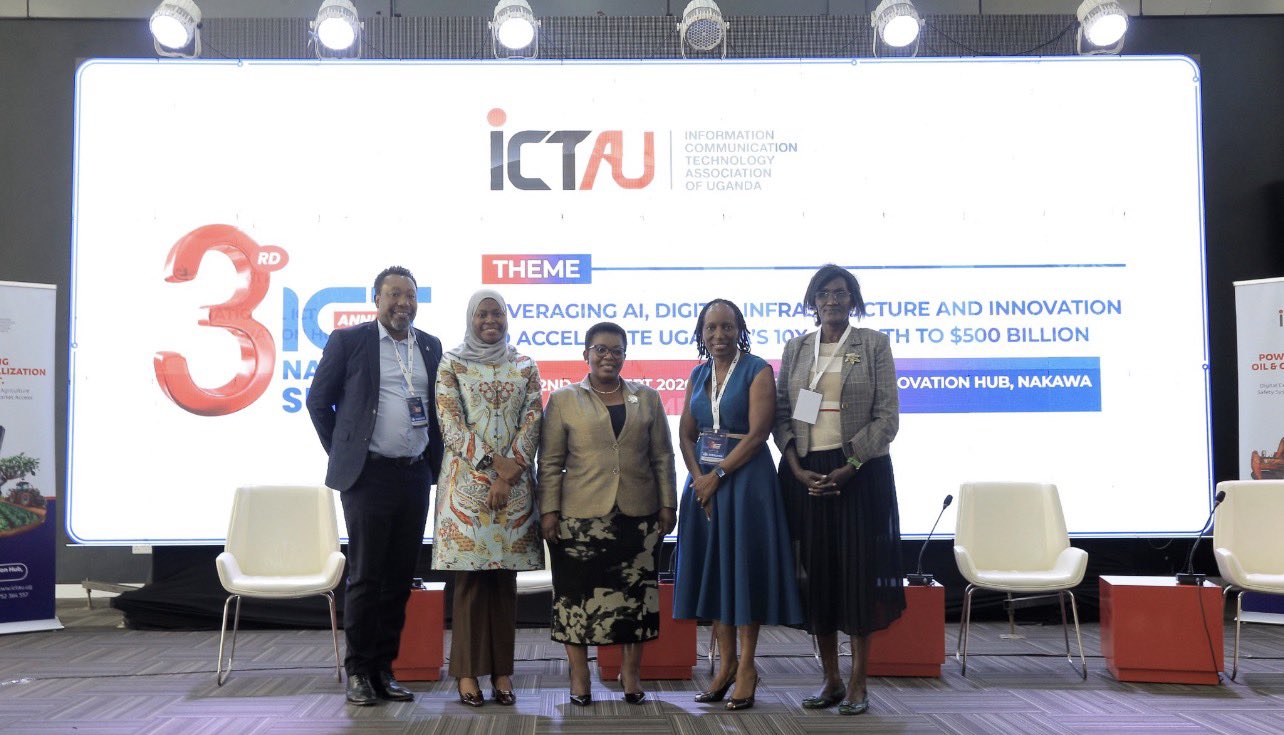
Uganda's technology establishment spent the first week of September arguing about arithmetic. The 3rd National ICT Summit, held from 2 to 4 September at the National ICT Innovation Hub in Nakawa, ran under a theme that left no room for ambiguity: "From Connectivity to Intelligence: Leveraging AI, Digital Infrastructure and Innovation to Accelerate Uganda's Ten-Fold Growth to a $500 Billion Economy by 2040."
Organised by the ICT Association of Uganda, the summit was opened by Justine Kasule Lumumba, Minister for ICT and National Guidance, representing President Yoweri Museveni. The agenda covered artificial intelligence, cloud infrastructure, cybersecurity, agritech, healthtech, smart energy, fintech, govtech, IoT, robotics and digital skills, with deep-dive sessions on mineral development, oil and gas, and science, technology and innovation. There were live product demonstrations, investor pitch slots, and a floor's worth of startups and high-growth SMEs.
THE NUMBER THAT FRAMES EVERYTHING
The most consequential contribution came from Dr Aminah Zawedde, Permanent Secretary at the Ministry of ICT and National Guidance, and it was a piece of arithmetic rather than a policy announcement. Moving Uganda from an economy of roughly $50 billion to $500 billion, she noted, requires sustained annual growth of about 15 per cent.
It is worth sitting with that figure. Uganda grew 6.7 per cent in 2025 — a strong result by any regional standard, and one built on a construction boom in the oil sector that will not repeat. Even the most optimistic oil-transition forecasts put growth in the 8 to 10.4 per cent range at the peak of the production ramp, before settling back toward 6 per cent. Fifteen per cent every year for fourteen consecutive years is not an extrapolation of Uganda's current trajectory. It is a different trajectory entirely, of a kind achieved historically by a small handful of economies, all of which combined very high investment rates with rapid structural transformation out of subsistence agriculture.
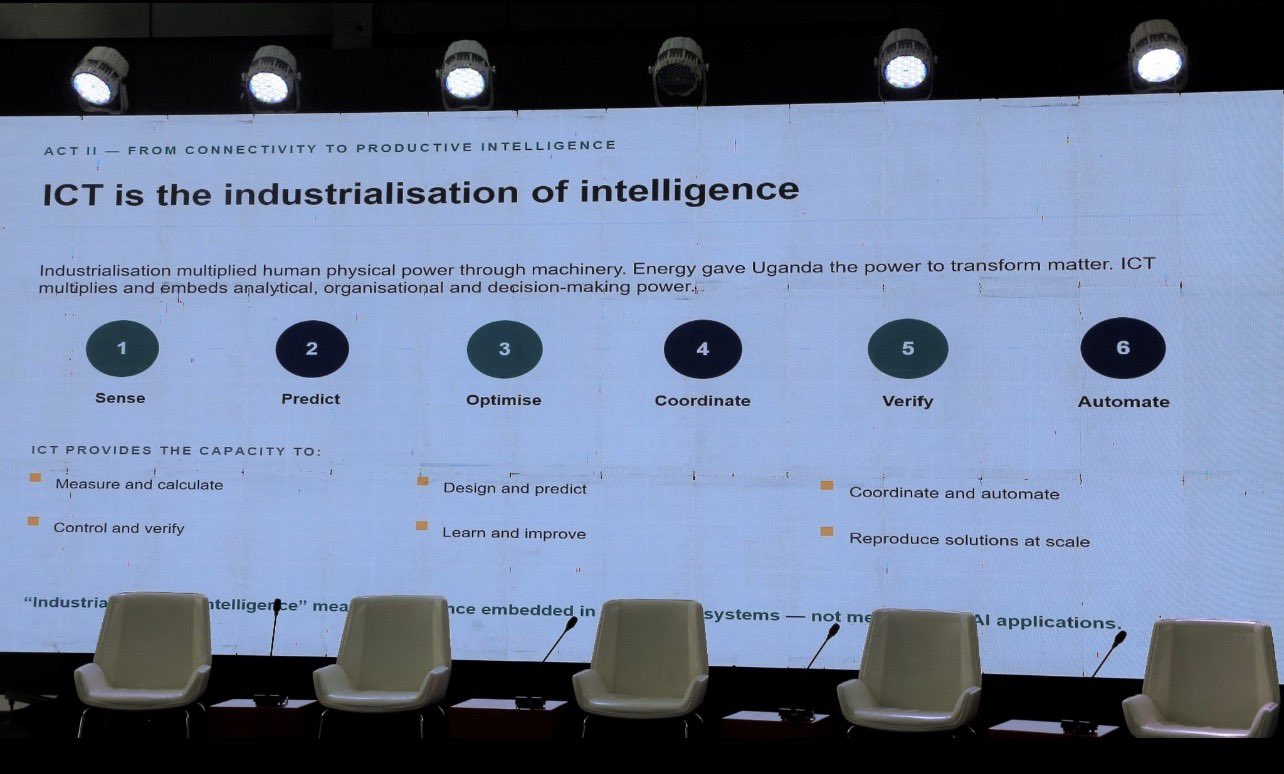
Naming that gap publicly, from the podium, is more useful than another round of aspiration. It reframes the ICT agenda from "a promising sector" to "the only plausible source of the productivity multiplier that closes an otherwise impossible gap." Zawedde positioned ICT precisely that way: a strategic contributor operating through digital infrastructure, innovation and technology-driven productivity, rather than as a standalone industry to be measured by its own GDP share.
WHAT THE GOVERNMENT SAYS IT HAS BUILT
Zawedde pointed to three concrete pieces of progress. The first is aggregated procurement of government IT systems — buying centrally rather than letting each ministry and agency contract separately, which in principle reduces duplicated spending and the proliferation of systems that cannot talk to each other. The second is the establishment of six regional ICT hubs to support innovation outside Kampala, a direct response to the long-standing concentration of Uganda's tech ecosystem in a handful of Kampala neighbourhoods. The third is automation of business registration.
Minister Lumumba's emphasis was different and, in the medium term, arguably more important. She pressed the case for home-grown digital solutions and for widening the number of citizens who can participate in innovation, and she called on universities and other higher education institutions to become stronger centres of research and innovation. Among the participating institutions was the Uganda Institute of Information and Communications Technology, which framed its involvement around producing a digitally skilled, industry-ready workforce.
THE CONSTRAINT NOBODY AT THE SUMMIT DISPUTED
The summit did not take place in a vacuum. In April and May this year, the Science, Technology and Innovation Secretariat convened the Uganda Deep Technology Summit under the theme "Positioning Uganda as a Regional Gateway for Applied AI Innovation." It drew 106 participants from 18 nationalities across five tracks: infrastructure and data; education and talent; startups and private-sector adoption; policy, ethics and regulation; and societal adoption.
Its closing message was notably unsentimental. Uganda, the Secretariat argued, does not need more ideas — it needs coordinated action: build systems, not silos; fund execution, not just ideas; connect talent to opportunity.
The evidence base behind that message is Uganda's 2025 National AI Landscape Assessment, which identified a lack of skills as the leading barrier to AI adoption in the country, alongside the absence of AI-focused curricula and limited hands-on training. Broader assessments of the ecosystem point to the same cluster of problems: fragmented institutional efforts, limited scale-up capacity for firms that get past prototype, weak data infrastructure, low commercialisation of university research, and a funding gap for deep-tech startups whose capital needs sit awkwardly between a grant and a venture round.
This is why Lumumba's call for universities to become research and innovation centres, and UICT's focus on industry-ready graduates, are the substantive parts of the week rather than the ceremonial ones. Cloud regions and fibre routes can be procured. A pipeline of engineers who can build and maintain systems on top of that infrastructure takes a decade, and it is the binding constraint in every honest assessment Uganda has produced of itself.
WHO THE PLAYERS ARE
The institutional map matters for anyone tracking whether this agenda moves. The Ministry of ICT and National Guidance, under Lumumba with Zawedde as Permanent Secretary, owns digital infrastructure and government systems. The Science, Technology and Innovation Secretariat, which sits in the Office of the President, owns the research and deep-tech agenda. The ICT Association of Uganda convenes the private sector. UICT, Makerere University and the wider tertiary system own the talent pipeline. The Uganda National Council for Science and Technology handles research governance and is implementing a science, technology, engineering and innovation skills enhancement project with support from China.
That is a reasonable division of labour on paper. It is also, in practice, the source of the fragmentation the Deep Tech Summit complained about — five institutions with overlapping mandates and separate budget lines. "Build systems, not silos" was aimed inward.
WHY IT MATTERS
Uganda is arriving at its digital moment at the same time as its oil moment. First oil is expected imminently, and oil revenues are projected to average around 2.2 per cent of GDP a year. That is a meaningful but finite windfall arriving in a country with a very young population and a labour force growing faster than formal-sector job creation.
The ICT agenda is, in effect, the answer to what the oil money is for. Petroleum receipts can fund fibre, data centres, laboratories and scholarships — assets that keep producing after the fields decline — or they can fund recurrent expenditure. The $500 billion target and the 15 per cent arithmetic behind it are the government's way of saying it intends the former.
There is also a regional dimension. Uganda is due to host the Digital Government Africa Summit 2026, a convening role that carries reputational weight and gives Kampala a platform to argue for regional data and AI policy alignment. Landlocked digital economies depend on their neighbours for transit capacity in much the same way they depend on them for physical trade routes; harmonised rules are not an abstraction.
WHAT TO WATCH
Four things will indicate whether this is a strategy or a season of summits.
The first is whether the six regional ICT hubs produce measurable output — companies formed, people trained, systems deployed — or become buildings. Regional innovation hubs have a poor track record across the continent when they are launched without recurrent operating budgets.
The second is curriculum. The National AI Landscape Assessment named the absence of AI-focused curricula as a primary barrier. Curriculum change runs through the National Curriculum Development Centre and the universities, not the ICT ministry, and it is slow. Concrete evidence of movement there in the next twelve months would be the strongest signal available.
The third is financing for deep-tech startups. The gap between grant funding and commercial venture capital is where Ugandan hardware and applied-AI companies currently die. Whether the STI Secretariat's "fund execution, not just ideas" translates into an actual instrument is the test.
The fourth is aggregated procurement. Centralised government IT buying is the most immediately checkable of Zawedde's claims: it should show up as fewer, larger, interoperable contracts and lower per-agency spending in the next audit cycle.
The gap between 6.7 per cent and 15 per cent is the whole story. Whether AI and digital infrastructure can close any meaningful part of it is a question Uganda will start answering in classrooms and procurement offices rather than at summits.
Published By | Tech Wiz