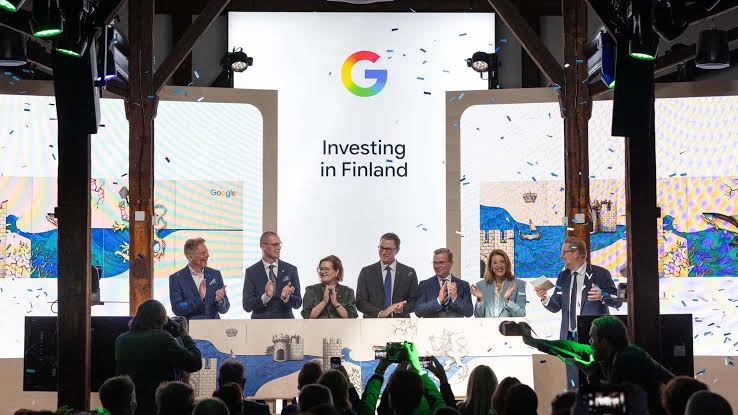
HAMINA, FINLAND — September 10, 2026
It started with a dead paper mill.
In 2009, Google walked into the little Finnish port town of Hamina, bought a shuttered pulp factory on the edge of the Gulf of Finland, and turned it into one of the strangest data centres on Earth — a server hall cooled by raw Baltic seawater, pumped through tunnels the papermakers had already dug decades earlier. Locals thought it was a curiosity. Seventeen years later, that curiosity has become the anchor of the single largest investment Google has ever made on the European continent.
On Tuesday, September 9, Google announced it will spend at least €13 billion — roughly $15.1 billion — on digital infrastructure in Finland across just two years, 2027 and 2028. The money expands Hamina and builds three entirely new data centre campuses in Kajaani, Muhos and Vaala, three northern communities most Europeans could not find on a map.
But the headline number is not the part that made energy traders sit up. Buried in the announcement was a 22-year power purchase agreement with the Finnish utility Fortum that will keep the Loviisa nuclear power plant — a facility supplying roughly a tenth of Finland's entire electricity supply — running until 2050. Without it, Loviisa was heading for the scrapheap in 2030.
A REACTOR WITH A DEATH SENTENCE — COMMUTED
Loviisa sits on a rocky peninsula about 90 kilometres east of Helsinki, and not far from Google's original Hamina site. It employs around 580 people. It generates about 10 per cent of Finland's power. And, according to Google's own statement, "without the lifetime extension investment program, the plant could not continue operations beyond 2030."
Life-extending a nuclear plant is not a matter of repainting the control room. Fortum has said that roughly 80 per cent of the projects required — and about €700 million of the capital expenditure needed to push Loviisa through to 2050 — were still awaiting final investment decisions. Utilities do not sign off on that kind of spending without knowing someone will buy the electricity at the far end. In a Nordic power market defined by wild price swings and thin forward visibility, nobody could give Fortum that guarantee.
Google just did. The deal covers up to half of Loviisa's output from 2030 to 2049 — and it is Google's first nuclear power purchase agreement anywhere outside the United States.
"Long-term partnerships like the one between Fortum and Google are essential," Fortum's president and chief executive Markus Rauramo said, "especially in today's uncertain market environment characterised by low visibility and highly volatile electricity prices. They provide the visibility needed to invest in new low-carbon power generation capacity, strengthen energy security and support new digital and industrial investments."
Translation: a search-and-advertising company from Mountain View has effectively underwritten a chunk of a sovereign nation's baseload electricity supply for the next quarter century.
And the two parties are not stopping there. Alongside the PPA, Google and Fortum signed a memorandum of understanding to explore new generation capacity at the Loviisa site — including, explicitly, work to "improve the commercial viability of potential new nuclear reactors." New reactors. In Finland. Financed on the back of AI demand.
WHY THE FAR NORTH? THE GRID TRICK NOBODY TALKS ABOUT
Here is the detail that separates this announcement from the standard data-centre land grab: Google is deliberately building in the north, not the south.
Finland's electricity generation is concentrated in the north — hydro, wind, and the industrial legacy of a heavily electrified forestry economy. Demand, historically, has been concentrated in the south, around Helsinki. That mismatch means power has to be shoved down long transmission corridors, and those corridors cost money to reinforce.
Google says it worked with Fingrid, the Finnish transmission system operator, and the state agency Business Finland to pick sites that sit at strong points on the existing grid — putting the load next to the generation instead of at the other end of the country.
"We welcome Google's new projects in Muhos, Kajaani and Vaala where they can grow as there is significant grid capacity for electricity consumption in the production-dominated north," said Asta Sihvonen-Punkka, president and chief executive of Fingrid. "Our aim is to keep the costs of the growing electricity system competitive, while reducing environmental impacts, and these locations at strong grid points both help the whole electricity system and ensure cost-effective network development."
It is a genuinely clever bit of siting — and it is also, transparently, a political shield. The single most toxic accusation facing hyperscale data centres worldwide is that they drive up household energy bills. Google has pre-emptively built its answer into the architecture.
THE MONEY THAT LANDS ON THE GROUND
The economic projections attached to the announcement are eye-watering for a country of 5.6 million people.
During the 2027–2028 construction phase alone, Google estimates the initiative will contribute an annual average of €3.6 billion to Finland's gross domestic product and support more than 37,000 jobs nationwide. Around 16,000 of those are construction roles, generating an estimated €911 million in average annual labour income across the sector.
Once the sites are actually running, Google projects roughly 7,000 ongoing jobs a year, at average wages 24 per cent above Finland's median.
There is community money too, and it is unusually specific. Google is committing €31 million over four years across Hamina, Kajaani, Muhos and Vaala, with €10 million ring-fenced for research and innovation. There is funding for solar panels and heat pumps in low-income households, energy-efficiency renovations of municipal buildings, upgraded lighting on ski and running trails to extend their winter use, and backup power for local emergency, health and water services.
On the workforce side, Google.org's AI Opportunity Fund will train more than 4,400 workers, delivered through local partners including Oamk, Tieke and Xamk. A separate programme with the vocational college EKAMI will put up to 100 Finnish students through a year of data-centre career training.
Prime Minister Petteri Orpo called the decision "a clear testament to our strengths," adding that "the value of the data economy extends far beyond direct investment into spurring innovation, research, and development."
Ilari Soosalu, the mayor of Hamina, was blunter and warmer: "Our partnership with Google is a true success story that began back in 2009. The collaboration has been absolutely great and exceptionally smooth, and we are very happy to see it deepening here in Hamina!"
WIND, BATTERIES AND A BLUEPRINT
The nuclear deal grabbed the headlines, but it is one leg of a four-legged energy stool.
Google also signed new onshore wind PPAs with two Finnish developers — Valorem, in Ostrobothnia, and Suomen Hyötytuuli, in Ostrobothnia and Central Finland — bringing the total new-to-the-grid onshore wind capacity it supports in Finland to 629 megawatts. The company says it is working with partners to let that wind portfolio participate in Fingrid's ancillary services markets, which is the unglamorous plumbing that actually keeps a grid's frequency stable.
And there is storage. A contracted 94-megawatt battery system will connect to the Finnish grid near the Kajaani site, expected operational in late 2027 — specifically pitched as insurance for what Nordic engineers call the Dunkelflaute: those cold, windless, dark stretches of winter when renewables underperform and prices spike.
Google is also carrying forward the trick that made Hamina famous. Its offsite heat recovery project there is designed to cover 80 per cent of the annual heat demand of Hamina's district heating network — waste server heat piped into people's radiators. The company says heat-recovery readiness is now designed into all its new European data centres from the start.
Ruth Porat, president and chief investment officer of Alphabet and Google, framed the whole package as a template: "This investment underscores Google's commitment to grow our presence responsibly, pairing the expansion of our technical infrastructure with new energy capacity, grid enhancements, and energy affordability initiatives."

THE EXPERT PERSPECTIVE — AND THE NUMBERS THAT WEREN'T THERE
Not everyone reading the press release came away dazzled.
Energy analysts have flagged a technical point that gets glossed over in almost every corporate clean-energy announcement: a power purchase agreement does not physically route a dedicated stream of nuclear electrons into one building. It is a financial and commercial arrangement — a contract that supports generation and matches consumption over time on an accounting basis. Electrons on a synchronised grid do not carry name tags. That does not make the deal meaningless; keeping 10 per cent of a country's carbon-free supply online for twenty extra years is a real, physical outcome. But "our data centre runs on nuclear power" is a marketing sentence, not an engineering one.
The sharper criticism concerns what the announcement leaves out. There is no megawatt figure for the new data centres. No annual consumption estimate in terawatt-hours. No power usage effectiveness ratio. No water withdrawal or consumption figure — a conspicuous gap for facilities being built in a country whose lakes and rivers are a defining national asset, and in a sector where water use has become a flashpoint from Arizona to Aragón.
In other words: we know precisely how many euros Google is spending, how many jobs it claims to create, and how many trail lights it will upgrade. We do not know how much electricity these buildings will actually draw. That asymmetry is not an accident, and it is worth naming.
Finland's Minister of Climate and the Environment, Sari Multala, offered the government's counterweight: "These investments are very welcome in Finland and demonstrate that it is possible to invest in AI infrastructure in a way that benefits both local communities and the broader energy system, including other energy users."
Google's own line is that it is "bringing a targeted portfolio of additional carbon-free energy supply to the Finnish grid, so that its new energy demand does not contribute to higher power prices for Finnish households." It is a promise. Finnish electricity bills over the next five years will be the audit.
WHAT THIS MEANS FOR YOU
You probably do not live in Vaala. So why should this land on your radar?
Because it is the clearest signal yet of how the AI build-out is going to reshape ordinary electricity markets — and it is a template that will be copied. The old model was simple: a tech company builds a shed somewhere with cheap power, buys some renewable certificates, and moves on. The new model, on display here, is a company acting as a long-horizon utility financier — signing 22-year contracts, funding reactor life extensions, contracting batteries, and negotiating siting with the national grid operator before choosing a plot of land.
That has two consequences for anyone who pays a power bill. The first is upward pressure: AI demand is enormous and it is arriving fast, and demand growth without matching supply growth means higher prices. The second is a genuine counterweight: when a buyer with Alphabet's balance sheet guarantees revenue for decades, plants that would have closed stay open and new capacity that would never have cleared a financing committee gets built. Loviisa is the proof of concept. Something that was going to be decommissioned is now scheduled to run to 2050.
The open question — the one that should shape how you read the next dozen announcements like this — is who captures the benefit. If the added supply genuinely outruns the added demand, everyone's bill benefits. If it does not, the data centres get their power and households get the invoice. Watch for the missing numbers. When a company announces a data centre and tells you the GDP contribution but not the megawatts, that gap is the story.
THE BOTTOM LINE
Finland has spent a decade quietly positioning itself as the most sensible place in Europe to put a very large computer: cold air, a decarbonised grid, political stability, and a population that broadly trusts institutions. On September 9, that bet paid off in the largest single European cheque Google has ever written.
For Hamina, Kajaani, Muhos and Vaala, this is transformative — thousands of jobs, restored peatland and forest, new trails and saunas and piers, and a shot at being something other than a place young people leave.
For Loviisa's 580 workers, it is a reprieve that arrived from an unexpected direction.
And for everyone else, it is a preview. The machines that write your emails and summarise your documents need somewhere to live and something to eat. Increasingly, what they eat is baseload nuclear power — and the companies that own them have started buying the farms.
Published By | Tech Wiz