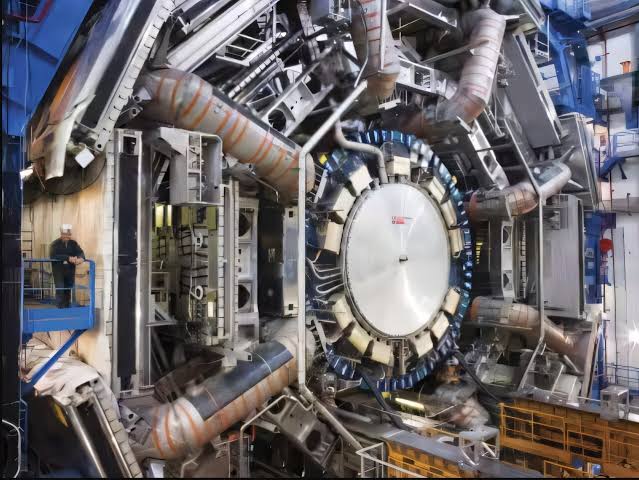
Oxford scientists smashed protons together at 99.99% the speed of light and found that "spooky action at a distance" — the quantum weirdness Einstein hated — still holds even inside the wreckage of some of the heaviest, shortest-lived particles ever created
SCIENCE & TECH
Deep beneath the Swiss-French border, in a 17-mile ring of superconducting magnets, physicists just pushed one of the strangest ideas in science to a breaking point — and watched it refuse to break.
Researchers working with the ATLAS and CMS experiments at CERN's Large Hadron Collider (LHC) announced this month they have found strong evidence of quantum entanglement between Z bosons, fleeting particles that flicker in and out of existence in the debris of the universe's most powerful particle smashups. It's being hailed as one of the highest-energy confirmations of quantum entanglement ever achieved — a phenomenon so counterintuitive that Albert Einstein himself spent decades trying to prove it couldn't be real, dismissing it as "spooky action at a distance."
He lost that argument, again.
"Finding it alive and well among particles as heavy and short-lived as Z bosons — created and destroyed within a fraction of a fraction of a second inside conditions violent enough to briefly recreate the energy of the early universe — shows just how fundamental and robust this quantum effect really is," said Professor Alan Barr, one of the Oxford physicists involved in the research, in comments accompanying the findings.
What Actually Happened Inside the World's Biggest Machine
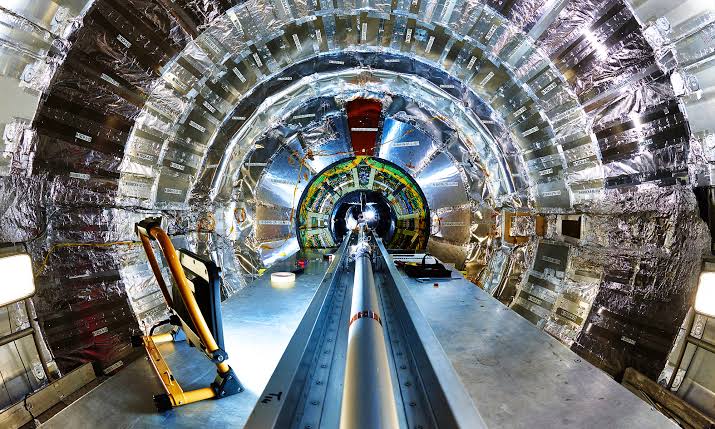
To understand why physicists are excited, you have to understand what the LHC actually does: it's the largest, most powerful particle accelerator ever built, a ring-shaped tunnel where beams of protons are whipped around at 99.99% of the speed of light before being smashed head-on into each other. The collisions briefly generate energies of 13 trillion electron volts, conditions not seen naturally since fractions of a second after the Big Bang.
Out of that chaos, exotic and unstable particles briefly wink into existence — including, occasionally, the Higgs boson, the particle famously tied to how matter gets its mass. When a Higgs boson decays, it can produce a pair of Z bosons, particles that carry the weak nuclear force. Z bosons are so short-lived they exist for a tiny fraction of a second before disintegrating further into pairs of electrons or muons.
That instant of decay is exactly where things get strange. Physics dictates that the combined spin — a fundamental quantum property — of the two Z bosons produced by a Higgs decay must add up to zero, matching the Higgs boson's own spin. If one Z boson is measured with a spin of +1, its partner must instantly resolve to a spin of -1, no matter how the two particles' properties are correlated. That correlation, if it holds up to rigorous statistical testing, is the signature of quantum entanglement: a link between particles so intimate that measuring one instantaneously determines the state of the other, even though nothing physically travels between them to enforce it.
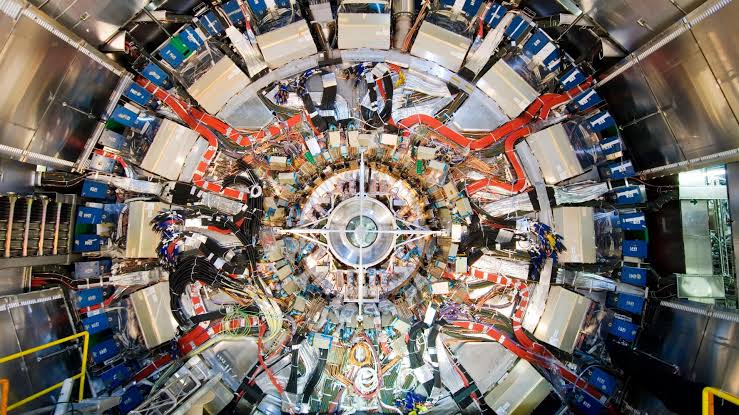
Because Z bosons vanish almost the instant they're born, the Oxford-led team, working within the ATLAS collaboration alongside a parallel effort by the CMS collaboration, couldn't observe them directly. Instead, researchers painstakingly reconstructed the Z bosons' original spin states by tracking the angles and trajectories of the electrons and muons they decayed into — essentially reverse-engineering the ghosts of particles that no longer exist by studying the debris they left behind. The data was drawn from the second and third operational runs of the LHC.
The result: statistically strong evidence that the two Z bosons were indeed entangled, extending a phenomenon previously confirmed in top quarks (a discovery made a couple of years earlier) into an entirely new and far more energetic regime of physics.
Why Einstein Hated This Idea in the First Place
To modern physicists, quantum entanglement is simply how the universe works at its smallest scales. But when Einstein, along with physicists Boris Podolsky and Nathan Rosen, first grappled with the implications of quantum mechanics in the 1930s, the idea struck him as absurd — a sign that quantum theory must be incomplete. The notion that measuring one particle could instantaneously affect a distant partner, without any signal passing between them, seemed to violate the basic rule that nothing travels faster than light. Einstein called it "spukhafte Fernwirkung" — spooky action at a distance — and used it as ammunition in his decades-long argument that quantum mechanics couldn't be the final word on reality.
Generations of increasingly clever experiments have since proven Einstein wrong on this point, most famously through tests of what's known as Bell's inequality, work that earned physicists Alain Aspect, John Clauser and Anton Zeilinger the 2022 Nobel Prize in Physics. But nearly all of those tests were performed using comparatively gentle, low-energy systems — photons of light, trapped ions, carefully isolated atoms sitting calmly in a laboratory.
What makes the new CERN result remarkable is the sheer violence of the environment in which entanglement was observed to survive. Z bosons aren't calm, isolated particles drifting in a vacuum chamber; they're byproducts of some of the most energetic, chaotic collisions humans have ever engineered, existing amid a firestorm of other particles and their own near-instant self-destruction. That entanglement holds up under those conditions surprised even some specialists.
"Entanglement is both the most promising and the most puzzling aspect of quantum reality," said Professor Chris Timpson, a philosopher of physics who has studied the foundations of quantum theory, in remarks on the findings. The persistence of the effect at such extremes, he and colleagues suggest, deepens rather than resolves that puzzle.
The Expert Perspective: Why Physicists Are Buzzing
Beyond the philosophical thrill of watching Einstein lose another round, physicists say the practical implications could be significant. Confirming that entanglement survives at extreme energies opens a genuinely new experimental frontier: using the world's most powerful particle collider not just to hunt for new particles, but as a laboratory for fundamental quantum information science — territory that, until recently, belonged almost exclusively to quieter, tabletop experiments.
Researchers say the find could sharpen scientists' understanding of how the Higgs boson interacts with other elementary particles, since the entanglement signature is itself a sensitive probe of that interaction. There's also cautious optimism that pushing entanglement studies into this new energy regime could eventually help physicists spot subtle deviations from the Standard Model — the reigning theory of particle physics — that might hint at entirely new physics.
The timing is notable, too. CERN's High-Luminosity LHC upgrade, due to dramatically boost the collider's collision rate in the coming years, should hand physicists vastly more data to test these entanglement signatures with greater precision, potentially turning what is currently "strong evidence" into ironclad, textbook-certain confirmation.
There's also a longer-term, more speculative payoff that has technologists paying attention: entanglement is the foundational resource behind emerging quantum computing and quantum sensing technologies. While nobody is suggesting engineers will soon be harvesting Z bosons to build quantum computers — the particles' lifetime is far too fleeting and their creation far too energy-intensive for any practical application — some researchers argue that understanding how robustly entanglement survives extreme conditions could inform theoretical work relevant to next-generation quantum technologies operating in noisy, high-energy or otherwise "messy" real-world environments.
What This Means for You
You will not be buying a Z-boson quantum computer anytime soon, and nothing about your daily life changes because two subatomic particles briefly agreed on their spin inside a Swiss tunnel. But this discovery matters in a bigger-picture way: it's fresh, hard evidence that quantum mechanics — the same body of theory underpinning the semiconductors in your phone, the lasers in barcode scanners, MRI machines, and the encryption securing your online banking — holds up even in the most extreme conditions scientists can currently create.
Every time researchers throw a harder, weirder test at quantum theory and it survives, it reinforces the foundation beneath a huge swath of modern technology, and it nudges forward the frontier for quantum computing and quantum sensing research that companies and governments are racing to commercialize. It's also, simply, a reminder that some of the strangest ideas in science — ideas that even Einstein found too bizarre to accept — keep turning out to be true.
The Bottom Line
Nearly a century after Einstein tried to argue quantum entanglement out of existence, physicists at the world's most powerful collider just watched it survive being smashed apart at 99.99% the speed of light. The "spooky action" he found so unsettling isn't just real — it's apparently one of the most stubbornly persistent features of the universe, showing up in conditions of chaos and violence that dwarf anything in a physics classroom. As CERN's upgraded collider comes online in the years ahead, scientists expect this strange, invisible thread linking particles across space to keep showing up in stranger places still — and Einstein, wherever the thought experiment leaves him, keeps losing the argument he started.
Published By | Tech Wiz