Written By | Torch Media Africa
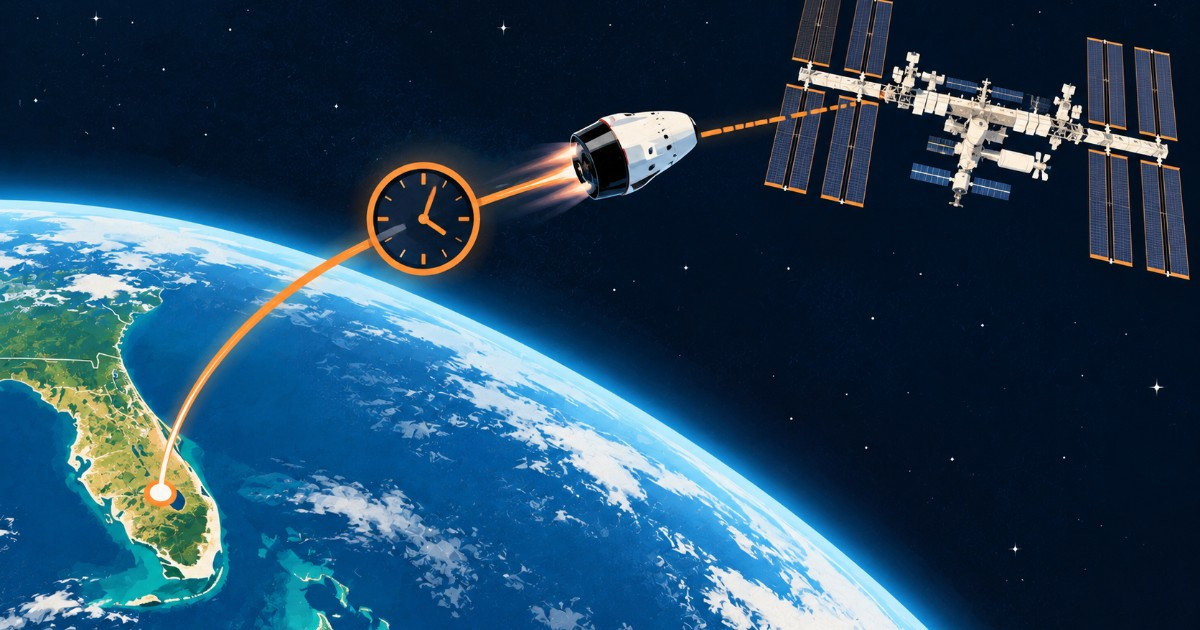
Three space rookies, one veteran and a Canadian dad-to-be raced to the ISS in under eight hours. Now the crew they replaced is heading home after 235 days in orbit.
TECH & SCIENCE DAILY | SPACE
Eight hours. That is roughly how long it takes to fly from London to Los Angeles with a stopover. It is also how long it took four people to leave the ground in Florida and shake hands with the International Space Station, 250 miles above the planet.
SpaceX's Crew-13 mission lifted off on Oct. 1, 2026, at 11:10 a.m. EDT from Pad 40 at Cape Canaveral Space Force Station and docked about seven hours and 55 minutes later, around 7 p.m. NASA described the trip as a record-setting flight. This week the story moves to its second act: the four astronauts and cosmonauts they replaced are packing up for the ride home, with undocking targeted for Wednesday, Oct. 7, and a splashdown off the California coast planned for Thursday, Oct. 8.
For a few busy days, the station has been the most crowded address in low Earth orbit.
Meet the Crew-13 four
Commanding the mission is NASA astronaut Jessica Watkins, a geologist with a Ph.D. who is on her second spaceflight; she previously flew on SpaceX's Crew-4. Her pilot is NASA's Luke Delaney, a former military test pilot making his first trip to space. Joining them are Russian cosmonaut Sergey Teteryatnikov, a former submarine force officer, and Canadian Space Agency astronaut Joshua Kutryk, also a former military test pilot. Both are first-time flyers.
The rookie count matters. Delaney, Teteryatnikov and Kutryk are now the 296th, 297th and 298th people to live aboard the ISS, according to NASA's counting. Kutryk is the 17th Canadian in space, and has been described as the first Canadian sent to orbit through NASA's Commercial Crew Program. The flight is the 13th operational crew mission of that program, and the crew is part of Expeditions 75 and 76.
The mission is planned to last about six months. For one member, that clock is ticking in an especially personal way.
A baby on the way, 250 miles below
Kutryk's wife is expecting the couple's third child around Thanksgiving, roughly two months into his mission, which means he will almost certainly miss the birth. Before launch, he did not sugarcoat what that felt like. 'Leaving these three (plus one on the way) is the hardest thing I've ever done,' he said.
It is a reminder that behind the countdowns and the carefully worded press releases, spaceflight remains a profoundly human commitment. Astronauts miss birthdays, graduations and, sometimes, births. Modern station crews can video-call home, but no video call replaces being in the room.
Why the fast trip matters
Early space-station crews often spent a day or more chasing the station through a series of orbital maneuvers before docking. Fast-rendezvous profiles shorten that to a handful of hours by placing the spacecraft on a tightly timed path. For the people inside a Dragon capsule, the difference is not trivial. Every hour saved is an hour less spent in a cramped cabin with limited room to move, and the first day on orbit is when many astronauts feel space motion sickness most acutely.
A sub-eight-hour trip also hints at how routine crew flights have become. The Commercial Crew Program began flying astronauts in 2020. Today, launches to the station from Florida are scheduled with the regularity of a busy airline route, and the space agency counts on them to keep the orbiting laboratory fully staffed.
The crew heading home: 235 days in orbit
Waiting to return are the members of Crew-12: NASA astronauts Jessica Meir, the commander, and Jack Hathaway, the pilot; European Space Agency astronaut Sophie Adenot; and Roscosmos cosmonaut Andrey Fedyaev. They launched on Feb. 13, 2026, at 5:15 a.m. EST and docked with the Harmony module the next day. By the time they undock, they will have spent about 235 days in orbit.
Their arrival came at an unusual moment. The previous crew, Crew-11, had left the station on Jan. 14, 2026, so the outpost was briefly operating below its usual seven-person complement before Crew-12 arrived. Headlines at the time noted that Crew-11 had departed earlier than originally planned.
On Oct. 4, as the handover neared, Meir formally passed command of the station to Roscosmos cosmonaut Pyotr Dubrov, a ceremony in which Expedition 75 changed hands. NASA says the station's population peaked at 11 people spread across two Dragon spacecraft while both crews were aboard.
If the schedule holds, the Crew-12 capsule will splash down off California at approximately 11:34 a.m. EDT on Thursday, Oct. 8. NASA is streaming the departure from 6 a.m. EDT on Oct. 7 and picks up return coverage at 10:20 a.m. EDT on Oct. 8. Note that NASA's published undocking time has varied between advisories, so check NASA's live coverage for the final timing.
The week in orbit: a timeline
Oct. 1: Crew-13 lifts off at 11:10 a.m. EDT from Cape Canaveral and docks roughly seven hours and 55 minutes later, bringing the station's population to 11 across two Dragon spacecraft.
Oct. 4: Meir hands command of the station to Dubrov in the traditional change-of-command ceremony, marking the formal turning of the page from one crew to the next.
Oct. 7: Crew-12 prepares to undock from the station, with NASA streaming the departure live and the exact undocking time subject to the agency's final go-ahead.
Oct. 8: Splashdown is targeted for about 11:34 a.m. EDT off the coast of California, where recovery teams will help the returning crew out of the capsule and begin the long process of readjusting to gravity.
After 235 days of weightlessness, even standing up can feel like lifting a lead blanket. Returning crews typically go through medical checks and rehabilitation to rebuild muscle and bone strength, a reminder that the human body pays a real price for living in space.
What do astronauts actually do up there?
A six-to-eight-month stay is not a vacation. When Crew-12 launched, NASA outlined a research menu that reads like a medical and agricultural lab rolled into one: studies of pneumonia-causing bacteria with implications for cardiovascular treatments, a system to generate intravenous fluids on demand for future long-duration missions, research on how physical characteristics affect blood flow in microgravity, and experiments on automated plant-health monitoring and plant-microbe interactions to improve food production in space.
NASA Administrator Jared Isaacman said at the time that 'the research this crew will conduct aboard the space station advances critical technologies for deep space exploration while delivering real benefits here on Earth.' That is the core pitch for the station: a place where scientists can run experiments that are impossible under gravity, and learn how humans survive far from home.
Every IV bag that does not have to be launched from Earth, every crop that grows with less human attention and every insight into how the heart behaves in weightlessness feeds directly into the plans for longer journeys to the Moon and, eventually, Mars.
A handover that keeps the station alive
The overlap between crews is not just ceremony. Outgoing astronauts spend days walking their replacements through the station's quirks: which hatch sticks, which experiment needs daily attention, which freezer is acting up. The 'handover' is a transfer of institutional memory, in a place where mistakes can be expensive and help is hundreds of miles away.
It also illustrates the international nature of the station. This single handover involved Americans, a Canadian, a European and Russians, all working together at a time when relations between their home countries are tense in many other areas. The ISS has often been a place where cooperation continues when politics get difficult, and a Russian cosmonaut taking command from an American astronaut this week is a small, visible example.
Expert perspective
Spaceflight analysts often point to the rhythm of crew rotations as the real measure of the station's health. A smooth handover, a rapid docking and a clean undocking are signs of a mature system. They also point to the thinning clock on the ISS itself: the station is planned to operate only until around the end of this decade, after which commercial stations are meant to take over as destinations for NASA's astronauts.
Isaacman's remarks underline how the agency wants to justify the station's remaining years: as a testbed for the technology and medicine that will make deep-space exploration possible. That is the lens through which NASA frames experiments on IV fluids and plant health, and why those seemingly mundane studies matter.
What this means for you
You will not be riding a Dragon to the station any time soon, but the work being done there has a way of reaching everyday life. Research on bacteria, blood flow and food production has direct medical and agricultural spin-offs, and the practical lessons from running crews of mixed nationalities for months at a time inform everything from polar research stations to submarines.
The bigger story is accessibility. If a trip to orbit takes less than eight hours and launches happen on a regular schedule, the barrier to entry for space keeps dropping. That trend feeds directly into the commercial space stations, lunar missions and private research flights that are expected to define the next decade.
And if you are watching the splashdown on Thursday, remember that every one of those returns is the end of an extraordinary personal story: months of work, time away from family and a fiery fall back through the atmosphere.
The bottom line
Crew-13 is already settling into life aboard the station, with a six-month job ahead of them and a baby on the way for one of them. Crew-12 is looking toward a quick drop into the Pacific and a long-awaited hug on dry land.
In between, the International Space Station keeps doing what it has done for more than two decades: orbiting quietly overhead, humming with experiments and proving that people from very different places can live and work together far above the planet. For a few days this week, there were eleven of them up there. By Thursday, it will be seven again.



