Beijing / Washington
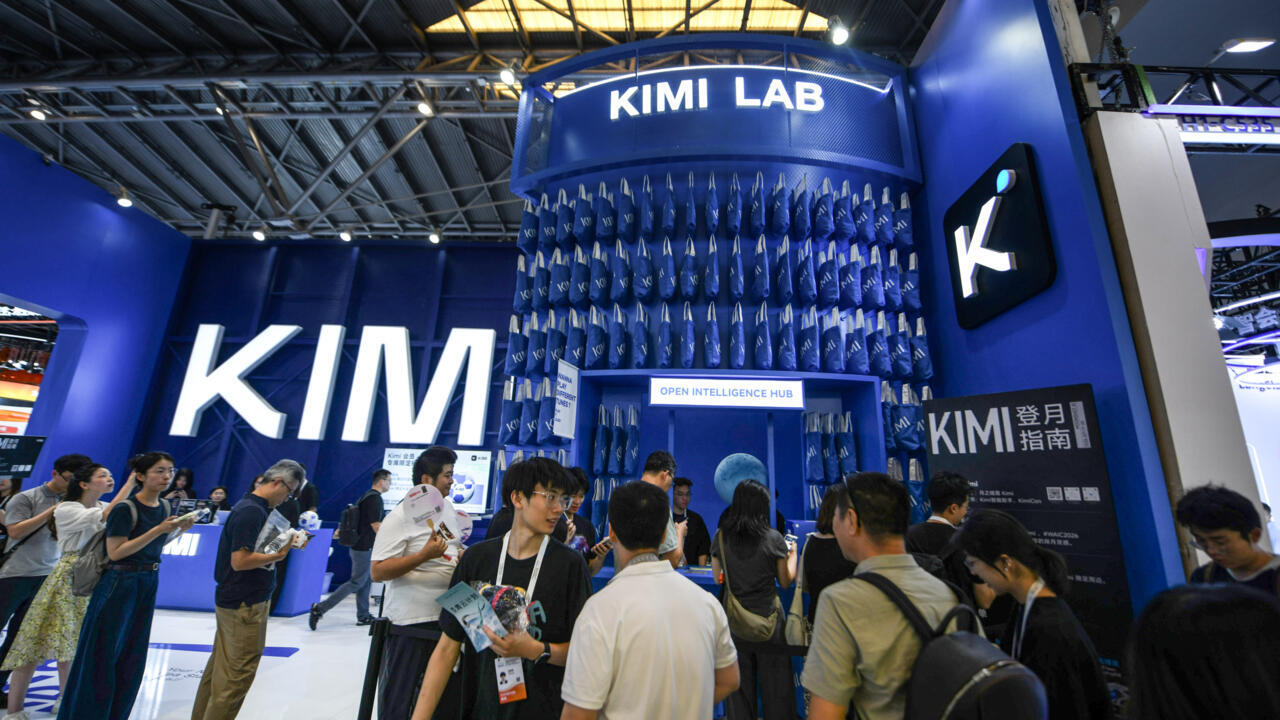
Somewhere in a data center that American officials say it was never supposed to have access to, a Chinese startup called Moonshot AI finished building the largest artificial intelligence model the world has ever seen in open form. It has 2.8 trillion parameters — the individual dials and knobs that give an AI its "knowledge" — stitched together across nearly 900 separate expert sub-networks. Tomorrow, July 27, Moonshot plans to dump the entire thing onto the internet, for anyone, anywhere, to download and run, free of charge, under a license so permissive it barely restricts anything at all.
It is called Kimi K3, and in the ten days since it first went live as a paid API on July 16, it has done something almost no one in Silicon Valley expected: it has beaten America's best coding models on a leading public benchmark, triggered a formal accusation from a senior White House official that its creator broke U.S. export law, and forced Nvidia's own CEO to publicly defend the company Washington is trying to punish.
This is the story of a machine that may be smarter, cheaper, and more politically radioactive than anything to come out of the AI race so far.
The Numbers That Broke the Curve
To understand why Kimi K3 has upended the AI industry's pecking order in a matter of days, you have to understand what "2.8 trillion parameters" actually means. Parameters are roughly the connections in an AI's simulated neural network — more of them generally means more capacity to reason, recall, and generate convincing language, code, and images. Kimi K3's total parameter count is about 75 percent larger than DeepSeek's V4 Pro, the previous record-holder for a Chinese open model at roughly 1.6 trillion parameters, and dwarfs most of what American labs have released publicly.
Critically, K3 doesn't use all 2.8 trillion parameters for every task. It runs on a "Mixture-of-Experts" architecture, meaning the model has 896 specialized sub-networks, or "experts," and activates only 16 of them for any given request. That trick is what lets a model this enormous run at a manageable cost — Moonshot is charging just $3 per million input tokens (and a discounted $0.30 per million for cached input) and $15 per million output tokens through its API, prices competitive with, and in some cases cheaper than, comparable Western models.
The model also boasts a one-million-token context window — enough to digest an entire codebase or a multi-hundred-page document in one go — native visual understanding for reading images and diagrams, and what Moonshot calls "thinking mode," an always-on extended reasoning process similar to what OpenAI and Anthropic have built into their own flagship reasoning models.

And it's fast climbing the leaderboards. On the Frontend Code Arena, a closely watched public benchmark that ranks AI models on how well they can build working, polished web interfaces, Kimi K3 posted a score of 1,679 — enough to leapfrog Anthropic's Claude Fable 5 (1,631), OpenAI's GPT-5.6 Sol (1,618), and Zhipu's GLM-5.2 (1,587). Moonshot itself is careful to note that K3 still trails Claude Fable 5 and GPT-5.6 Sol on broader, more holistic evaluation suites — but it says the model beats every other system it tested, including the older Claude Opus 4.8 and GPT-5.5, on coding and multi-step "agentic" tasks, the kind where an AI has to plan and execute a sequence of actions rather than simply answer a question.
When the full model weights land on Hugging Face on July 27 — packaged at roughly 1.4 terabytes using a compressed numerical format called MXFP4 — it will instantly become the largest open-weight model in history that any research lab, startup, or hobbyist with sufficiently powerful hardware can download, inspect, modify, and run without paying Moonshot a cent in licensing fees. It's being released under a Modified MIT license, one of the least restrictive open-source terms in software.
"It Accessed Chips It Was Never Supposed to Touch"
But the celebration inside China's AI industry — where state media has been quick to frame Kimi K3 as proof that Beijing is closing the gap with Silicon Valley despite years of U.S. export controls on advanced chips — has been undercut by an extraordinary accusation from inside the White House.
Michael Kratsios, director of the White House Office of Science and Technology Policy, told reporters this week that Moonshot AI "acquired GB300-equipped servers and has accessed GB300s in Thailand, likely to train its AI models." The GB300 is part of Nvidia's flagship Blackwell chip family — hardware the United States explicitly bars from sale to Chinese companies precisely because of its power to train frontier AI systems. If true, the allegation would mean Moonshot built the world's largest open AI model using hardware Washington spent years, and enormous diplomatic capital, trying to keep out of Chinese hands.
Kratsios's accusation didn't stop there. He also alleged that Moonshot engaged in "large-scale, covert distillation" of Anthropic's Claude Fable model — a technique where a company feeds the outputs of a rival's proprietary AI into its own model's training process, essentially using a competitor's system as an unpaid, uncredited teacher. If substantiated, that would represent not just a chip-smuggling problem but an intellectual-property one, with Moonshot potentially having built its record-breaking model in part by siphoning knowledge out of a competitor whose owners in Washington's telling never gave permission.
The Treasury Department is not treating this as an idle complaint. Secretary Scott Bessent told Fox Business that the U.S. government could sanction Chinese AI labs over alleged intellectual-property theft, saying entity-list designations — the same tool used to cut Huawei off from American technology — "will be on the table." An entity-list designation for Moonshot would bar American companies from supplying it with hardware, software, or services, a potentially crippling blow for a startup that industry watchers say is already straining under a "GPU crunch." Notably, Moonshot was forced to briefly pause new subscriptions to its consumer products in the days after K3's release, a move several tech outlets reported was a direct symptom of the company not having enough computing capacity to serve demand — an odd wrinkle for a company the White House says has illegal access to some of the most powerful chips on Earth.
Nvidia's CEO Breaks Ranks
The accusations have put Nvidia in an uncomfortable spot, since Nvidia's own chips are at the center of the export-control dispute. But CEO Jensen Huang has publicly refused to pile on. Rather than distance Nvidia from Kimi K3, Huang called open models like it "excellent" and argued the United States should embrace, not ban, Chinese open-weight releases. His logic, echoed by several Silicon Valley voices: shutting China's AI industry out of American chips and platforms doesn't stop Chinese labs from building powerful models — it just accelerates their push to build a fully independent domestic chip and software stack, ultimately weakening rather than strengthening America's long-term technological leverage.
That argument puts Huang at odds with Kratsios and Bessent, and it underscores a deepening rift inside the U.S. tech and policy establishment over how aggressively to police the flow of AI technology across borders — a rift that predates Kimi K3 but that this single 2.8-trillion-parameter release has thrown into sharp relief.
Why This Matters Beyond the Politics
Set the export-control fight aside for a moment, and Kimi K3 represents something else notable: proof that "open" AI — models whose weights anyone can download and run on their own servers, without depending on OpenAI, Anthropic, Google, or any single gatekeeper — is no longer a second-tier category reserved for hobbyists and researchers. It's now genuinely competitive with, and in narrow benchmarks superior to, the best closed, proprietary systems money can rent by the API call.
That has real consequences for anyone who uses AI tools, even indirectly. A startup or a national government that wants frontier-grade AI capability without depending on a Western company's servers, pricing, or content policies now has a viable, free option to build on. Universities, hospitals, and governments with strict data-privacy rules — who have historically been wary of sending sensitive information to a third-party API — can run Kimi K3 entirely inside their own infrastructure. And competitively, it puts pressure on OpenAI, Anthropic, and Google to keep cutting prices and pushing capability just to justify charging for access to something a free download can now increasingly replicate.
The technology press is not shy about the stakes. As one industry analysis put it this week, the AI race is no longer just about who builds the smartest model in a lab — it's a global contest over who controls the physical infrastructure, chips, and geopolitical rules that determine who gets to build the next one at all.

Expert Perspective
AI researchers who have examined Kimi K3's technical documentation describe the achievement in almost begrudging terms: impressive engineering wrapped inside an unresolved geopolitical scandal. The model's Mixture-of-Experts design — activating only 16 of nearly 900 available experts per query — is being cited by independent analysts as a genuinely efficient piece of systems engineering, not just brute-force scale for its own sake. At the same time, several of the same commentators note that Moonshot's benchmark victories are narrow: Kimi K3 dominates on code-generation leaderboards specifically, while still lagging top Western systems on the kind of broad, generalized reasoning tests that determine overall model quality. In other words, K3 is less an all-around champion than a very good, very cheap specialist that happens to have grabbed the single biggest headline number — parameter count — in AI history.
What This Means for You
If you're a developer, Kimi K3's arrival means you'll likely have access, within days, to a free, extremely capable coding assistant that can run on your own hardware or a cloud server of your choosing, no subscription to a Western AI company required. If you're simply an everyday consumer of AI tools — through a chatbot, a coding assistant, a customer service bot — expect the competitive pressure from K3 to translate into cheaper, more capable versions of the tools you already use, as Western labs respond to undercut Moonshot's pricing. And if you follow geopolitics, watch this space closely: how Washington responds to the chip-smuggling and IP-theft allegations in the coming weeks could reshape the rules governing the entire global AI supply chain, with ripple effects for any company, in any country, that depends on advanced semiconductors.
The Bottom Line
By this time tomorrow, the single largest open AI model ever built will be sitting on Hugging Face's servers, downloadable by anyone on Earth with sufficient hardware to run it — a scientific and engineering triumph shadowed by allegations of smuggled chips and pirated intelligence from a rival lab. Whether Washington responds with sanctions, whether Moonshot's GPU shortage catches up with its ambitions, and whether Nvidia's more conciliatory stance wins out over Treasury's hawkish one, will determine whether Kimi K3 becomes a one-off headline or the opening shot in a new, more chaotic phase of the AI arms race. Either way, the genie — all 2.8 trillion parameters of it — is about to be out of the bottle.
Published By | Tech Wiz