Algiers
Algeria is an unusual case in African technology policy. Most of the continent's digital success stories were built by private operators moving faster than regulators, with the state catching up afterwards. Algeria has done close to the opposite: the state has built or licensed almost every layer of the stack — fibre, spectrum, data centres, digital identity, even the venture capital — and is now waiting for a startup and payments economy to grow into the capacity it has created. The strategy has a name in Algiers: digital sovereignty. Its test in 2026 is whether sovereignty and adoption move at the same speed.

A connectivity baseline that is already high
The demand-side numbers are stronger than Algeria's reputation suggests. According to DataReportal's Digital 2026 report, there were 37.8 million internet users in Algeria at the end of 2025, an online penetration rate of 79.5 percent. Some 27.5 million social media user identities were recorded in October 2025, equivalent to 57.7 percent of the population, and 55.6 million cellular mobile connections were active in late 2025 — about 117 percent of the population, reflecting multi-SIM behaviour rather than universal individual ownership.
That is a materially connected market of roughly 47 million people, and it is a base most sub-Saharan economies would envy. What Algeria has historically lacked is not users but the transactional and commercial layer that converts connectivity into economic output: payments that work, firms that scale, and public services that can actually be completed online.
5G and the fibre push
Algeria formally opened 5G on 3 November, with licences awarded to the three mobile operators — Mobilis, Djezzy and Ooredoo — for a combined 63.9 billion Algerian dinars, roughly US$492 million. The national plan attaches an obligation of full nationwide coverage within six years, a demanding schedule for a country of Algeria's geography, where population is concentrated along the coastal north and the Saharan interior is vast and sparsely settled. Coverage obligations of this kind have historically been the most reliable instrument African regulators possess for pushing operators beyond commercially obvious cities, and they are also the most frequently renegotiated.
Beneath the spectrum, the fixed-line story is arguably more consequential. Algeria has connected roughly 2.9 to 3.1 million households to fibre to the home and is targeting 7 million households by 2027, with nationwide fibre access as the stated end state. If achieved even approximately, that would place Algeria among the best-served fixed-broadband markets on the continent, and would change the economics of everything from cloud adoption to remote work to the viability of hosting services locally.
Cables and orbits
International capacity is the other half of the equation, and Algeria has moved on it. The country is a landing partner in Medusa, an 8,760-kilometre Mediterranean submarine cable system linking five EU states — Cyprus, France, Italy, Portugal and Spain — with four countries of the EU's southern neighbourhood: Algeria, Egypt, Morocco and Tunisia. Medusa is designed with 24 fibre pairs at 20 terabits per second each, for a total system capacity of 480 Tbps, with the first phase scheduled for completion in 2026. For a market whose international bandwidth has long been a bottleneck and a single point of political sensitivity, additional diverse capacity is not a marginal upgrade.
In orbit, Algeria continues to operate Alcomsat-1, launched in 2017 by the Algerian Space Agency in partnership with China, providing Ka-band broadband at up to 20 Mbps. In April 2026 the country moved to open a genuinely new market segment by offering two licences to operate non-geostationary orbit satellite networks — the constellation-era services that have reshaped rural connectivity economics elsewhere. Licensing NGSO capacity is a notable decision for a state that has otherwise emphasised domestic control of infrastructure; it suggests the sovereignty doctrine is being applied pragmatically rather than absolutely.
The sovereign cloud and the data-residency question
The centrepiece of the sovereignty agenda is physical. Algeria inaugurated its National Centre for Digital Services, built around two interconnected national data centres located in Algiers and Blida, operating in a redundant configuration the authorities say guarantees service availability of up to 99.98 percent. The facilities are intended to host government workloads and citizen data domestically.
The policy driver is Law 18-07, which requires local hosting of citizen and transaction data. That requirement cuts two ways. It has effectively kept the major hyperscalers — Amazon Web Services, Microsoft Azure, Google Cloud — from operating regions in Algeria, which constrains the tooling available to Algerian developers and raises the cost of building anything that assumes modern managed cloud services. At the same time, it creates a protected domestic market for local hosting and, in principle, a reason for a sovereign provider to exist at scale. Which of those effects dominates over the next three years is one of the more genuinely open questions in North African tech policy.
From an AI declaration to an implementation roadmap
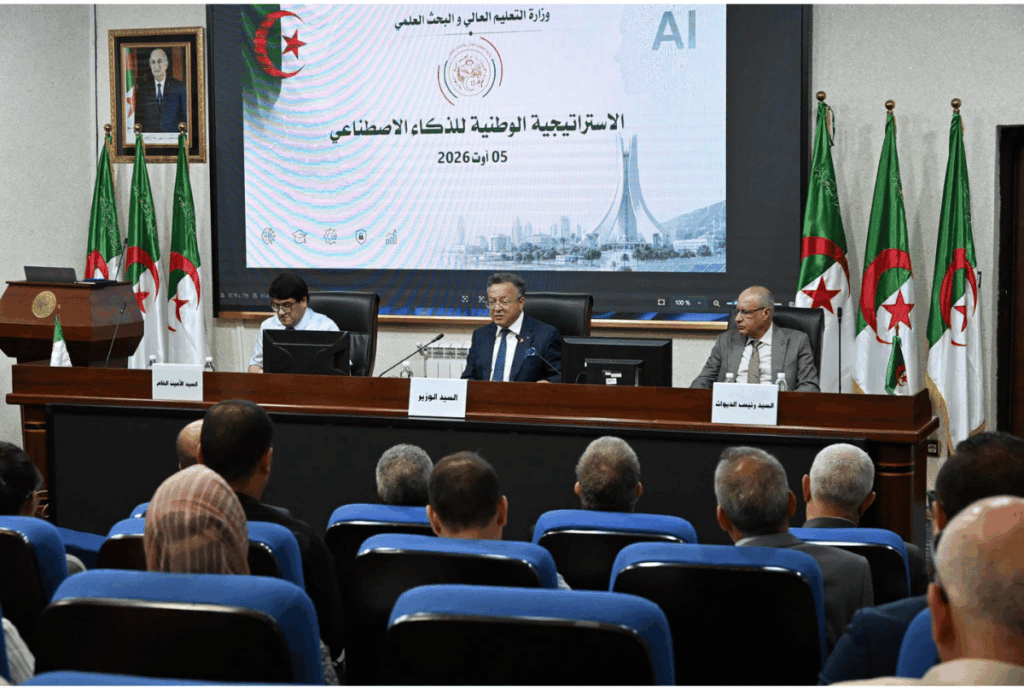
Algeria's AI Council announced the adoption of a National Artificial Intelligence Strategy on 8 December 2024. Through 2026 the initiative has moved from declaration toward machinery: the strategy, built around three structural pillars — data, digital infrastructure and human skills — was reviewed by the government on 25 May 2026, and an inter-ministerial coordination meeting was convened on 5 August 2026, chaired by the Minister of Higher Education and Scientific Research, Kamel Baddari. The programme envisages a national AI fund, improved public data systems, and a priority on sovereign, open-source government AI models for public-sector applications — a design choice consistent with the data-residency posture.
The skills pillar is where the most concrete commitments sit. Algeria's National Higher School of Artificial Intelligence and National Higher School of Mathematics formalised partnerships with the University of Notre Dame in November 2024, covering research collaboration, academic exchange and mentorship. From September 2026, vocational trainees are to receive instruction in cloud computing, cybersecurity and artificial intelligence leading to a diploma jointly issued by the ministry and Huawei. The vocational route matters more than the elite-school route for an economy that needs technicians in volume, not only researchers.
The startup layer and the funding gap
Algeria's startup policy is unusually state-led, and the numbers show both its reach and its ceiling. The Ministry of the Knowledge Economy has certified more than 2,000 startups under the national label since 2020, against a target of 20,000 labelled startups by 2029. The Algerian Startup Fund has invested in over 130 companies. In February 2025 the state operator Algérie Télécom launched a dedicated fund of 1.5 billion dinars — about US$11 million — aimed specifically at startups in artificial intelligence, cybersecurity and robotics. A National Venture Studio Programme has been announced with an ambition to mobilise around US$600 million behind a venture studio creating 1,000 startups across all 58 provinces.
Independent trackers give a more sober count of the commercial layer: Tracxn records roughly 1,236 startups in Algeria, of which only 86 had secured funding as of May 2026, and a single unicorn — Yassir, the super-app that has raised approximately US$193 million in total, including a US$150 million Series B led by BOND in November 2022, and now operates across six countries. The gap between 2,000 labelled companies and 86 funded ones is the honest measure of the ecosystem: certification is abundant, capital is scarce, and one outlier carries the international narrative.

Payments: the rail that is still missing
No digital economy scales without payments, and this is Algeria's clearest structural weakness. Roughly 57 percent of Algerian adults remain unbanked. The instruments that exist are largely state-adjacent: the EDAHABIA card base more than doubled to 14.3 million by the end of 2024, and Algeria Post's BaridiMob mobile application had its daily transaction ceiling raised from 50,000 to 200,000 dinars in July 2023. Card acceptance through Visa, Mastercard and the domestic CIB scheme exists but remains thin relative to European norms.
The regulatory scaffolding is now being assembled. The Bank of Algeria launched a framework for fintech firms in 2020; Instruction 06-2025 is in force, imposing capital requirements, wallet tiers and fund-segregation rules on payment service providers, with a regulatory sandbox targeted for 2026. This is the sequencing that matters: a licensed non-bank PSP category plus a sandbox is what allows a domestic fintech sector to exist at all. Whether Algerian entrepreneurs can build on it faster than incumbents can absorb the opportunity is the practical question for 2027.
Digital identity and the state as a service
The final layer is identity. On 2 November 2025 the government approved a draft law establishing general rules for trust services in electronic transactions and digital identification — digital signatures, time stamps, electronic seals and web authentication — modernising the 2015 electronic signature framework and linking it more tightly to Algeria's biometric national identity card. On the delivery side, the Dzair Digital Services portal aggregates 52 services across seven ministerial sectors, and the short-term implementation plan foresees more than 500 digital projects across 2025 and 2026, roughly three-quarters of them aimed at improving public services. Algeria has also joined the 50-in-5 campaign for digital public infrastructure.
What to watch
Algeria has spent the past two years buying the expensive, slow parts of a digital economy: spectrum, fibre, subsea capacity, sovereign compute, identity law and a public AI programme. Very few African states have assembled that full set. The risk is the familiar one for state-led technology strategy — that infrastructure utilisation lags infrastructure construction, and that the labelled-startup count grows faster than the funded-startup count. The three indicators worth tracking are simple: the ratio of funded to labelled startups, whether the fibre trajectory holds toward 7 million households by 2027, and whether the payments sandbox produces licensed operators serving the unbanked majority. If those move, the sovereign stack becomes an economy. If they do not, it remains an impressive set of buildings and licences.
Published By | Tech Wiz