PITTSBURGH, PENNSYLVANIA
Every so often, science produces a result that is quietly more shocking to the people who understand it than to the people who don't.
This is one of those.
Physicists at Carnegie Mellon University have reported, in the journal Nature Materials, that they have measured a version of the Hall effect that a century and a half of physics said could not happen. Not a refinement. Not a stronger measurement of a known thing. A signal appearing in a direction where the textbook says the answer is zero.
The Hall effect is not some obscure corner of theoretical physics. It is one of the true workhorse principles of the modern world. It is inside your car — several times over. It is in the keyboard some of you are typing on. It is in industrial motors, in medical imaging, in the position sensors that tell a robot arm where it is. Edwin Hall discovered it in 1879, before the electron itself was discovered, and engineers have been quietly cashing in on it ever since.
And for all 147 of those years, one thing about it was taken as settled. It isn't.

What Edwin Hall Found, and Why It Stuck
The original discovery is elegantly simple, which is part of why it has lasted.
Take a flat strip of conducting material and run an electric current along it. Now apply a magnetic field pointing straight through the strip — perpendicular to it, like a nail driven through a sheet of paper. The moving charges carrying the current get shoved sideways. They pile up on one edge. That pile-up creates a measurable voltage across the strip, at right angles to the current.
That voltage is a goldmine of information. It tells you whether the current in a material is carried by positive or negative charges. It tells you how many charge carriers there are. It tells you how easily they move. For more than a century it has been the single most reliable way to interrogate what is actually going on electrically inside a new material — and, in its commercial form, the basis of the Hall effect sensor, a device produced by the billions.
But there was always a condition attached, so obvious that it barely got stated: the magnetic field has to point perpendicular to the plane of the material. Lay the field flat, in the plane of the film, and the effect vanishes. Symmetry forbids it. That's not opinion; that's a mathematical argument, and it's a good one.
"For a long time, people thought the Hall effect only worked when the magnetic field was applied perpendicular to the plane of the film," said Simranjeet Singh, an associate professor of physics at Carnegie Mellon. "We've shown that that's not true — you can also get a response when the field is in-plane."
The Prediction Nobody Could Build
Here is the part that makes this a story about engineering as much as about physics: the idea was not new. Theorists had proposed an in-plane anomalous Hall effect on paper. The maths permitted it — under extremely specific conditions.
The catch was that those conditions were brutal. Symmetry is the gatekeeper. In a normal, well-behaved crystal, the symmetries of the atomic lattice cancel the in-plane response out to exactly nothing. To get a signal, you need a material whose internal symmetry is broken in precisely the right way — and it also has to be magnetic. Those two requirements had never been met in the same object.
"People proposed it and ideas were out there, but it's very difficult to make a magnetic material with the right symmetry to do it," Singh said. "What we did was we found a material with the right symmetry, and we made it magnetic."
That sentence is the whole experiment, compressed. It took two exotic crystals and a great deal of nanofabrication to unpack it.
Two Crystals, A Few Atoms Thick
The team, which included postdoctoral researchers I-Hsuan Kao and Ravi Kumar, started with tantalum iridium telluride — TaIrTe4 — a low-symmetry topological semimetal. Its crystal structure has exactly the awkward, lopsided geometry required to permit a multidimensional Hall response. What it does not have is magnetism.
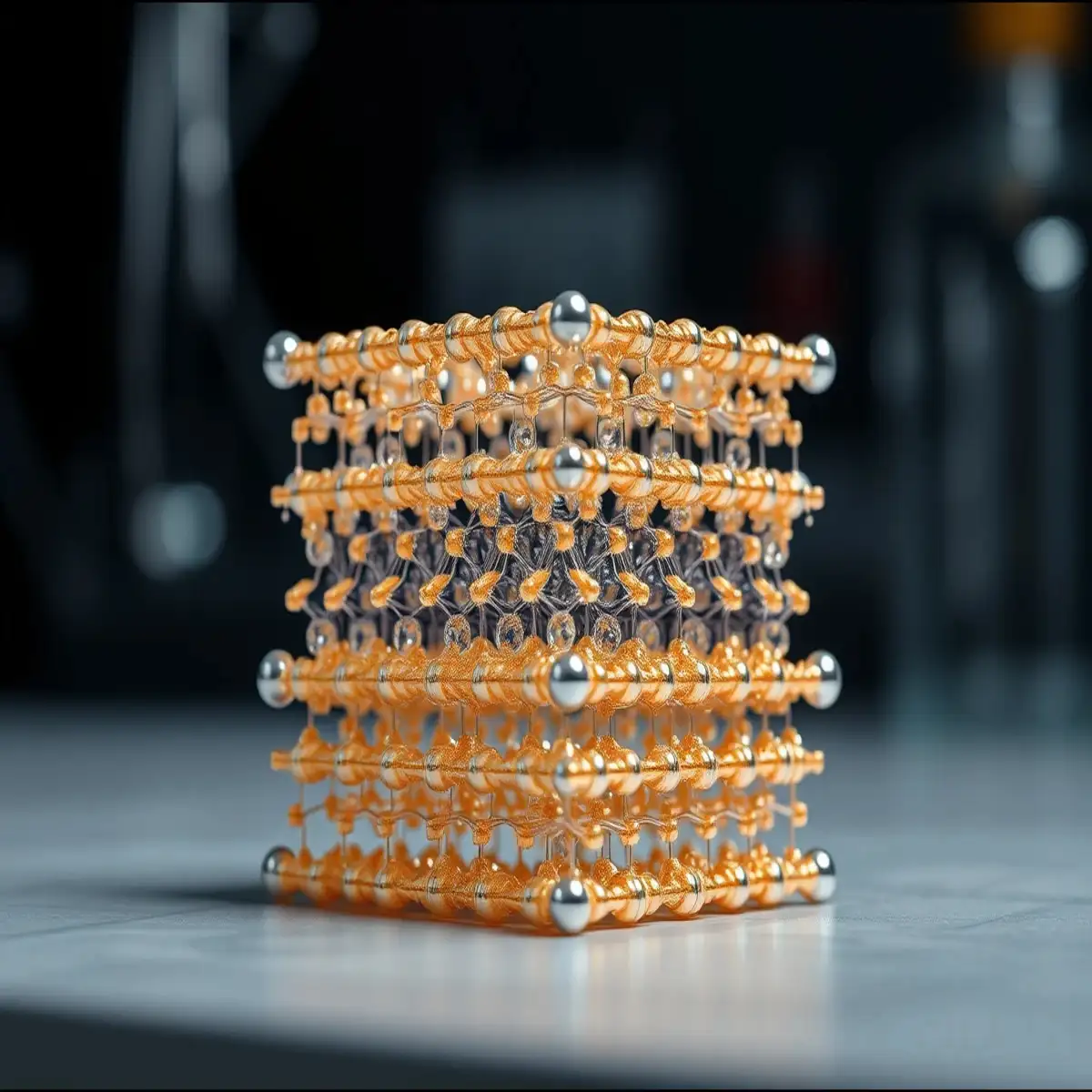
So they thinned it down to just a few atomic layers and laid it directly against a second material: Cr2Ge2Te6, or CGT, a layered ferromagnetic insulator. Stack two materials that closely and they stop behaving as two separate things. Magnetic order in the CGT bleeds across the interface and lends magnetism to the normally non-magnetic TaIrTe4 — without wrecking the electronic character that made TaIrTe4 interesting in the first place.
Building devices like that is its own specialist craft. Singh worked with Jyoti Katoch, an associate professor of physics who specialises in fabricating devices out of two-dimensional quantum materials, to assemble nanometre-scale structures with atomic precision.
"This truly demonstrates the power of building atomically precise heterostructures of emergent two-dimensional quantum materials to obtain on-demand electronic and magnetic properties," Katoch said.
That phrase — "on-demand" — is worth pausing on. It is a statement that materials scientists have moved from finding useful crystals in nature to assembling them to order, layer by layer, like someone building the properties they want out of atomic Lego.
The Signal That Shouldn't Be There
When the devices were cooled down and measured, the researchers saw the ordinary Hall signal, exactly as expected — the perpendicular response Edwin Hall would have recognised.
And then they saw a second one. An additional, unconventional signal that tracked the magnetisation lying flat, within the plane of the material. The forbidden direction. And, critically, it proved to be gate-tunable — the strength of the effect could be dialled up and down electrically, which is both strong evidence it is real and the single most useful property an effect can have if you ever want to build something with it.
Shubhayu Chatterjee, an assistant professor of physics at Carnegie Mellon, did the theoretical modelling to work out why the universe had suddenly permitted something it had spent 147 years refusing.
"We found that the reduced symmetry due to pairing with CGT allows additional spin-orbit coupling at the interface," Chatterjee said. "These spin-orbit coupling terms are crucial for the in-plane anomalous Hall effect to emerge once CGT becomes ferromagnetic at low temperatures."
In everyday terms: by pressing the two crystals together, the researchers destroyed almost all of the symmetry that had been cancelling the effect out. What survived was a single mirror plane. Once the material's magnetism tipped even slightly into that plane, the last piece of protective symmetry broke — and the forbidden signal came through.
Chatterjee, to his credit, refused to over-claim. While some features of the observed signal are consistent with an intrinsic origin, he noted, a detailed characterisation of few-layered TaIrTe4 is still needed to nail down the precise mechanism. The effect is real and measured. The full explanation is a work in progress.
One Sensor Instead of Two
This is where a beautiful piece of condensed-matter physics turns into something with a price tag.
Hall effect sensors are everywhere, and most people never think about them. In a modern car there are dozens: crankshaft and camshaft position sensors, wheel-speed sensors feeding the ABS, throttle position, gear selection, seatbelt latch detection, the sensor that tells the car the boot is shut. In brushless electric motors — the kind in drones, power tools, electric vehicles and cordless everything — Hall sensors tell the controller where the rotor is so it knows when to fire the next coil. Some mechanical keyboards use them. Industrial equipment is riddled with them.
They share a limitation: each one reads a magnetic field along one axis. If you need to know a field's direction in two or three dimensions, you need two or three sensors, physically oriented at right angles to each other, plus the packaging and calibration to hold them there. That is bulk, cost, alignment error and power.
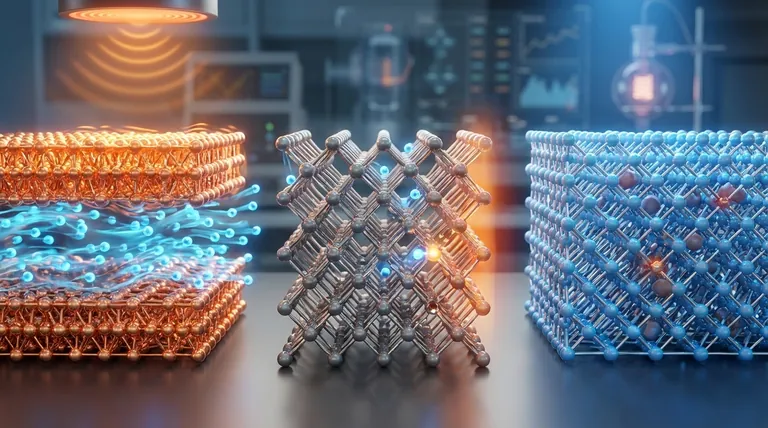
The Carnegie Mellon result attacks that directly. Because the device produces both the conventional out-of-plane Hall signal and an in-plane one, a single ultrathin element can read a magnetic field along more than one axis at once.
"We have broadened the potential application of these materials," Singh said. "You can do multidimensional magnetic sensing with one sensor only. Before, you needed to put two sensors to measure the magnetic field in two directions."
Singh also flagged the specific application that matters most: vector magnetometry — measuring not just how strong a magnetic field is, but which way it points — carried out in a single planar device. "Beyond fundamental importance, this discovery can enable novel planar device architectures and sensor types, such as vector magnetometry, via measuring the out-of-plane and in-plane anomalous Hall effect signals in the same device," he said.
The Catch — And It's a Real One
Nobody should be expecting this in a phone next year, and the researchers are not pretending otherwise.
The effect described in Nature Materials depends on CGT becoming ferromagnetic at low temperatures. Cryogenic conditions are fine for a laboratory bench and hopeless for a car engine bay. Room temperature is the wall every promising 2D-materials result eventually runs into, and this one is standing at it.
The Carnegie Mellon team knows exactly where the bar is. Their Lab for Investigating Quantum Materials, Interfaces and Devices — abbreviated, with some style, to LIQUID — is now hunting for other material combinations that produce the same unconventional Hall response, and testing how the existing device behaves as the temperature climbs. Room-temperature operation, they acknowledge, is the requirement if any of this is ever going to leave the lab.
It is worth noting they are not working alone. The in-plane Hall response has become one of the hottest chases in condensed-matter physics over the past two years, with independent groups reporting related effects in other systems — including a pronounced in-plane anomalous Hall signal in chromium telluride and a dominant in-plane response in a monoclinic room-temperature ferromagnet. When several groups start converging on the same forbidden corner from different directions, it usually means the corner is about to open up.
What This Means For You
Three things, in ascending order of how long you'll have to wait for them.
In the near term, this is a new instrument. Physicists now have a way to probe magnetic and topological structure in more than one direction inside the same sample. Materials that were hard to characterise — because their interesting behaviour lay flat rather than sticking up — just became easier to read. That accelerates the whole search for the next generation of quantum and spintronic materials, the ones aimed at memory and computing that use far less energy than today's silicon.
In the medium term, sensors. If a room-temperature version can be built, replacing two or three sensors with one has straightforward consequences: cheaper, smaller, lower-power sensing in vehicles, in industrial machinery, in consumer electronics. Carnegie Mellon specifically names transportation and medical imaging as target areas. Medical technology is a serious candidate because magnetic sensing sits inside imaging systems and increasingly inside neural interfaces, where physical size and power draw are hard constraints rather than nice-to-haves.
And in the long term, the thing worth taking away has nothing to do with sensors. A rule that everyone in the field accepted for 147 years turned out to be a rule about the materials that happened to be available, not a rule about nature. It held because nobody had built the exception. Then somebody stacked two crystals a few atoms thick, and the exception showed up on the oscilloscope.
That should make you slightly more suspicious of the phrase "it's impossible" the next time you hear it from someone who ought to know.
The Bottom Line
Edwin Hall ran his experiment in 1879, eighteen years before J.J. Thomson identified the electron that makes it work. The principle he found went on to become one of the most commercially deployed pieces of physics in history, and one of its boundaries — field perpendicular, or nothing — became so accepted that it stopped being discussed.
A team in Pittsburgh has now shown that boundary is negotiable, given the right two crystals and the patience to stack them right. The result is published in Nature Materials. It works at low temperature. It is electrically tunable. And it turns one of the most common sensors on Earth into something that can, in principle, see in more than one direction at once.
Whether that ends up in your car depends entirely on whether someone can make it work when it's warm. But the physics is done — and physics, once it's done, has a habit of not going back in the box.
Published By | Tech Wiz