Share
COMMENTARY
History has a peculiar way of preserving words. Long after battles have ended, speeches fade from memory, and governments change, the written word remains to remind nations of what their leaders once believed.
One such reminder is found in President Yoweri Kaguta Museveni's address to Permanent Secretaries at a seminar held in Jinja on 12 February 1990 under the theme, "Where is the Public Spirit in the Public Service?" The speech was later published in What Is Africa's Problem? edited by Elizabeth Kanyogonya, with a foreword by Julius K. Nyerere.
President Museveni concluded his address with a memorable appeal:
"Down with defeatism!"
In encouraging public servants to reject excuses and embrace innovation, President Museveni cited remarkable examples from Uganda's liberation struggle. Among those examples were two doctors whose extraordinary contribution, according to the President himself, deserves a permanent place in Uganda's history.
On pages 86-87, President Museveni recalled:
"Again in the bush, people like Doctors Ronald Batta and Kiiza Besigye operated on patients in banana plantations... They carried out caesarean sections, amputation of limbs, all kinds of operations, in fact, except brain and heart surgery."
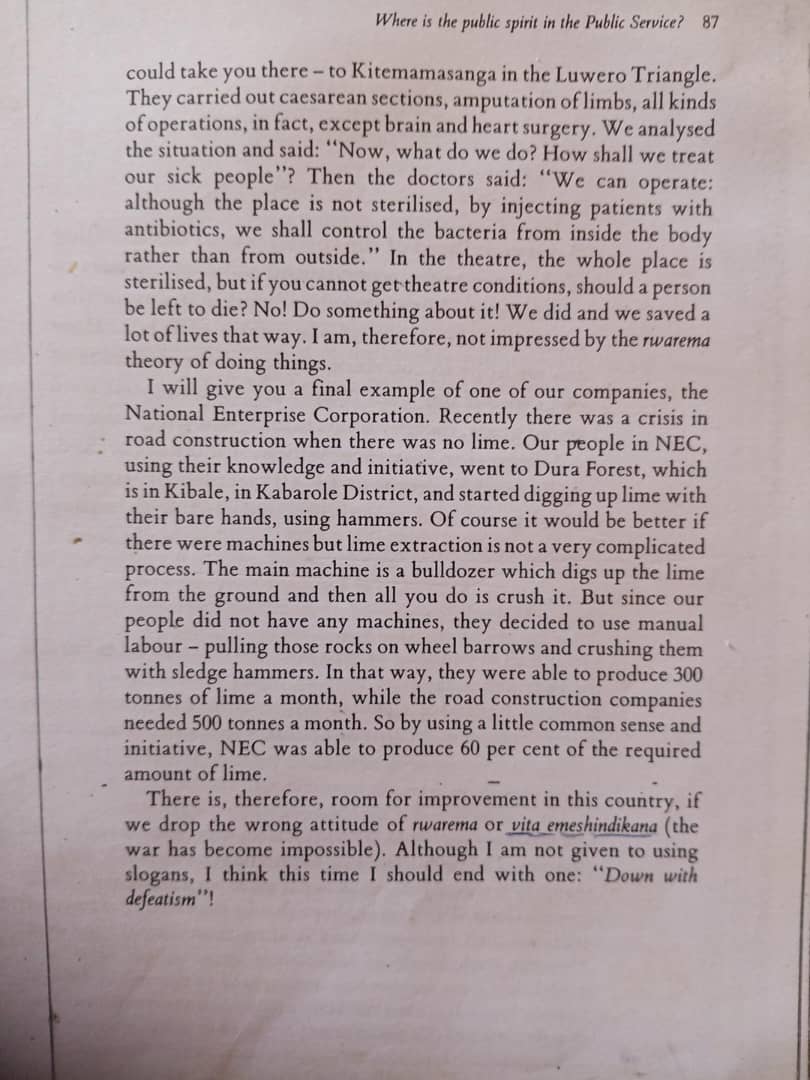
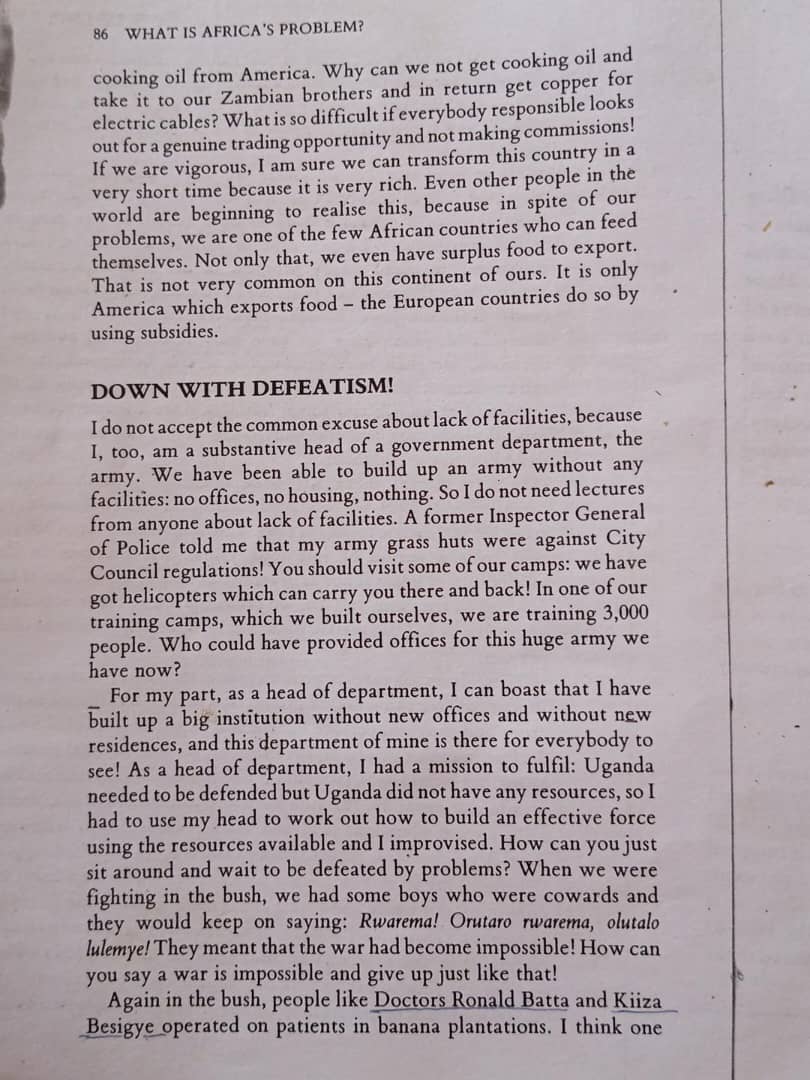
He further narrated: "The doctors said: 'We can operate: although the place is not sterilised, by injecting patients with antibiotics, we shall control the bacteria from inside the body rather than from outside.'... If you cannot get theatre conditions, should a person be left to die? No! Do something about it! We did and we saved a lot of lives that way."
These are not the words of political sympathisers.
They are the testimony of the Commander of the National Resistance Army himself.
History therefore records Dr. Kiiza Besigye not merely as an opposition politician, but as one of the doctors whom President Museveni publicly credited with saving countless lives under the harshest conditions imaginable during the Luwero liberation struggle.
Following the NRA victory in 1986, Dr. Besigye continued serving the new government with distinction. He served as President Museveni's personal physician, became a senior medical officer in the Uganda People's Defence Force, chaired the UPDF Medical Board, and later served as Minister of State in the President's Office. These appointments reflected the immense confidence that the new government had in a man who had already demonstrated extraordinary patriotism during the liberation struggle.
However, history took a different course.
In 1999, Dr. Besigye published An Insider's View of How the NRM Lost the Broad Base, a document that openly criticised what he perceived as the Movement's departure from its original ideals. In 2001, he challenged President Museveni for the presidency, beginning one of the longest political rivalries in Uganda's modern history. Since then, he has contested presidential elections in 2001, 2006, 2011 and 2016, consistently advocating constitutionalism, electoral reforms, accountable governance and the protection of civil liberties through peaceful political participation.
His political journey has, however, been characterised by repeated arrests, prosecutions and lengthy court battles. During the 2005-2006 presidential election period, his campaign came to an abrupt halt when he was arrested and charged with treason and rape. The treason allegations were linked to claims that he had connections with the People's Redemption Army (PRA), while the rape charge related to allegations dating back to 1997. Dr. Besigye denied all the accusations.
His arrest sparked widespread demonstrations in Kampala and other parts of Uganda. Many opposition supporters, civil society actors and international observers questioned the timing of the prosecutions, expressing concern that they could undermine confidence in the electoral process. After the High Court granted him bail, he was immediately re-arrested on separate military charges relating to terrorism and unlawful possession of firearms. Dr. Besigye maintained that, having retired from the army, he ought to be tried only before civilian courts. Those legal proceedings became one of the defining constitutional debates in Uganda regarding the relationship between military jurisdiction and civilian justice.
Over the last two decades, Dr. Besigye has remained one of Uganda's most resilient opposition leaders. Whether one agrees with his politics or disagrees with him entirely, few can deny that he has consistently pursued political change through campaigns, public mobilisation, court actions and civic activism rather than armed rebellion. His persistence has earned him admiration among supporters and respect even from many who disagree with his political ideology.
This history makes President Museveni's own words spoken in Jinja in February 1990 especially significant.
The same President who publicly praised Dr. Besigye as one of the doctors who saved lives under banana plantations now stands opposite him as his principal political rival.
History therefore presents Uganda with an important question.
Can a liberation hero and a political opponent be recognised as both at the same time?
Many Ugandans believe they can.
The story becomes even more profound when one reflects upon the historical relationship between President Museveni and the Byanyima family. The late Mzee Boniface Byanyima is widely remembered as one of the early national leaders who extended support and guidance to the young Yoweri Museveni during his formative political years. His daughter, Ambassador Winnie Byanyima, herself an accomplished public servant and international diplomat, later married Dr. Kiiza Besigye. Consequently, many Ugandans view the strained relationship between these historical allies with sadness rather than celebration, believing that those who once sacrificed together for Uganda's future should not become symbols of enduring political hostility.
The current legal proceedings involving Dr. Besigye continue to attract significant national and international attention. Recent concerns expressed by his supporters regarding restrictions affecting members of his legal team—including Kampala Lord Mayor and senior advocate Erias Lukwago, as well as the deportation of Kenyan Senior Counsel Martha Karua when she sought to participate in his defence—have further intensified public debate about the appearance of fairness in the judicial process. While the relevant authorities have advanced legal and security justifications for their decisions, many Ugandans believe that justice must not only be done but must also be visibly seen to be done. Public confidence in the administration of justice is strengthened whenever every accused person is afforded full and effective legal representation without unnecessary impediments.
Your Excellency President Yoweri Kaguta Museveni,
No one understands the sacrifices of Luwero better than you.
No one understands Dr. Kiiza Besigye's contribution to that struggle better than you because it was you who publicly acknowledged his heroism before the nation.
That acknowledgment carries with it a moral responsibility.
This appeal does not ask for political agreement.
It does not ask for interference with judicial independence.
Neither does it ask that anyone be placed above the law.
Rather, it humbly appeals for constitutional statesmanship, fairness, dignity and humanity in handling a man whose contribution to Uganda's liberation you yourself immortalised in your own words.
Political rivalry should never erase historical truth.
Disagreement should never extinguish gratitude.
The greatest leaders are remembered not because they defeated their opponents, but because they rose above personal conflict for the sake of national unity and reconciliation.
If Dr. Kiiza Besigye has offences to answer, let Uganda's independent courts determine them transparently, fairly and without any appearance that justice is being influenced by politics.
The Constitution demands nothing less.
History expects nothing less.
Future generations will remember not merely the verdicts rendered by courts, but the manner in which Uganda treated one of the very doctors whose courage under banana plantations once saved the lives of those who would eventually govern this nation.
The President who concluded his historic 1990 speech with the words,
"Down with defeatism!"
has another opportunity today.
Not to defeat a political opponent.
But to demonstrate the highest victory of all— the victory of magnanimity, the victory of constitutionalism, the victory of reconciliation,
and the victory of showing that even where politics divides, justice, dignity and history can still unite a nation.
For nations become truly great not when they forget their heroes, but when they honour history even where politics has created rivals.
About the Writer
Evan Sande Ndahura is a Ugandan political and legal commentator, columnist, poet, and social justice advocate whose writings focus on governance, constitutionalism, democracy, and the political economy of power in Africa. He is widely published on issues of judicial accountability, electoral justice, human rights, and institutional reform, with a particular emphasis on Uganda's political and legal systems. Writing from a Pan-African critical perspective, he interrogates the failures of state institutions and the lived realities of ordinary citizens under entrenched systems of power. He strongly believes that the liberation of Africa will ultimately be achieved through the mighty power of the pen rather than the gun.



