Share
By Evan Sande Ndahura
Politics is not merely a contest for power; it is also a test of character. One of the greatest dilemmas in public life emerges when a person who once fiercely criticized a government later accepts an appointment to serve within that same government. Whether motivated by patriotism, ambition, reconciliation, or the hope of reforming the system from within, such a transition is never politically neutral. It demands uncommon wisdom, exceptional integrity, and a constant awareness that every action thereafter will be judged against one's former convictions.
Joining a government one once condemned is like entering a deep latrine with the pockets of one's trousers full of precious valuables. A single careless movement may cause everything to fall into the pit. Reputation, credibility, moral authority, and public trust—assets accumulated over years of principled opposition—can disappear in a moment.
History repeatedly demonstrates that critics who cross into the establishments they once challenged often find themselves walking a difficult path. Some succeed in bringing meaningful reforms from within. Others gradually become defenders of policies they once denounced. Still others become embroiled in controversies that overshadow both their previous criticism and their later service. Whether these outcomes result from coincidence, institutional pressures, personal failings, or political calculations differs from case to case. Yet the pattern is sufficiently common to deserve careful reflection.
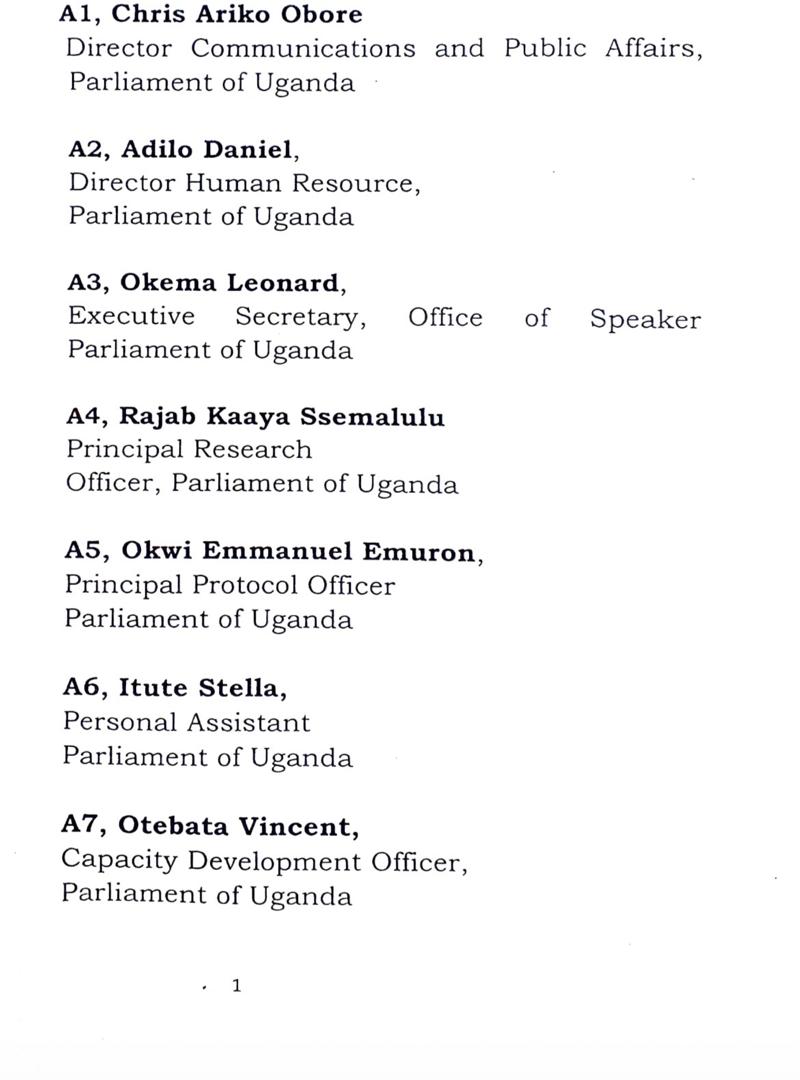
The image above lists officials of the Parliament of Uganda, among them Chris Obore, the Director of Communications and Public Affairs. Before entering parliamentary administration, Obore built a public reputation as a journalist with the Daily Monitor, where he was known for rigorous reporting and outspoken commentary on governance, accountability, and corruption. Like many investigative journalists, he frequently questioned those in authority and demanded greater transparency from public institutions.
His transition from journalism into a senior public office reflected a broader political phenomenon: critics sometimes become administrators of the very institutions they once scrutinized. Such transitions are not inherently wrong. Indeed, democratic societies often benefit when experienced critics bring their knowledge to public service. However, the transition also invites heightened public scrutiny because expectations become much higher. Former critics are expected not merely to serve the government but also to uphold the principles they previously defended.
Where controversies later arise involving former critics who have entered government, public debate often becomes polarized. Some observers interpret such events as evidence that power eventually compromises ideals. Others argue that accusations against public officials should be determined only through fair legal processes rather than political speculation. Both perspectives deserve careful consideration, and neither should replace the rule of law.
Throughout Uganda's political history, several individuals who once opposed the ruling establishment eventually accepted appointments or cooperation with it. Their experiences have varied considerably. Some remained influential within government; others quietly disappeared from political prominence, while still others faced political isolation, internal disagreements, or legal and public controversies. These differing outcomes caution against simplistic conclusions while reminding us that political transitions are rarely free of consequence.
The same phenomenon extends beyond Uganda.
In Zimbabwe, portions of the opposition entered the Government of National Unity after the disputed 2008 elections. While the arrangement temporarily stabilized the economy and reduced political tensions, many analysts argue that the opposition's revolutionary image gradually weakened, ultimately benefiting the incumbent political establishment more than the coalition partners.
In Kenya, the Grand Coalition Government formed after the 2007–2008 post-election violence restored peace, yet it also blurred distinctions between government and opposition. Many reform promises stalled, and political loyalties shifted in ways that permanently altered the country's opposition landscape.
Elsewhere, coalition governments in countries such as Italy, Israel, and South Africa have demonstrated that alliances between former rivals can either strengthen democratic governance or diminish the identity of smaller political movements. Political cooperation is therefore neither inherently noble nor inherently corrupt; its value depends on whether principles survive the alliance.
The American statesman John F. Kennedy is often associated with the observation that one way to deal with enemies is to transform them into friends. Although versions of this idea are more commonly attributed to Abraham Lincoln, the underlying strategic principle has echoed throughout political history. An elderly woman is said to have questioned such thinking by asking, "Why call them friends when they were once your enemies?" Her concern reflected an enduring political truth: proximity changes relationships, sometimes for reconciliation, sometimes for domination.
This strategic thinking resembles one of the themes explored by Robert Greene in The 48 Laws of Power. Greene repeatedly argues that power is exercised not only through confrontation but also through co-option—bringing rivals into one's orbit, where they become more predictable and, at times, less threatening. While Greene's work describes strategies of power rather than moral prescriptions, his observations invite readers to think critically about how political systems absorb their critics.
Perhaps the greatest danger for any former opponent is not that they will be arrested, investigated, praised, or promoted. The greatest danger is that they may gradually forget why they opposed the system in the first place. Convictions do not usually disappear overnight. They fade slowly under the comforts of office, the privileges of power, the fear of losing position, and the desire to remain acceptable to new political allies.
This reality raises profound questions for every opposition politician contemplating government service.
Can one reform a system without becoming part of its weaknesses?
Can one criticize corruption yesterday yet ignore it today because one now sits at the same table?
Can one continue speaking truth to power after becoming part of power?
These questions have no universal answers. They depend upon the strength of personal character.
Public office should never require the burial of conscience. Governments need competent administrators, but nations need men and women whose principles survive promotion. Political appointments should enlarge one's capacity to serve the public, not diminish one's commitment to truth.
Power has an extraordinary ability to change human beings. It rewards loyalty, tests integrity, and constantly tempts the conscience. Those who once denounced injustice but later become silent in the face of similar injustices risk losing something far greater than political office—they lose the moral authority that first earned them the public's trust.
Every generation therefore faces the same challenge: not merely choosing between opposition and government, but choosing between conviction and convenience.
The true measure of leadership is not whether one joins a government or opposes it. The true measure is whether one remains faithful to justice after crossing the bridge from criticism to power.
"History rarely condemns those who changed sides. It judges those who changed their principles."
About the Writer
Evan Sande Ndahura is a Ugandan political and legal commentator, columnist, poet, and social justice advocate whose writings focus on governance, constitutionalism, democracy, and the political economy of power in Africa. He is widely published on issues of judicial accountability, electoral justice, human rights, and institutional reform, with particular emphasis on Uganda's political and legal systems. Ndahura writes from a Pan-African critical perspective, interrogating the failures of state institutions and the lived realities of ordinary citizens under entrenched systems of power. He believes that the liberation of Africa will occur through a mighty pen, not the gun.



