Share
A national commentary by Sande Evan Ndahura
Uganda’s motto reads “For God and My Country.”
But too many citizens now confess — painfully, truthfully — that the new creed has become: “For God and My Stomach.” It is a tragic rewrite authored not by the poor, but by leaders entrusted with the nation’s resources.
We are a country that Winston Churchill once admired as the “Pearl of Africa,” blessed with gentle climate, fertile soils, rolling valleys, glittering lakes, generous sunshine and mineral wealth. Yet today the Pearl sits in the Third World, not by fate, not by lack of talent, but by deliberate human choices that siphon opportunity into private pockets and leave the nation drifting.
Corruption with Names, Dates and Receipts
Ugandans have not imagined the decay; it is written clearly in our national record:
* The OPM–PRDP Scandal (2012):
Billions meant for post-war recovery in northern Uganda disappeared into private accounts. Donors halted funding, development stalled, and the victims of conflict remained victims of government negligence.
* The Global Fund Health Scandals:
Drugs, HIV/AIDS money, malaria and TB funding — all meant to save lives — were siphoned, forcing donors to suspend support and prompting international audits.
* Parliament & Procurement Graft:
From inflated budgets to fake workshops, ghost travel, and shady “classified” expenditures, corruption has become a competitive sport in the national legislature.
* Judiciary & Police Delayed Justice:
Case backlogs stretch years because files “disappear,” suspects bribe their way out, and complainants become the accused. Justice has grown a price tag only the rich can afford.
* Security-Sector Corruption:
Army officers implicated in diversion of fuel, food supplies, and procurement funds — all protected by ranks, connections, or quiet transfers.
* High-Level Scandals & International Sanctions:
In recent years, foreign governments have sanctioned Ugandan officials for grand corruption and human-rights-linked graft — a powerful indication that our internal systems have failed to police themselves. 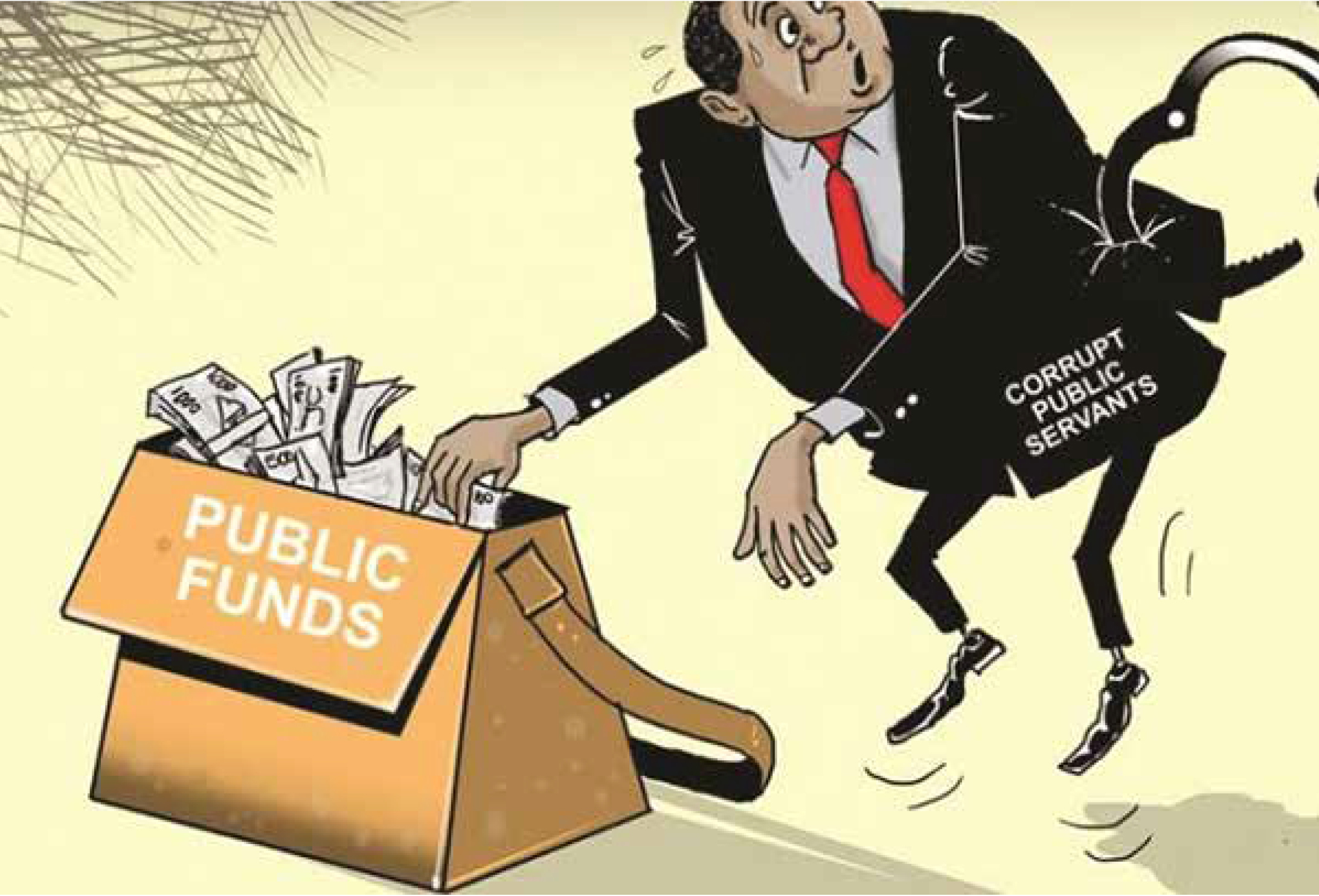
Every ministry, every sector — roads, health, education, agriculture — carries footprints of theft. Budgets are passed in billions, yet clinics have no drugs, classrooms have no teachers, and roads collapse six months after construction.
One day the writer was diagnosed with malaria at a government hospital. “There are no drugs,” he was told, and sent to a private clinic. The tablets he was sold carried the stamp: “Property of Government of Uganda—Not For Sale.” This is not a story; this is a national sickness.
Leadership & the Politics of Looking Away
Uganda’s corruption persists because it is protected. When the President once publicly told the IGG “Go slow on the thieves, or they will take their money out of the country,” the message was unmistakable: the powerful must never feel the full weight of the law.
This echoes exactly what Human Rights Watch once described as “letting the big fish swim.”
In such a system, the small thieves are punished for surviving; the big thieves are shielded for belonging.
And here is where Robert Greene becomes painfully relevant:
In The 48 Laws of Power, Law 42 states:
“Strike the shepherd and the sheep will scatter.”
Greene’s point is simple — corruption is not a grassroots phenomenon. It is leadership-driven. If the top is clean, the system strengthens; if the top is compromised, every subordinate finds justification to loot.
So the question is no longer: Who is to blame? The question is: Who leads the shepherds? Who protects them?
Uganda’s Annual Losses — A National Emergency
Various national audits and IGG reports have estimated that Uganda loses between UGX 9 trillion and UGX 20 trillion every year to corruption.
That means: Enough money is stolen annually to build modern hospitals in every district.
Enough money is stolen annually to double teachers' and health workers’ salaries.
Enough money is stolen annually to pave hundreds of kilometres of roads.
Instead, Uganda builds palaces for thieves and leaves classrooms in ruins.
What Other Nations Did — Lessons from Lee Kuan Yew
Singapore was once as corrupt as Uganda. But Prime Minister Lee Kuan Yew declared corruption “a cancer that must be cut out completely,” and he did so by:
Paying civil servants well and punishing corruption without fear or favour
Allowing independent investigators to arrest even ministers,
Fast-tracking corruption trials
Protecting whistleblowers
Ensuring that no political ally was “untouchable”
His conclusion was blunt: “If you want to fight corruption, be prepared to jail your friends.”
Uganda, by contrast, jails whistleblowers, demotes investigators, reshuffles the guilty, and rewards the loyal.
What Must Be Done — A Blueprint for a Recovering Nation
Political Will at the Top — not speeches, but action.
Lifestyle Audits That Actually Bite — including unexplained wealth seizures.
Independent Anti-Corruption Agencies — protected from political interference.
Judicial Speed & Special Anti-Graft Courts — corruption cases must not linger.
Digital Procurement & Open Budgets — sunlight destroys corruption.
Citizen Protection & Free Media — journalists must not fear writing the truth.
International Cooperation — trace and recover assets abroad.
Uganda will rise again the moment corruption becomes politically expensive.
Conclusion — The Pearl Can Shine Again
Uganda is not poor because God cursed it.
Uganda is poor because leaders stole it.
The sun still shines. The soils are still generous. The rivers still flow and the forests still breathe.
But a country cannot be fertile if its leadership is barren of integrity.
Let us return to a time when “For God and My Country” meant service —
not survival, not stomachs, not self-preservation.
Let us strike the shepherds of corruption, and the entire flock of thieves will scatter.
About the Writer
Sande Evan Ndahura is a Ugandan writer, social critic and observer of public life whose work blends intellect, truth-telling and patriotic concern. His columns challenge leadership to rise above mediocrity and call citizens to reclaim accountability, integrity and national dignity. He writes with the conviction that Uganda can — and must — become better.
Torch Media Africa



